Saturday, January 31, 2026
Vitamin D and Heart Diseases
https://www.youtube.com/watch?v=5yaI5s_3K7o
Vitamin D and the heart
https://jamanetwork.com/journals/jamacardiology/fullarticle/2735646
Vol. 4, No. 8
Vitamin D Supplementation and Cardiovascular Disease Risks in More Than 83 000 Individuals in 21 Randomized Clinical TrialsA Meta-analysis
1. Mahmoud Barbarawi, MD1; Babikir Kheiri, MD, MRCP, PGDip1; Yazan Zayed, MD1
2. et al
3. Key Points
4. Question Does vitamin D supplementation have any association with cardiovascular disease risk?
5. Findings In this meta-analysis of randomized clinical trials that included more than 83 000 participants, vitamin D supplementation was not associated with reduced risks of major adverse cardiovascular events, myocardial infarction, stroke, cardiovascular disease mortality, or all-cause mortality compared with placebo.
6. Meaning These results suggest that vitamin D supplementation may not confer cardiovascular protection and may not be indicated for this purpose.
7. Abstract
8. Importance Observational studies have reported an association between low serum vitamin D levels and elevated risk of cardiovascular disease (CVD) events, but such studies cannot prove causation because of possible unmeasured confounding.
9. Objective We conducted a meta-analysis of randomized clinical trials that tested the association of vitamin D supplementation with reduced CVD events and all-cause mortality.
10. Data Sources Literature search through PubMed, the Cochrane Library, and Embase was completed by 2 reviewers from each database’s inception to December 15, 2018.
11. Study Selection Inclusion criteria were randomized clinical trials that reported the effect of long-term (≥1 year) vitamin D supplementation on CVD events and all-cause mortality. Studies that did not include cardiovascular outcomes were excluded.
12. Data Extraction and Synthesis Data were abstracted independently by 2 authors. Random-effects models were used to report the risk ratios (RRs) and 95% CIs.
13. Main Outcomes and Measures Major adverse cardiovascular events was the primary outcome, and rates of myocardial infarction, stroke or cerebrovascular accident, CVD mortality, and all-cause mortality were the secondary end points.
14. Results Twenty-one randomized clinical trials were included (including 83 291 patients, of whom 41 669 received vitamin D and 41 622 received placebos). The mean (SD) age of trial participants was 65.8 (8.4) years; 61 943 (74.4%) were female. Only 4 trials had prespecified CVD as a primary end point. Vitamin D supplementation compared with placebo was not associated with reduced major adverse cardiovascular events (RR, 1.00 [95% CI, 0.95-1.06]; P = .85) nor the secondary end points of myocardial infarction (RR, 1.00 [95% CI, 0.93-1.08]; P = .92), stroke (RR, 1.06 [95% CI, 0.98-1.15]; P = .16), CVD mortality (RR, 0.98 [95% CI, 0.90-1.07]; P = .68), or all-cause mortality (RR, 0.97 [95% CI, 0.93-1.02]; P = .23). Results were generally consistent by sex, baseline 25-hydroxyvitamin D level, vitamin D dosage, formulation (daily vs bolus dosing), and presence or absence of concurrent calcium administration.
15. Conclusions and Relevance In this updated meta-analysis, vitamin D supplementation was not associated with reduced major adverse cardiovascular events, individual CVD end points (myocardial infarction, stroke, CVD mortality), or all-cause mortality. The findings suggest that vitamin D supplementation does not confer cardiovascular protection and is not indicated for this purpose.


Friday, January 30, 2026
Nipah Virus
Nipah Virus a type of zoonotic disease spread by fruit bats, spread through direct or indirect contact with the bodily fluids of an infected person.
https://abcnews.go.com/Health/nipah-virus-amid-cases-detected-india/story?id=129667635
Everything to know about Nipah virus amid cases being detected in India
Two cases have been detected in India among health care workers.
Mary Kekatos
January 29, 2026, 10:54 AM
Several countries, including Thailand and Nepal, have increased their surveillance after cases of the deadly Nipah virus were detected in India.
So far, just two cases have been confirmed among 25-year-old nurses, a woman and a man, in West Bengal, according to the World Health Organization.
A spokesperson for the Department of Health and Human Services told ABC News earlier this week that Indian health authorities have deployed an outbreak response team and the Centers for Disease Control and Prevention is in contact with local officials. The CDC said it is "monitoring" the situation.
Despite the virus's high fatality rate, experts have said it's very unlikely it will lead to a global emergency.
Here's what you need to know about the virus, including signs and symptoms, how the virus is transmitted and what treatments are available.
https://i.abcnewsfe.com/a/819213e4-4b21-427c-8598-42649c9054fe/nipah-virus-airport-ss-jt-260129_1769697256193_hpMain.jpg?w=1500
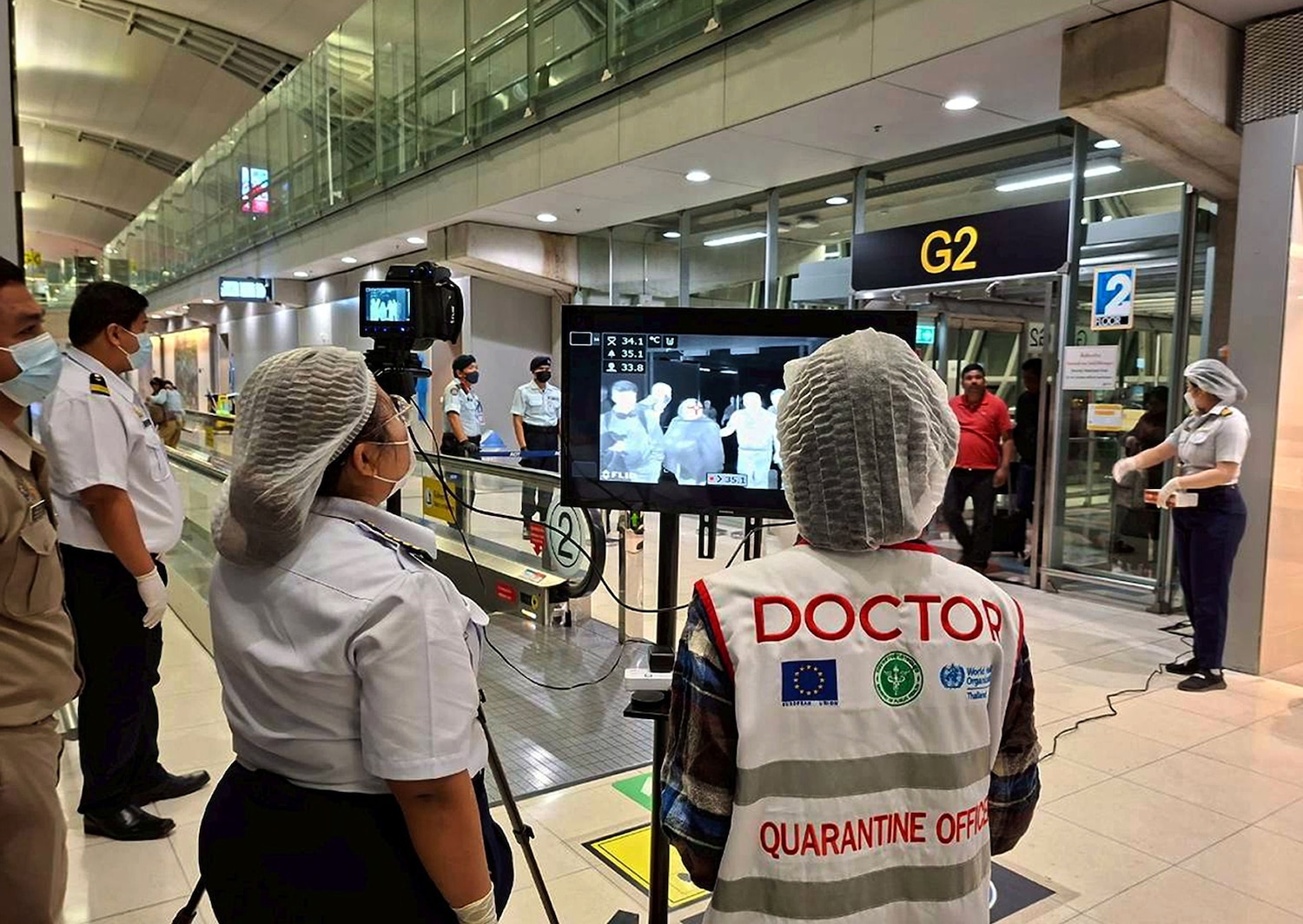 A handout photo released by Suvarnabhumi Airport shows Thai health officials wearing protective masks monitoring passengers from international flights arriving at Suvarnabhumi Airport, Samut Prakan province, Thailand, Jan. 25, 2026. Thailand's international disease control checkpoints at Suvarnabhumi and Don Mueang International Airports began implementing health screening measures for flights arriving from West Bengal, India, to monitor and prevent Nipah virus infection.
The Suvarnabhumi Airport Office via EPA via Shutterstock
What is Nipah virus?
Nipah virus is a type of zoonotic disease, meaning it's primarily found in animals and can spread between animals and people.
It was first discovered in 1999 after a disease affected both pigs and people in Malaysia and Singapore, according to the CDC.
The virus is most often spread by fruit bats, and can spread through direct or indirect contact.
The virus can also spread from person to person by being in close contact or coming into contact with the bodily fluids of an infected person.
What are the symptoms?
Symptoms typically occur between four and 14 days after exposure. The most common symptom is fever followed by headache, cough, sore throat, difficulty breathing and vomiting.
Diagnosing the virus in the early stages is often difficult because the symptoms resemble many other illnesses, the CDC has said.
The virus can lead to severe symptoms, including disorientation, drowsiness, seizures or encephalitis, which is inflammation of the brain. These can progress to a coma within 24 to 48 hours, according to the CDC.
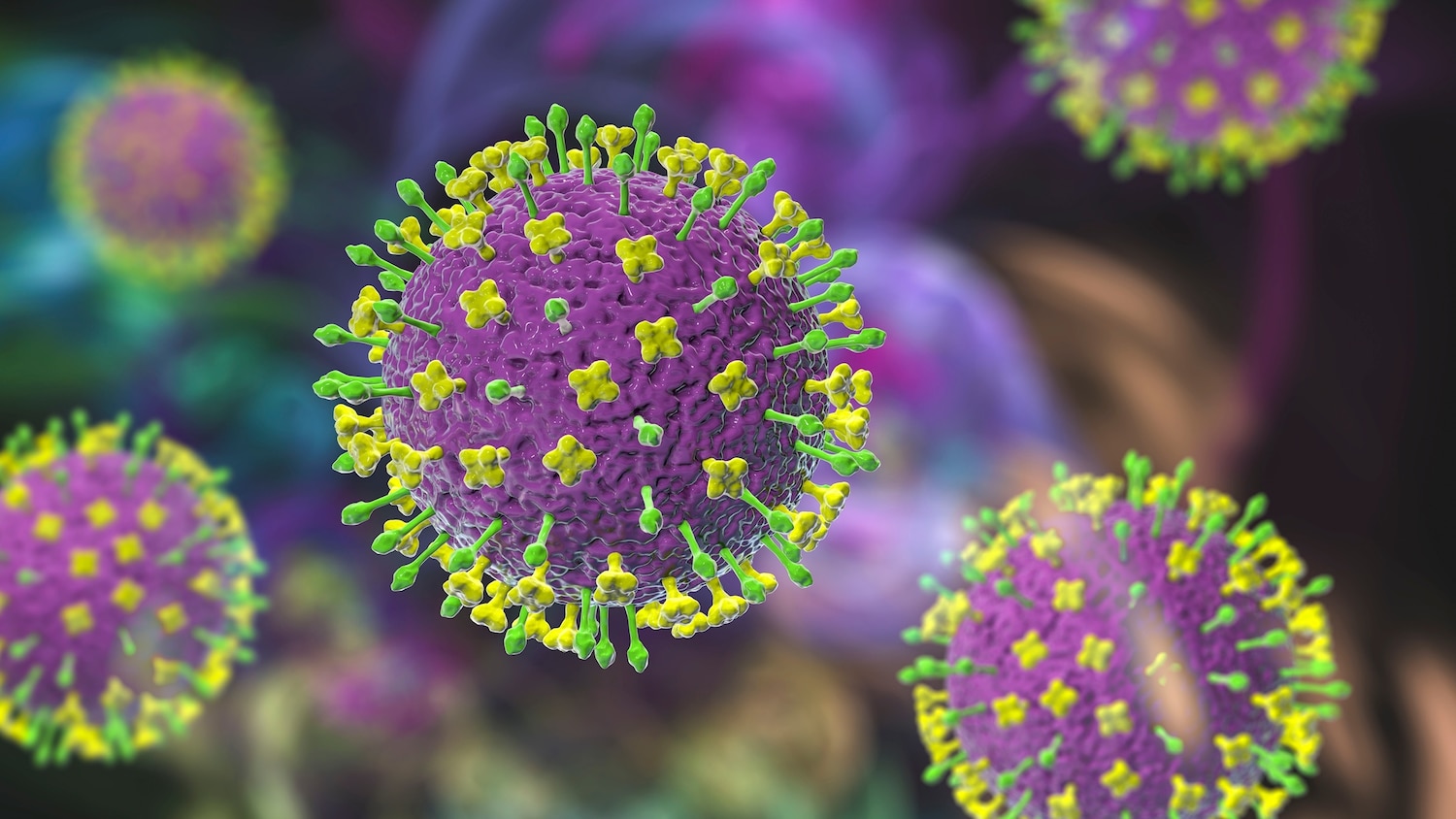
Nipah virus particles, computer illustration. Nipah virus is zoonotic (transmitted to humans from animals) and was first found in Malaysia and Singapore in people who had close contact with pigs. It was initially isolated in 1999 upon examining samples from an outbreak of encephalitis and respiratory illness among adult men in those two countries.
Kateryna Kon/Science Photo Library/Getty Images
https://i.abcnewsfe.com/a/c79dd445-298a-4c05-86fb-0f4bbb100c27/nipah-virus-gty-jt-260129_1769697603311_hpEmbed_16x9.jpg?w=1500
A handout photo released by Suvarnabhumi Airport shows Thai health officials wearing protective masks monitoring passengers from international flights arriving at Suvarnabhumi Airport, Samut Prakan province, Thailand, Jan. 25, 2026. Thailand's international disease control checkpoints at Suvarnabhumi and Don Mueang International Airports began implementing health screening measures for flights arriving from West Bengal, India, to monitor and prevent Nipah virus infection.
The Suvarnabhumi Airport Office via EPA via Shutterstock
What is Nipah virus?
Nipah virus is a type of zoonotic disease, meaning it's primarily found in animals and can spread between animals and people.
It was first discovered in 1999 after a disease affected both pigs and people in Malaysia and Singapore, according to the CDC.
The virus is most often spread by fruit bats, and can spread through direct or indirect contact.
The virus can also spread from person to person by being in close contact or coming into contact with the bodily fluids of an infected person.
What are the symptoms?
Symptoms typically occur between four and 14 days after exposure. The most common symptom is fever followed by headache, cough, sore throat, difficulty breathing and vomiting.
Diagnosing the virus in the early stages is often difficult because the symptoms resemble many other illnesses, the CDC has said.
The virus can lead to severe symptoms, including disorientation, drowsiness, seizures or encephalitis, which is inflammation of the brain. These can progress to a coma within 24 to 48 hours, according to the CDC.
Nipah virus particles, computer illustration. Nipah virus is zoonotic (transmitted to humans from animals) and was first found in Malaysia and Singapore in people who had close contact with pigs. It was initially isolated in 1999 upon examining samples from an outbreak of encephalitis and respiratory illness among adult men in those two countries.
Kateryna Kon/Science Photo Library/Getty Images
https://i.abcnewsfe.com/a/c79dd445-298a-4c05-86fb-0f4bbb100c27/nipah-virus-gty-jt-260129_1769697603311_hpEmbed_16x9.jpg?w=1500
 What are the treatments available?
Currently there are no specific treatments available for Nipah virus other than managing symptoms with supportive care, including rest and fluids.
Experts said there are treatments currently under development. One is a monoclonal antibody, a treatment that uses immune system proteins manufactured in a lab. They mimic the antibodies the body naturally creates when fighting the virus.
Dr. Diana Finkel, an associate professor of medicine in the division of infectious disease at Rutgers New Jersey Medical School, previously told ABC News that the drug has already completed phase I clinical trials and is currently being used on a compassionate basis.
Researchers are also studying the potential benefit of remdesivir -- the intravenous medication used to treat COVID-19 -- which has been shown to work well in nonhuman primates with Nipah virus.
What is the likelihood of Nipah virus spreading?
Experts said that while anything is possible, it's very unlikely that cases in India will lead to global spread.
"The world is small, but the likelihood that somebody's infected, or an infected fruit bat with Nipah virus would be here, right now, is very unlikely," Finkel previously told ABC News.
She said when people are exposed in health care settings, it's often because proper standard precautions were not followed, such as not wearing gloves or masks.
Experts have said Nipah virus cases are also a reminder of the potentially devastating effects of habitat destruction and climate change, possibly leading to more interaction between infected animals and humans.
"You have to think about why are fruit bats that harbor this Nipah virus, why are they coming into contact with people?" Dr. Peter Rabinowitz, director of the University of Washington Center for One Health Research, previously told ABC News. "What is changing in terms of the movement of the bat populations? Are they leaving [a] habitat where there were not very many people? Are they now spending more time close to people?"
What are the treatments available?
Currently there are no specific treatments available for Nipah virus other than managing symptoms with supportive care, including rest and fluids.
Experts said there are treatments currently under development. One is a monoclonal antibody, a treatment that uses immune system proteins manufactured in a lab. They mimic the antibodies the body naturally creates when fighting the virus.
Dr. Diana Finkel, an associate professor of medicine in the division of infectious disease at Rutgers New Jersey Medical School, previously told ABC News that the drug has already completed phase I clinical trials and is currently being used on a compassionate basis.
Researchers are also studying the potential benefit of remdesivir -- the intravenous medication used to treat COVID-19 -- which has been shown to work well in nonhuman primates with Nipah virus.
What is the likelihood of Nipah virus spreading?
Experts said that while anything is possible, it's very unlikely that cases in India will lead to global spread.
"The world is small, but the likelihood that somebody's infected, or an infected fruit bat with Nipah virus would be here, right now, is very unlikely," Finkel previously told ABC News.
She said when people are exposed in health care settings, it's often because proper standard precautions were not followed, such as not wearing gloves or masks.
Experts have said Nipah virus cases are also a reminder of the potentially devastating effects of habitat destruction and climate change, possibly leading to more interaction between infected animals and humans.
"You have to think about why are fruit bats that harbor this Nipah virus, why are they coming into contact with people?" Dr. Peter Rabinowitz, director of the University of Washington Center for One Health Research, previously told ABC News. "What is changing in terms of the movement of the bat populations? Are they leaving [a] habitat where there were not very many people? Are they now spending more time close to people?"
Thursday, January 29, 2026
Thiền Metta
https://thuvienhoasen.org/a43451/cac-vi-tang-di-tren-bao-tuyet-kien-cuong-va-khong-dung-buoc-tinh-thuy-bbt-tvhs
Thiền Metta, còn gọi là thiền tâm từ (từ tiếng Pali metta nghĩa là lòng từ bi hoặc thiện ý, và bhavana nghĩa là sự tu tập), là một pháp thực hành truyền thống trong Phật giáo nhằm phát triển tình thương vô điều kiện, lòng từ bi và thiện lành đối với bản thân và tất cả chúng sinh. Pháp này giúp nuôi dưỡng ước nguyện chân thành mong muốn hạnh phúc và thoát khỏi khổ đau cho mọi người, bắt đầu từ chính mình rồi dần mở rộng ra. Thiền Metta giúp đối trị các cảm xúc tiêu cực như sân hận, oán giận và ác ý, từ đó nuôi dưỡng sự bình an nội tâm và lòng đồng cảm. Đây là một trong bốn trạng thái tâm cao thượng (brahmaviharas) trong Phật giáo, bên cạnh bi, hỷ và xả. Trong giáo lý nhà Phật, Brahmavihāras thường được gọi là Tứ Vô Lượng Tâm tức là bốn trạng thái tâm cao thượng, đại diện cho tình thương và sự bao dung không giới hạn dành cho mọi chúng sinh
Metta không chỉ là tình cảm ngọt ngào mà là một ý định thiện lành sâu sắc, nhận ra rằng tất cả chúng sinh đều mong muốn hạnh phúc và tránh khổ đau, giống như chính mình.
Cách Thực Hành Thiền Metta
Pháp thực hành này đơn giản, dễ tiếp cận với người mới bắt đầu, và có thể thực hiện trong 10–20 phút (hoặc lâu hơn để đi sâu). Dưới đây là hướng dẫn từng bước theo truyền thống và hiện đại:
Chuẩn Bị Và An Trú Tìm một nơi yên tĩnh, thoải mái. Ngồi thẳng lưng trên ghế hoặc đệm, mắt nhắm hoặc mở nhẹ. Thư giãn cơ thể, hít thở sâu vài lần và buông bỏ căng thẳng. Bạn có thể đặt tay lên tim để kết nối với cảm giác ấm áp.
Bắt Đầu Với Chính Mình Hướng metta đến bản thân trước (điều này có thể khó nếu bạn hay tự chỉ trích — hãy kiên nhẫn). Hình dung chính mình hoặc cảm nhận hơi thở ở vùng tim. Lặng lẽ lặp lại các câu nguyện như:
-Mong tôi được an toàn.
-Mong tôi được hạnh phúc.
-Mong tôi được khỏe mạnh.
-Mong tôi sống an lạc. (Hoặc: Mong tôi được bình an và tự tại / thoát khỏi khổ đau.) Lặp lại chậm rãi, chân thành ý nghĩa từng lời. Nếu cảm giác ấm áp xuất hiện, hãy để nó lan tỏa.
Mở Rộng Đến Người Thân Yêu Hoặc Ân Nhân Hình dung một người dễ khơi dậy sự ấm áp — bạn bè thân thiết, người thân, thầy cô, hoặc thậm chí thú cưng. Hình dung họ và lặp lại các câu nguyện, thay “tôi” bằng “bạn”:
-Mong bạn được an toàn.
-Mong bạn được hạnh phúc. v.v.
Mở Rộng Đến Người Trung Tính Nghĩ đến một người bạn không thích cũng không ghét mạnh (ví dụ: đồng nghiệp hoặc nhân viên cửa hàng). Hướng các câu nguyện tương giống vậy đến họ.
Mở Rộng Đến Người Khó Ưa (Tùy Chọn Cho Người Mới) Dần dần bao gồm người khiến bạn khó chịu (không chọn người khó nhất ngay từ đầu). Điều này xây dựng lòng từ bi thực sự mà không ép buộc sự tha thứ.
Mở Rộng Đến Tất Cả Chúng Sinh Cuối cùng, tỏa metta ra toàn vũ trụ: đến tất cả bạn bè, người trung tính, người khó ưa và mọi chúng sinh ở khắp nơi. Các câu nguyện:
-Mong tất cả chúng sinh được an toàn.
-Mong tất cả chúng sinh được hạnh phúc. v.v. Hình dung điều này như ánh sáng ấm áp hoặc gợn sóng lan tỏa từ tim bạn.
Nếu có cảm xúc phân tán (sân hận, buồn bã) xuất hiện, hãy nhẹ nhàng thừa nhận và quay lại các câu nguyện. Kết thúc bằng cách an trú trong cảm giác mở rộng.
Một Số Lời Khuyên Để Thực Hành Hiệu Quả
Bắt đầu ngắn (5–10 phút) rồi dần tăng thời gian.
Sử dụng lời của chính bạn nếu các câu truyền thống cảm thấy không tự nhiên.
Thực hành hàng ngày để có kết quả tốt nhất.
Nếu hướng metta đến bản thân khó khăn, hãy bắt đầu từ ân nhân rồi quay lại mình sau.
Kết hợp với chánh niệm hơi thở để tăng sự tĩnh lặng.
Lợi Ích
Thực hành metta đều đặn giúp giảm stress, sân hận và lo âu; tăng lòng đồng cảm, cảm xúc tích cực và khả năng phục hồi; cải thiện các mối quan hệ và sức khỏe tổng thể. Trong Phật giáo, pháp này làm suy yếu ác ý và nuôi dưỡng tâm từ bi vô lượng, hỗ trợ thiền định sâu hơn và tuệ giác.
Pháp thực hành này rất linh hoạt — bạn có thể thử các bài hướng dẫn âm thanh nếu cần. Hãy nhớ: điều quan trọng là ý định chân thành, không phải cảm xúc hoàn hảo. Theo thời gian, metta sẽ thay đổi cách bạn liên hệ với chính mình và thế giới xung quanh.
Tịnh Thủy | BBT TVHS
Renal disease and kidney
https://www.mayoclinic.org/diseases-conditions/end-stage-renal-disease/symptoms-causes/syc-20354532
Renal disease and kidney
Early in chronic kidney disease, you might have no signs or symptoms. As chronic kidney disease progresses to end-stage renal disease, signs and symptoms might include:
• Nausea
• Vomiting
• Loss of appetite
• Fatigue and weakness
• Changes in how much you urinate
• Chest pain, if fluid builds up around the lining of the heart
• Shortness of breath, if fluid builds up in the lungs
• Swelling of feet and ankles
• High blood pressure (hypertension) that's difficult to control
• Headaches
• Difficulty sleeping
• Decreased mental sharpness
• Muscle twitches and cramps
• Persistent itching
• Metallic taste
Signs and symptoms of kidney disease are often nonspecific, meaning they can also be caused by other illnesses. Because your kidneys can make up for lost function, signs and symptoms might not appear until irreversible damage has occurred.
Wednesday, January 28, 2026
'Night owl' lifestyle may bring higher risk of heart disease
https://abcnews.go.com/Health/night-owl-lifestyle-bring-higher-risk-heart-disease/story?id=129595210
'Night owl' lifestyle may bring higher risk of heart disease: Study
"Evening type" people had a 16% higher risk of heart attack and stroke.
By Dr. Joseph Wendt
January 28, 2026, 4:33 AM
So-called "night owls" may face a higher risk for heart attack and stroke, a new study published Wednesday finds.
Researchers found that "evening type" people had poorer cardiovascular health scores than those who were neither "morning type" or "evening type" people and had an associated 16% higher risk of heart attack and stroke.
The study, published in the Journal of the American Heart Association, analyzed survey and biometric data from more than 320,000 British adults aged 39 to 74.
Participants were asked whether they considered themselves a "definite morning" person, a "definite evening" person or somewhere in between, termed "intermediate."
Researchers then calculated each person's heart health using the American Heart Association's Life's Essential 8 (LE8) score. These factors include four health behaviors -- diet quality, physical activity, sleep duration and nicotine exposure -- and four health factors, including blood pressure, body mass index, blood sugar and blood fat levels.
"These are the factors the American Heart Association has identified as cardiovascular disease risk factors," Kristen Knutson, associate professor of neurology and peventive medicine at Northwestern University Feinberg School of Medicine specializing in sleep and circadian rhythm research and fellow at the American Heart Association, told ABC News.
"Different people will have them in different combinations, but they are all correlated with one another," she added.
Evening people were 79% more likely to have poor overall heart health compared with those in the intermediate group, the study found. Morning people did slightly better than the intermediate group, with a 5% lower risk of having a poor LE8 score.
Researchers found the evening people had a 16% higher risk of both heart attack and stroke. Researchers estimated that about 75% of this higher risk was explained by other LE8 factors, rather than sleep timing alone.
"It isn't being a night owl that's a problem," Knutson said. "I think being a night owl who's trying to live in a morning lark's world is a conflict between one's internal clock and their social clock."
The higher risk appeared to be due to certain lifestyle behaviors and other health factors, the study found.
Nicotine use had the strongest impact on heart health, explaining 34% of the link between late bedtime and heart disease. Shorter sleep duration accounted for 14% of the extra risk, high blood sugar for 12% and body weight and diet each accounted for about 11% of the increased risk.
Behavioral effects of being a night owl were stronger in women than in men -- women were 96% more likely to have lower LE8 scores compared to 67% in men, though they did not have a higher risk of heart attack or stroke.
"Women are further stressed by that lifestyle because they're having to still get up and be the primary caregiver for family members," Dr. Sonia Tolani, preventative cardiologist, Associate Professor of Medicine, and co-director of the Columbia University Women's Heart Center, told ABC News.
Heart disease remains the leading cause of death in the U.S., according to the Centers for Disease Control and Prevention. The researchers concluded prevention efforts should focus on improving lifestyle habits when spending more time awake at night.
"The most obvious way is to quit smoking and that's not new advice," Knutson says. "But sleep regularity, meaning trying to go to bed at about the same time every day and not jumping around the clock -- particularly on days off -- can really help lead to regular timing of other behaviors like light exposure, meals, exercise activity."
"Prioritize the low-hanging fruit" recommended Tolani. If an hour at the gym is not doable, "maybe you can find a way to do a 10-minute walk or cut a little bit of salt from your diet. Just try to make small changes," she said.
Note:
Dr. Joseph Wendt is a public health and preventive medicine resident at Icahn School of Medicine at Mount Sinai and a member of the ABC News Medical Unit.
‘Ngày Tận Thế’ đang đến rất gần?
Hiếu Chân/Người Việt
Chỉ hai mươi ngày nữa năm Con Rắn (Ất Tỵ) sẽ đi qua, năm Con Ngựa (Bính Ngọ) sẽ đến. “Mã đáo thành công,” năm mới sẽ mang theo phúc lộc cho nhân quần xã hội, theo niềm tin truyền thống của các người gốc Á Châu như người Việt chúng ta. Tuy vậy, nhìn vào thế cục, cả trong nước Mỹ lẫn trên toàn cầu, chưa bao giờ người ta bi quan về tương lai như hiện nay.
https://www.nguoi-viet.com/wp-content/uploads/2026/01/Tan-Tich-Hiroshima-2048x1370.jpg
 Một di tích của trận đánh bom nguyên tử còn sót lại ở thành phố Hiroshima, Nhật Bản, từ năm 1945. (Hình mminh họa: STR/JIJI Press/AFP via Getty Images)
Theo bản tin của hãng Reuters, hôm Thứ Ba, 27 Tháng Giêng, 2026, kim “Đồng Hồ Tận Thế” đã được vặn tới một chút, chỉ còn cách thời khắc nửa đêm 85 giây đồng hồ, nghĩa là gần với nửa đêm hơn bốn giây so với năm ngoái. Đây là một lời cảnh báo đáng sợ không chỉ cho mỗi cá nhân mà cả nhân loại. Hãy tạm gác những niềm riêng để cùng suy ngẫm về tương lai chung, bởi vì suy cho cùng thế giới cũng chỉ là một ngôi làng toàn cầu trong đó mọi sinh linh đều gắn bó với nhau mật thiết.
Chỉ còn 85 giây!
Đồng Hồ Tận Thế (Doomsday Clock) không có thật mà là một công cụ tượng trưng để cảnh báo cho loài người mối nguy bị huỷ diệt bởi chiến tranh nguyên tử trên thế giới. Ý tưởng về Ngày Tận Thế hay sự hủy diệt nền văn minh xuất hiện sau khi Hoa Kỳ thả hai trái bom nguyên tử xuống thành phố Hiroshima và Nagasaki của Nhật vào Tháng Tám, năm 1945.
Chỉ trong chớp mắt cả thành phố sầm uất bị san phẳng, số người chết lên tới hàng trăm ngàn và hàng trăm ngàn người khác bị nhiễm phóng xạ, sống lay lắt trong bệnh hoạn, tật nguyền. Quả là không có thảm họa nhân tạo nào khủng khiếp hơn; tận thế không còn là truyền thuyết hoang đường mà đã hiển hiện ngay trước mắt.
Choáng váng vì sức hủy diệt của bom nguyên tử, năm 1947, các nhà khoa học thuộc tổ chức phi lợi nhuận Chicago Atomic Scientists do Albert Einstein và J. Robert Oppenheimer lãnh đạo đã lập ra Đồng Hồ Tận Thế để cảnh báo loài người về nguy cơ diệt vong khi các tiến bộ về khoa học và kỹ thuật không được kiểm soát.
Thời điểm tận thế được quy ước là nửa đêm, lúc kim đồng hồ chỉ 24:00. Kim đồng hồ này không chuyển động một chiều mà chạy tới hoặc lùi lại tùy vào nguy cơ chiến tranh nguyên tử và các nguy cơ hủy diệt khác tăng lên hay giảm xuống. Khi ra đời, kim Đồng Hồ Tận Thế chỉ 23:53, tức là bảy phút trước nửa đêm – khoảng cách mà nhân loại bị huỷ diệt không còn xa.
Trong tám mươi năm qua, kim Đồng Hồ Tận Thế đã dịch chuyển 26 lần vào Tháng Giêng hằng năm, trong đó tám lần lùi lại và 18 lần tiến tới. Khi Liên Xô thử thành công quả bom nguyên tử đầu tiên năm 1949, kim đồng hồ nhích lên 23:57 (cách 3 phút); rồi lùi xuống 23:48 (cách 12 phút) năm 1963 khi Mỹ và Liên Xô ký hiệp ước cấm vũ khí nguyên tử; tiến trở lại mức 23:57 năm 1984 khi Mỹ và Liên Xô tái chạy đua vũ trang.
Những năm gần đây, Đồng Hồ Tận Thế không chỉ cảnh báo nguy cơ chiến tranh nguyên tử mà khái niệm “hủy diệt” được mở rộng để bao hàm nhiều nguy cơ khác đe dọa sự sinh tồn của nền văn minh nhân loại. Đó có thể là hậu quả thảm khốc của biến đổi khí hậu, đại dịch, thậm chí sự ra đời và phát triển vượt tầm kiểm soát của trí thông minh nhân tạo.
Thời điểm nhân loại cách xa ngày tận thế nhất là năm 1991, kim đồng hồ chỉ 23:43 (cách 17 phút) sau khi Mỹ và Liên Xô ký hiệp định cắt giảm vũ khí nguyên tử chiến lược START-1 và sau đó là sự tan rã của Liên Xô, kết thúc Chiến Tranh Lạnh. Thời điểm cận kề Ngày Tận Thế nhất là 27 Tháng Giêng, 2026, kim đồng hồ chỉ 23:58:35, chỉ cách nửa đêm 1 phút 25 giây!
Đây cũng là lần thứ ba trong bốn năm qua, kim Đồng Hồ Tận Thế nhích về phía trước, chứng tỏ thế giới đang vận hành theo một xu thế hết sức nguy hiểm.
Bóng ma vũ khí nguyên tử trở lại
Khi công bố hiện trạng Đồng Hồ Tận Thế năm 2026, bà Alexandra Bell, chủ tịch kiêm giám đốc điều hành tổ chức Bulletin of the Atomic Scientists nhận xét: “Về rủi ro nguyên tử, trong năm 2025 không có gì diễn ra đúng hướng. Những khuôn khổ ngoại giao lâu đời hoặc đang sụp đổ, hoặc đang bị chèn ép, mối nguy thử nghiệm vũ khí nguyên tử đã quay trở lại và hiện có ba cuộc chiến tranh diễn ra dưới cái bóng của vũ khí nguyên tử cùng những mối đe dọa đi kèm. Nguy cơ sử dụng vũ khí nguyên tử đang cao một cách không chấp nhận được.”
Có ít nhất sáu cường quốc sở hữu vũ khí nguyên tử đang tham gia chiến tranh ở một mức độ nào đó: Nga xâm lược Ukraine, Mỹ và Israel dội bom Iran, Ấn Độ và Pakistan đụng độ ở biên giới, Trung Quốc gây sức ép quân sự lên Đài Loan trong khi Bắc Hàn không ngừng phô diễn năng lực nguyên tử.
Tuy chưa có nước nào đem bom nguyên tử ra sử dụng trong thực chiến nhưng đe dọa sử dụng thì nhiều. Gần đây Nga phóng loại hỏa tiễn siêu thanh Oreshnik có thể mang đầu đạn nguyên tử vào các thành phố Ukraine và bố trí loại hỏa tiễn này ở Belarus nhằm rút ngắn khoảng cách tới các thủ đô Châu Âu là một sự leo thang không thể coi nhẹ.
Rào chắn ngăn chặn sự lan tràn của vũ khí nguyên tử là các hiệp ước giữa Nga và Hoa Kỳ; hiệp ước cuối cùng đang còn hiệu lực là The New START, ký kết dưới thời Tổng Thống Barack Obama quy định mỗi nước chỉ được bố trí tối đa 1,550 đầu đạn nguyên tử. Nhưng hiệp ước New START sẽ hết hạn vào ngày 5 Tháng Hai, 2026, tức chỉ một tuần nữa. Hồi Tháng Chín, 2025, Tổng Thống Nga Vladimir Putin đề nghị cùng Mỹ gia hạn hiệp ước thêm một năm nhưng Tổng Thống Donald Trump chưa trả lời. Quan điểm của chính quyền Mỹ là mọi hiệp ước về hạn chế vũ khí nguyên tử nhất thiết phải có sự tham gia của Trung Quốc – điều mà Bắc Kinh chưa chấp nhận, lấy lý do kho vũ khí của họ còn quá nhỏ so với Nga và Mỹ.
Nếu Hiệp Ước New START hết hạn mà không có giải pháp ngoại giao nào thay thế thì Nga, Mỹ và nhiều nước khác sẽ không còn bị ràng buộc nữa.
Lựa chọn hợp lý hay rủi ro hủy diệt?
Tổng Thống Donald Trump hồi Tháng Mười năm ngoái còn ra lệnh cho quân đội Mỹ chuẩn bị nổ thử bom nguyên tử trở lại sau hơn ba mươi năm đình chỉ. Gần phần tư thế kỷ qua, trừ Bắc Hàn, không quốc gia nào nổ thử bom nguyên tử cả. Nếu Mỹ tái tục việc nổ thử bom nguyên tử đời mới thì không có gì ngăn cản các nước khác làm theo. Kẻ hưởng lợi nhiều nhất trong việc này là Trung Quốc, theo bà Bell – từng là viên chức cao cấp của Bộ Ngoại Giao Mỹ phụ trách kiểm soát vũ khí và giải trừ quân bị.
Hơn thế nữa, sự kiện ông Trump đảo ngược chính sách đối ngoại đã tồn tại nhiều thập niên của Mỹ theo hướng dựa trên sức mạnh và đồng tiền, đang buộc các đồng minh, và cả đối thủ, phải tính tới chuyện tự bảo vệ trước dã tâm thôn tính của các thế lực chuyên chế Nga, Trung Quốc, Bắc Hàn.
Phát triển vũ khí nguyên tử được cho là lựa chọn hợp lý nhất. Ông Trump đổ quân bắt sống Tổng Thống Venezuela Nicolas Maduro như lấy đồ trong túi; ông cho ném bom Iran, ông doạ thâu tóm đảo Greenland của Đan Mạch… Nếu các quốc gia này có vũ khí nguyên tử như Bắc Hàn thì chắc ông Trump đã không tự tung tự tác như vậy. Ông Putin cũng chỉ xua quân xâm lược Ukraine sau khi Kiev đã từ bỏ kho vũ khí nguyên tử theo Thỏa Thuận Budapest năm 1994.
Các nước đồng minh lâu nay được che chở dưới chiếc dù an ninh của Mỹ cũng đang tính toán lại chiến lược. Ba Lan và Đức ở Châu Âu, Nam Hàn và Nhật Bản ở Đông Á đều đang có kế hoạch tự phát triển vũ khí nguyên tử khi nhận ra Mỹ không còn là đồng minh tin cậy mà Nga, Trung Quốc và Bắc Hàn cứ đe dọa xâm lấn. Thăm dò dư luận cho thấy 52% cử tri Đức muốn đất nước họ có vũ khí nguyên tử, con số này ở Nam Hàn là 72.8% cử tri.
Mỗi một trái bom nguyên tử ra đời là nhân loại có thêm một rủi ro đi đến sự hủy diệt.
Không thể ngủ yên!
Bà Alexandra Bell cho rằng, sở dĩ tình hình u ám như vậy là do sự thất bại trong lãnh đạo toàn cầu. Các siêu cường Mỹ, Trung Quốc, Nga càng ngày càng hung hăng, làm mọi chuyện chỉ vì lợi ích riêng của mình bất chấp sự an nguy của toàn nhân loại.
Sự sụp đổ của trật tự thế giới dựa trên luật pháp, sự tái sinh của chủ nghĩa đế quốc chẳng những thúc đẩy nhu cầu phát triển vũ khí nguyên tử mà còn ngăn cản sự hợp tác quốc tế trong việc giải quyết những mối đe dọa sinh tử khác như biến đổi khí hậu, đại dịch và trí tuệ nhân tạo (A.I.).
Tổng Thống Trump đã rút Mỹ ra khỏi Tổ Chức Y Tế Thế Giới (WHO) và Hiệp Ứớc Liên Hiệp Quốc về chống biến đổi khí hậu – hiện tượng mà ông coi là “trò lừa đảo xanh!”
Ở quy mô thế giới, A.I. đang được tích hợp tràn lan vào mọi lĩnh vực cuộc sống mà không được kiểm soát; đáng sợ nhất là đưa A.I. vào các hệ thống vũ khí, chẳng hạn các drone tự tìm và diệt mục tiêu theo lệnh đặt trước ở chiến trường Ukraine hiện nay.
Người ta còn lạm dụng A.I. để tạo ra các mối đe dọa sinh học mới, các mầm bệnh mới để phục vụ các mục đích chính trị. Phổ biến hơn cả là nạn sử dụng A.I. để tạo ra và phát tán tin giả, tin xuyên tạc trên quy mô toàn cầu để lũng đoạn chính trị, định hướng dư luận theo những ý đồ nguy hiểm. Riết rồi bây giờ đọc một bản tin trên mạng, nghe một bài hát hoặc xem một bộ phim người ta cứ băn khoăn không biết đó là tác phẩm thực hay chỉ là một sản phẩm do A.I. tạo ra.
Chiến tranh nguyên tử, đại dịch, trái đất nóng lên, A.I. vượt ngoài tầm kiểm soát… làm cho tương lai của loài người trở nên hết sức bấp bênh và mờ mịt!
Chưa cần nhìn cây kim Đồng Hồ Tận Thế nhích dần tới phía nửa đêm, chỉ quan sát những sự kiện đang diễn ra hàng ngày thì người ưu thời mẫn thế không thể yên lòng cho dù mùa Xuân đang gõ cửa! [kn]
Một di tích của trận đánh bom nguyên tử còn sót lại ở thành phố Hiroshima, Nhật Bản, từ năm 1945. (Hình mminh họa: STR/JIJI Press/AFP via Getty Images)
Theo bản tin của hãng Reuters, hôm Thứ Ba, 27 Tháng Giêng, 2026, kim “Đồng Hồ Tận Thế” đã được vặn tới một chút, chỉ còn cách thời khắc nửa đêm 85 giây đồng hồ, nghĩa là gần với nửa đêm hơn bốn giây so với năm ngoái. Đây là một lời cảnh báo đáng sợ không chỉ cho mỗi cá nhân mà cả nhân loại. Hãy tạm gác những niềm riêng để cùng suy ngẫm về tương lai chung, bởi vì suy cho cùng thế giới cũng chỉ là một ngôi làng toàn cầu trong đó mọi sinh linh đều gắn bó với nhau mật thiết.
Chỉ còn 85 giây!
Đồng Hồ Tận Thế (Doomsday Clock) không có thật mà là một công cụ tượng trưng để cảnh báo cho loài người mối nguy bị huỷ diệt bởi chiến tranh nguyên tử trên thế giới. Ý tưởng về Ngày Tận Thế hay sự hủy diệt nền văn minh xuất hiện sau khi Hoa Kỳ thả hai trái bom nguyên tử xuống thành phố Hiroshima và Nagasaki của Nhật vào Tháng Tám, năm 1945.
Chỉ trong chớp mắt cả thành phố sầm uất bị san phẳng, số người chết lên tới hàng trăm ngàn và hàng trăm ngàn người khác bị nhiễm phóng xạ, sống lay lắt trong bệnh hoạn, tật nguyền. Quả là không có thảm họa nhân tạo nào khủng khiếp hơn; tận thế không còn là truyền thuyết hoang đường mà đã hiển hiện ngay trước mắt.
Choáng váng vì sức hủy diệt của bom nguyên tử, năm 1947, các nhà khoa học thuộc tổ chức phi lợi nhuận Chicago Atomic Scientists do Albert Einstein và J. Robert Oppenheimer lãnh đạo đã lập ra Đồng Hồ Tận Thế để cảnh báo loài người về nguy cơ diệt vong khi các tiến bộ về khoa học và kỹ thuật không được kiểm soát.
Thời điểm tận thế được quy ước là nửa đêm, lúc kim đồng hồ chỉ 24:00. Kim đồng hồ này không chuyển động một chiều mà chạy tới hoặc lùi lại tùy vào nguy cơ chiến tranh nguyên tử và các nguy cơ hủy diệt khác tăng lên hay giảm xuống. Khi ra đời, kim Đồng Hồ Tận Thế chỉ 23:53, tức là bảy phút trước nửa đêm – khoảng cách mà nhân loại bị huỷ diệt không còn xa.
Trong tám mươi năm qua, kim Đồng Hồ Tận Thế đã dịch chuyển 26 lần vào Tháng Giêng hằng năm, trong đó tám lần lùi lại và 18 lần tiến tới. Khi Liên Xô thử thành công quả bom nguyên tử đầu tiên năm 1949, kim đồng hồ nhích lên 23:57 (cách 3 phút); rồi lùi xuống 23:48 (cách 12 phút) năm 1963 khi Mỹ và Liên Xô ký hiệp ước cấm vũ khí nguyên tử; tiến trở lại mức 23:57 năm 1984 khi Mỹ và Liên Xô tái chạy đua vũ trang.
Những năm gần đây, Đồng Hồ Tận Thế không chỉ cảnh báo nguy cơ chiến tranh nguyên tử mà khái niệm “hủy diệt” được mở rộng để bao hàm nhiều nguy cơ khác đe dọa sự sinh tồn của nền văn minh nhân loại. Đó có thể là hậu quả thảm khốc của biến đổi khí hậu, đại dịch, thậm chí sự ra đời và phát triển vượt tầm kiểm soát của trí thông minh nhân tạo.
Thời điểm nhân loại cách xa ngày tận thế nhất là năm 1991, kim đồng hồ chỉ 23:43 (cách 17 phút) sau khi Mỹ và Liên Xô ký hiệp định cắt giảm vũ khí nguyên tử chiến lược START-1 và sau đó là sự tan rã của Liên Xô, kết thúc Chiến Tranh Lạnh. Thời điểm cận kề Ngày Tận Thế nhất là 27 Tháng Giêng, 2026, kim đồng hồ chỉ 23:58:35, chỉ cách nửa đêm 1 phút 25 giây!
Đây cũng là lần thứ ba trong bốn năm qua, kim Đồng Hồ Tận Thế nhích về phía trước, chứng tỏ thế giới đang vận hành theo một xu thế hết sức nguy hiểm.
Bóng ma vũ khí nguyên tử trở lại
Khi công bố hiện trạng Đồng Hồ Tận Thế năm 2026, bà Alexandra Bell, chủ tịch kiêm giám đốc điều hành tổ chức Bulletin of the Atomic Scientists nhận xét: “Về rủi ro nguyên tử, trong năm 2025 không có gì diễn ra đúng hướng. Những khuôn khổ ngoại giao lâu đời hoặc đang sụp đổ, hoặc đang bị chèn ép, mối nguy thử nghiệm vũ khí nguyên tử đã quay trở lại và hiện có ba cuộc chiến tranh diễn ra dưới cái bóng của vũ khí nguyên tử cùng những mối đe dọa đi kèm. Nguy cơ sử dụng vũ khí nguyên tử đang cao một cách không chấp nhận được.”
Có ít nhất sáu cường quốc sở hữu vũ khí nguyên tử đang tham gia chiến tranh ở một mức độ nào đó: Nga xâm lược Ukraine, Mỹ và Israel dội bom Iran, Ấn Độ và Pakistan đụng độ ở biên giới, Trung Quốc gây sức ép quân sự lên Đài Loan trong khi Bắc Hàn không ngừng phô diễn năng lực nguyên tử.
Tuy chưa có nước nào đem bom nguyên tử ra sử dụng trong thực chiến nhưng đe dọa sử dụng thì nhiều. Gần đây Nga phóng loại hỏa tiễn siêu thanh Oreshnik có thể mang đầu đạn nguyên tử vào các thành phố Ukraine và bố trí loại hỏa tiễn này ở Belarus nhằm rút ngắn khoảng cách tới các thủ đô Châu Âu là một sự leo thang không thể coi nhẹ.
Rào chắn ngăn chặn sự lan tràn của vũ khí nguyên tử là các hiệp ước giữa Nga và Hoa Kỳ; hiệp ước cuối cùng đang còn hiệu lực là The New START, ký kết dưới thời Tổng Thống Barack Obama quy định mỗi nước chỉ được bố trí tối đa 1,550 đầu đạn nguyên tử. Nhưng hiệp ước New START sẽ hết hạn vào ngày 5 Tháng Hai, 2026, tức chỉ một tuần nữa. Hồi Tháng Chín, 2025, Tổng Thống Nga Vladimir Putin đề nghị cùng Mỹ gia hạn hiệp ước thêm một năm nhưng Tổng Thống Donald Trump chưa trả lời. Quan điểm của chính quyền Mỹ là mọi hiệp ước về hạn chế vũ khí nguyên tử nhất thiết phải có sự tham gia của Trung Quốc – điều mà Bắc Kinh chưa chấp nhận, lấy lý do kho vũ khí của họ còn quá nhỏ so với Nga và Mỹ.
Nếu Hiệp Ước New START hết hạn mà không có giải pháp ngoại giao nào thay thế thì Nga, Mỹ và nhiều nước khác sẽ không còn bị ràng buộc nữa.
Lựa chọn hợp lý hay rủi ro hủy diệt?
Tổng Thống Donald Trump hồi Tháng Mười năm ngoái còn ra lệnh cho quân đội Mỹ chuẩn bị nổ thử bom nguyên tử trở lại sau hơn ba mươi năm đình chỉ. Gần phần tư thế kỷ qua, trừ Bắc Hàn, không quốc gia nào nổ thử bom nguyên tử cả. Nếu Mỹ tái tục việc nổ thử bom nguyên tử đời mới thì không có gì ngăn cản các nước khác làm theo. Kẻ hưởng lợi nhiều nhất trong việc này là Trung Quốc, theo bà Bell – từng là viên chức cao cấp của Bộ Ngoại Giao Mỹ phụ trách kiểm soát vũ khí và giải trừ quân bị.
Hơn thế nữa, sự kiện ông Trump đảo ngược chính sách đối ngoại đã tồn tại nhiều thập niên của Mỹ theo hướng dựa trên sức mạnh và đồng tiền, đang buộc các đồng minh, và cả đối thủ, phải tính tới chuyện tự bảo vệ trước dã tâm thôn tính của các thế lực chuyên chế Nga, Trung Quốc, Bắc Hàn.
Phát triển vũ khí nguyên tử được cho là lựa chọn hợp lý nhất. Ông Trump đổ quân bắt sống Tổng Thống Venezuela Nicolas Maduro như lấy đồ trong túi; ông cho ném bom Iran, ông doạ thâu tóm đảo Greenland của Đan Mạch… Nếu các quốc gia này có vũ khí nguyên tử như Bắc Hàn thì chắc ông Trump đã không tự tung tự tác như vậy. Ông Putin cũng chỉ xua quân xâm lược Ukraine sau khi Kiev đã từ bỏ kho vũ khí nguyên tử theo Thỏa Thuận Budapest năm 1994.
Các nước đồng minh lâu nay được che chở dưới chiếc dù an ninh của Mỹ cũng đang tính toán lại chiến lược. Ba Lan và Đức ở Châu Âu, Nam Hàn và Nhật Bản ở Đông Á đều đang có kế hoạch tự phát triển vũ khí nguyên tử khi nhận ra Mỹ không còn là đồng minh tin cậy mà Nga, Trung Quốc và Bắc Hàn cứ đe dọa xâm lấn. Thăm dò dư luận cho thấy 52% cử tri Đức muốn đất nước họ có vũ khí nguyên tử, con số này ở Nam Hàn là 72.8% cử tri.
Mỗi một trái bom nguyên tử ra đời là nhân loại có thêm một rủi ro đi đến sự hủy diệt.
Không thể ngủ yên!
Bà Alexandra Bell cho rằng, sở dĩ tình hình u ám như vậy là do sự thất bại trong lãnh đạo toàn cầu. Các siêu cường Mỹ, Trung Quốc, Nga càng ngày càng hung hăng, làm mọi chuyện chỉ vì lợi ích riêng của mình bất chấp sự an nguy của toàn nhân loại.
Sự sụp đổ của trật tự thế giới dựa trên luật pháp, sự tái sinh của chủ nghĩa đế quốc chẳng những thúc đẩy nhu cầu phát triển vũ khí nguyên tử mà còn ngăn cản sự hợp tác quốc tế trong việc giải quyết những mối đe dọa sinh tử khác như biến đổi khí hậu, đại dịch và trí tuệ nhân tạo (A.I.).
Tổng Thống Trump đã rút Mỹ ra khỏi Tổ Chức Y Tế Thế Giới (WHO) và Hiệp Ứớc Liên Hiệp Quốc về chống biến đổi khí hậu – hiện tượng mà ông coi là “trò lừa đảo xanh!”
Ở quy mô thế giới, A.I. đang được tích hợp tràn lan vào mọi lĩnh vực cuộc sống mà không được kiểm soát; đáng sợ nhất là đưa A.I. vào các hệ thống vũ khí, chẳng hạn các drone tự tìm và diệt mục tiêu theo lệnh đặt trước ở chiến trường Ukraine hiện nay.
Người ta còn lạm dụng A.I. để tạo ra các mối đe dọa sinh học mới, các mầm bệnh mới để phục vụ các mục đích chính trị. Phổ biến hơn cả là nạn sử dụng A.I. để tạo ra và phát tán tin giả, tin xuyên tạc trên quy mô toàn cầu để lũng đoạn chính trị, định hướng dư luận theo những ý đồ nguy hiểm. Riết rồi bây giờ đọc một bản tin trên mạng, nghe một bài hát hoặc xem một bộ phim người ta cứ băn khoăn không biết đó là tác phẩm thực hay chỉ là một sản phẩm do A.I. tạo ra.
Chiến tranh nguyên tử, đại dịch, trái đất nóng lên, A.I. vượt ngoài tầm kiểm soát… làm cho tương lai của loài người trở nên hết sức bấp bênh và mờ mịt!
Chưa cần nhìn cây kim Đồng Hồ Tận Thế nhích dần tới phía nửa đêm, chỉ quan sát những sự kiện đang diễn ra hàng ngày thì người ưu thời mẫn thế không thể yên lòng cho dù mùa Xuân đang gõ cửa! [kn]
Tuesday, January 27, 2026
Compassion
https://www.ted.com/talks/joan_halifax_compassion_and_the_true_meaning_of_empathy
Compassion and the true meaning of empathy
Joan Halifax TEDWomen 2010. Dec 2010
Compassion Demands Fierce Strength, Not Just Tenderness
Compassion is not just a gentle feeling but a powerful force that sustains humanity and all life. In a hospice in Bangalore, young women caregivers reveal the quiet strength of true compassion as they tend to the dying. Neuroscience shows compassion strengthens the immune system and builds resilience. Genuine compassion requires clear-eyed engagement with suffering, the courage to act, and the wisdom to release attachment to outcomes.
•Compassion awakens when people directly face suffering without flinching or denial.
•Strength and vulnerability work together to create deep, transformative empathy.
•Fear and moral outrage can block compassion, leaving societies paralyzed.
•Practicing compassion mobilizes the immune system and connects the entire brain.
•Teaching compassion to children and leaders could reshape how care shapes the future.
https://www.ted.com/talks/dayananda_saraswati_the_profound_journey_of_compassion
The profound journey of compassion
Dayananda Saraswati - Chautauqua Institution - October 2009
Compassion Emerges From Self-Acceptance, Not Obligation
Personal growth is rooted in the shift from helpless dependency to the discovery of one's inner wholeness. Even in fleeting moments, such as an athlete's empathy for a defeated rival at Wimbledon, people reveal an innate capacity for compassion. True compassion arises not from mandates or status, but from feeling secure and complete within oneself. By acting compassionately, even before fully feeling it, people gradually tap into the deeper well of connection that unites everyone.
•Empathy is universal and cannot be erased by culture, religion, or nationality.
•Self-blame from early life can block the transition from consuming to giving.
•Acts of compassion often begin before genuine feeling, building depth through practice.
•Recognizing one's fundamental wholeness makes authentic giving possible.
•Real compassion transcends occasional moments and becomes woven into daily life.
Dayananda Saraswati: The profound journey of compassion | TED Talk
https://www.ted.com/talks/robert_thurman_expanding_your_circle_of_compassion
Expanding your circle of compassion
Robert Thurman - Chautauqua Institution - October 2009
Real Happiness Begins When Compassion Replaces Self-Concern
True freedom and joy come from expanding compassion beyond personal circles to include all beings, even adversaries. Drawing on a vivid tale of a saint’s 12-year struggle before reaching genuine compassion, the speaker illustrates how even hardship can become a doorway to empathy. A seven-step meditation method helps move from clinging and hostility toward a sense of universal responsibility. This shift not only relieves personal suffering but also sparks a deeper, more lasting happiness.
•Compassion is not just a feeling; it can be actively cultivated and strengthened.
•Seeing others as family, even imagined as past mothers, dissolves the barrier of 'otherness.'
•Loving one’s enemies is practical—happier; enemies cause less harm and conflict.
•Universal responsibility means treating others' suffering as inseparable from one’s own.
•Practicing compassion first benefits the practitioner, radiating outward to everyone encountered.
Monday, January 26, 2026
AI in the World of Work
Hilke Schellmann, The Algorithm - How AI Decides Who Gets Hired, Monitored, Promoted & Fired & Why We Need to Fight Back Now (New York, NY: Harchette Books, 2024).
Chapter 1: Resume Screeners
Chapter 2: Cambridge Analytica for Work - Scanning Your Online Life
Chapter 3: The Games We Play - On Creative AI Tests
Chapter 4: You Said What? On Facial Expression and Tone-of-Voice Analysis
Chapter 5: The Essential You - On the Ideas Behind AI Tools
Chapter 6: Does One Size Really Fit All? On the Bias Agianst Disabilities
Chapter 7: Finding Hidden Gems - On Predictive Analytics and Quiet Hiring
Chapter 8: We Are Watching (and Measuring) - On Surveillance at Work
Chapter 9: We're Ready to Help -On Our Health Data at Work
Chapter 10 Fired by an Algorithm - On Trying to Find Problem Employees -
Epilogue: Living in a Predictive Society
Appendix
Employee Assistance Programs (EAPs) used by Google. Counseling sessions to employees who complain about discrimination => could send the message that the employee is the problem. There must be legislation to regulate and monitor EAPs. p. 228
Meditation apps and apps to sleep better => Bank of America and the insurance company AXA (Asia and Africa for the global insurance company) have formed the non-profit OneMind at Work that will score the effectiveness of an organization's mental health programs, but data sharing and ethical considerations around these programs are not on the non-profit's agenda. p. 229
Surveillance in the name of safety - Brain wave detection by SmartCap (Australia) to track miners and truck drivers' alertness and fatigue and alert them to prevent falling asleep at work/ at the wheel. In China, safety helmets and wave-sensing/EEG-based headbands used on schoolchildren to check their attention levels. MN8 headphones => detect electrical activity across different areas of the brain used to measure employees' levels of focus and stress.p 230
Digital Hiring Tools - Facial Expression and Tone of Voice Analysis:HireVue, and Retorio, vendors that built job interview by AI. p.84 Curious Thing,, company that sold AI-based phone interview software.p. 94
Vocal biomarker tools (still in its infancy at Ellipsis Health; Sonde Health, Oregon Health...) to detect anxiety and depression could be used via phone calls, Zoom meetings, recordings of meetings, smart speakers Alexa....p231
HireVue an assessment of employee performance pp. 249-250; Capterra, a tech review and research company. 98% of midsize companies would rely on algorithms, HR software, and AI to make layoff decisions in 2023. p. 251
"Algorithms are not going to replace us anytime soon, but what is changing is that algorithms and artificial intelligence-based toolsbare becoming the "bosses" of more and more workers." p. 252
Amazon, Amazon Flex and warehouse and delivery drivers/workers pp253-258; warehouse managers p. 260-263 "productivity rate", "make rate,""time off task" (TOT)...set by an algorithm; "digital sweatshop."
Constant surveillance, monitoring the logs of employees'computers => main evidence in their termination.
Food delivery workers - Postmates, DoorDash....
"An overly rigid application of a productivity algorithm will result in unlawful treatment." Charles Burrows, Chair of Equal Employment Opportunity Commission (EEOC). "the use of these technologies is not only increase employers' power, but it's decreaseing their incentive to take into account individual variations and workers' circumstances or the reasons that different things happen in the workplace. It encourages them to take this rigid, one-size-fits-all approach to monitoring their workforce." Matthew Scherer, senior policy counsel, Center for Democracy and Technology p. 263
AI tools have gotten way less attention than social media algorithms. Lack of regulation and oversight. The public is seeing only the tip of the iceberg. p. 265
Dice.com => products that scrape social media websites and build skills profiles of people. p. 271 Skill score system about workers.
Job Application Tips pp289-291
Make your resume machine-readable: no images, no two columns, no special characters such as ampersands (&) or tildes (~). Computers may not be able to correctly ingest that information.
Use the most common template. Use short, crisp sentences: be declarative and quantify achievements where possible (Ian Siegel, CEO of the job platform ZipRecruiter).
List licenses, including license number and certifications.
Do not list your address or location, especially if you do not live near the worksite.
List your skills in a separate section using bullet points so machines can esily ingest it.
Make sure your resume matches the keywords in the job description and compare your resume to the job description using online resume scanners (Jobscan and others) to see if you are a match for the role. (Aim for a 60-85 percent match because AI might filter out 100% matches, considering them a copy of the job description.)
AI is used to infer whether you are a woman and/or a person of color. [Beware of unintentional cues/hints to AI for inferences]
Do not apply via job boards if you can avoid it. Apply directly via the company's website. [Only if the candidate pool is insufficient, then recruiters turn to job platforms like Indeed, Monster, ZipRecruiter, and others.]
Contact recruiters via LinkedIn after applying for a job.
Engage with recruiters on job platforms to signal to the AI that you are actively looking for a job. Most AI tools are optimized to find "qualified people likely to apply."
Apply for jobs that require more expriences than you have, as long as you have some of the qualifications in the job descriptions.
If you have a profile on a job platform like LinkedIn, make sure to list all your your skills because recruits often search for candidates by location and skills.
Network with folks in the industry and at companies you want to land in.
For entry-level and administrative jobs, consider stating that you are competent in Microsoft Office Suite applications, even if it's not in the job description.
Many job applicants now use ChatGPT and other language models to write or polish their resume and cover letters. Make sure you fact check the results. Prompt ChatGPT for the most common interview questions and have it help you prepare answers in advance.
Don't be discouraged
What if I'm Being Tracked? p. 292
Assume everything on a work computer, tablet, and phone is monitored. Nothing is private, even private messages in Slack or Microsoft Teams. Everything can be accessed y an employer, including deleted messages (using remote tracking software).
Assuming that every printout and every file you move off a work computer is tracked as well.
Use a second personal computer or your personal phone to check your email or surf the web when at work.
If you can avoid it, do not install company software on your phone.
Check your email for sentiment. Some companies are enabling "employee listening" to track sentiment in messages.
Keep yr updates in LinkedIn steady and do not update everything at once because they can increase your flight risk score.
Related Links:
https://apnews.com/article/ai-workplace-gemini-chatgpt-poll-4934bc61d039508db32bc49f85d63d99
How Americans are using AI at work, according to a new Gallup poll
MATT O’BRIEN and LINLEY SANDERS
7:01 AM CST, January 25, 2026
Some 12% of employed adults say they use AI daily in their job, according to a Gallup Workforce survey conducted this fall of more than 22,000 U.S. workers.
The survey found roughly one-quarter say they use AI at least frequently, which is defined as at least a few times a week, and nearly half say they use it at least a few times a year. That compares with 21% who were using AI at least occasionally in 2023, when Gallup began asking the question, and points to the impact of the widespread commercial boom that ChatGPT sparked for generative AI tools that can write emails and computer code, summarize long documents, create images or help answer questions….
AI at work for many in technology, finance and education
About 6 in 10 technology workers say they use AI frequently, and about 3 in 10 do so daily.
The share of Americans working in the technology sector who say they use AI daily or regularly has grown significantly since 2023, but there are indications that AI adoption could be starting to plateau after an explosive increase between 2024 and 2025.
In finance, another sector with high AI adoption, 28-year-old investment banker Andrea Tanzi said he uses AI tools every day to synthesize documents and data sets that would otherwise take him several hours to review….In addition, majorities of those working in professional services, at colleges or universities or in K-12 education, say they use AI at least a few times a year.
The benefits and drawbacks of AI adoption
The AI industry and the U.S. government are heavily promoting AI adoption in workplaces and schools. More people and organizations will need to buy these tools in order to justify the huge amounts of investment into building and running energy-hungry AI computing systems. But not all economists agree on how much they will boost productivity or affect employment prospects.
“Most of the workers that are most highly exposed to AI, who are most likely to have it disrupt their workflows, for good or for bad, have these characteristics that make them pretty adaptable,” said Sam Manning, a fellow at the Centre for the Governance of AI and co-author of new papers on AI job effects for the Brookings Institution and the National Bureau of Economic Research....Workers in those mostly computer-based jobs that involve a lot of AI usage “usually have higher levels of education, wider ranges of skill sets that can be applied to different jobs, and they also have higher savings, which is helpful for weathering an income shock if you lose your job,” Manning said.
On the other hand, Manning’s research has identified some 6.1 million workers in the United States who are both heavily exposed to AI and less equipped to adapt. Many are in administrative and clerical work, about 86% are women and they are older and concentrated in smaller cities, such as university towns or state capitals, with fewer options to shift careers….
A separate Gallup Workforce survey from 2025 found that even as AI use is increasing, few employees said it was “very” or “somewhat” likely that new technology, automation, robots or AI will eliminate their job within the next five years. Half said it was “not at all likely,” but that has decreased from about 6 in 10 in 2023.…Reported AI usage is less common in service-based sectors, such as retail, health care or manufacturing….
[Gallup’s quarterly workforce surveys were conducted with a random sample of adults age 18 and older who work full time and part time for organizations in the United States and are members of Gallup’s probability-based Gallup Panel. The most recent survey of 22,368 employed U.S. adults was conducted from Oct. 30-Nov. 13, 2025. The margin of sampling error for all respondents is plus or minus 1 percentage point.]
Sunday, January 25, 2026
Truth and Justice
The Four Types of Trump Voters
https://moreincommon.substack.com/p/beyond-maga-the-four-types-of-trump
Beyond MAGA: The Four Types of Trump Voters
More in Common US
Jan 20, 2026
Summary: Today, January 20th, 2026, the first anniversary of President Trump’s second term, More in Common is releasing the most comprehensive study to date of the Americans who voted for President Trump in November 2024. Beyond MAGA: A Profile of the Trump Coalition provides a detailed segmentation of these voters and their views on the major issues confronting our country and the world. The report marks the first in a three-part series revisiting our seminal Hidden Tribes work from 2018.
Read the full report, explore profiles, and engage with related content at beyondmaga.us. To hear directly from the researchers behind the report, sign up for our Beyond MAGA webinar on February 12th, 1:30 PM ET. Registration link here.
This newsletter is the first in a multi-part series on Beyond MAGA. In this post, we will introduce the four types of Trump voters, including their profiles and key characteristics.
A coalition, not a cult
There is an image at the heart of American politics: a sea of red-hat-wearing MAGA supporters at a Trump campaign rally, representing the millions of Americans who voted for him over the past three elections — 63 million in 2016, 74 million in 2020, and 77 million in 2024.
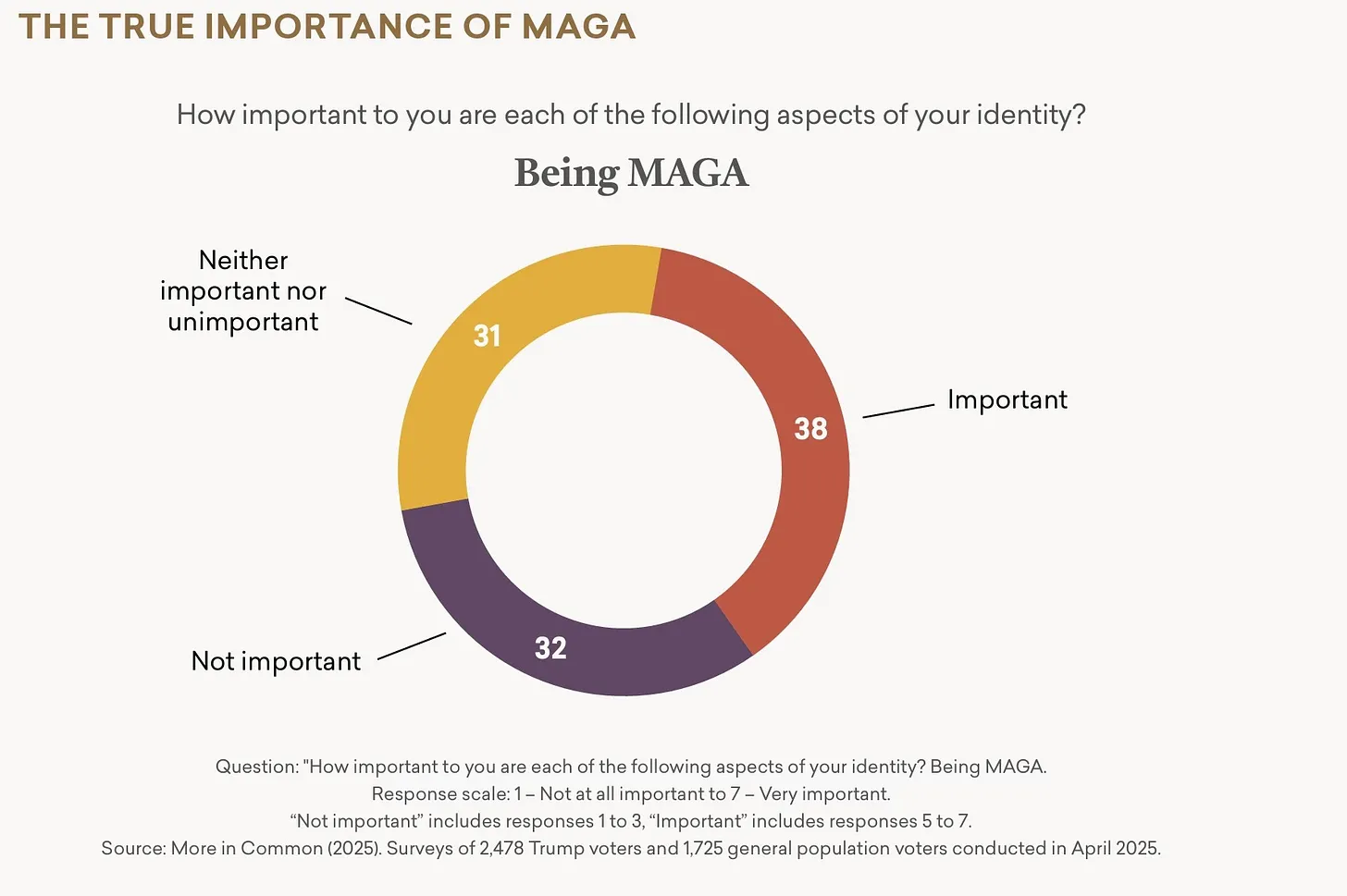
Yet this image is misleading. President Trump has built a coalition, not a cult. This coalition shares many concerns, from immigration to progressive overreach to American decline. But it also contains groups with distinct identities, competing priorities, and clashing worldviews. And while there is a strong core of ardent Trump supporters whose identity is wrapped up in the MAGA movement, they represent a minority: only 38 percent of Trump voters say that being MAGA is important to them.
https://substackcdn.com/image/fetch/$s_!GU4V!,w_1456,c_limit,f_webp,q_auto:good,fl_progressive:steep/https%3A%2F%2Fsubstack-post-media.s3.amazonaws.com%2Fpublic%2Fimages%2F2833f8ea-c57c-4e0b-91a6-807cd2db5621_1156x1363.jpeg
• MAGA Hardliners represent the fiery core of Trump’s base. They are fiercely loyal, deeply religious, and animated by a sense that America is in an existential struggle between good and evil, with God firmly on their side.
• Anti-Woke Conservatives are relatively well-off, politically engaged, and deeply frustrated by the perceived takeover of schools, culture, and institutions by the progressive left.
• Mainline Republicans are middle-of-the-road conservatives who play by the rules and expect others to do the same. Most do not follow politics closely. For them, Trump’s strength is that he advances familiar conservative priorities: securing the border, keeping the economy strong, and preserving a sense of cultural stability.
• The Reluctant Right is the most ambivalent cohort of Trump’s coalition, and the group most likely to have voted for Trump transactionally: the businessman who was “less bad” than the alternative. Many feel disconnected from national politics and believe politicians do not share their priorities.
 https://substackcdn.com/image/fetch/$s_!aXYa!,w_1456,c_limit,f_webp,q_auto:good,fl_progressive:steep/https%3A%2F%2Fsubstack-post-media.s3.amazonaws.com%2Fpublic%2Fimages%2F36253b49-c8f5-4c92-9533-1c6602b8b580_1780x1185.jpeg
Drawing on surveys, interviews and group conversations conducted with over 10,000 Trump voters over 10 months that concluded in early 2026, this study finds four distinct types of Trump voters: MAGA Hardliners, Anti-Woke Conservatives, Mainline Republicans, and the Reluctant Right.
When it comes to core cultural attitudes and policy issues, Trump voters express different opinions. MAGA Hardliners often hold the most extreme stances, followed by Anti-Woke Conservatives and Mainline Republicans, while the Reluctant Right typically holds the least partisan viewpoints.
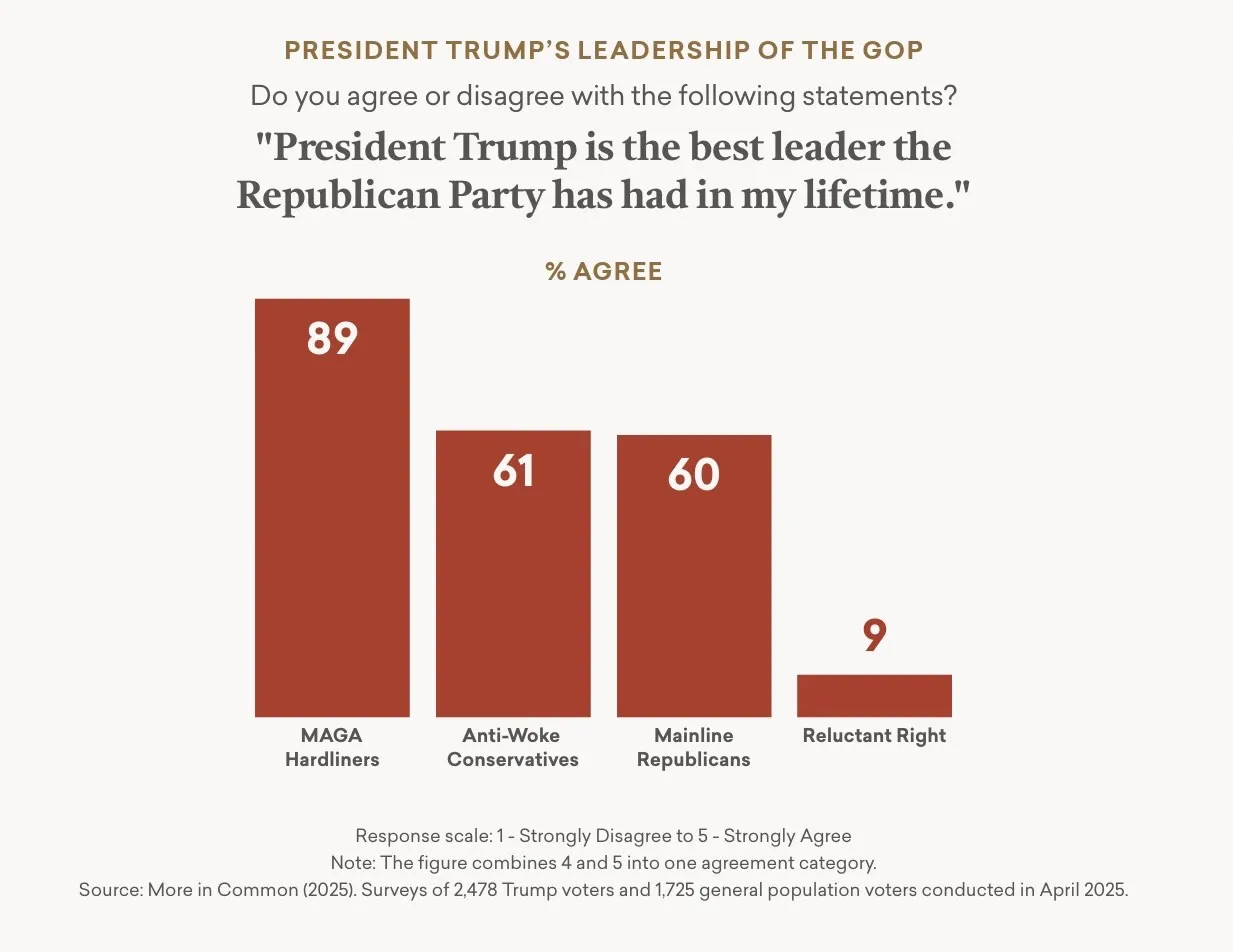
For example, 89 percent of MAGA Hardliners agree that President Trump “is the best leader the Republican Party has had in my lifetime” as compared to only 9 percent of the Reluctant Right. Anti-Woke Conservatives and Mainline Republicans fall in between, with 61 percent and 60 percent agreement respectively.
https://substackcdn.com/image/fetch/$s_!aXYa!,w_1456,c_limit,f_webp,q_auto:good,fl_progressive:steep/https%3A%2F%2Fsubstack-post-media.s3.amazonaws.com%2Fpublic%2Fimages%2F36253b49-c8f5-4c92-9533-1c6602b8b580_1780x1185.jpeg
Drawing on surveys, interviews and group conversations conducted with over 10,000 Trump voters over 10 months that concluded in early 2026, this study finds four distinct types of Trump voters: MAGA Hardliners, Anti-Woke Conservatives, Mainline Republicans, and the Reluctant Right.
When it comes to core cultural attitudes and policy issues, Trump voters express different opinions. MAGA Hardliners often hold the most extreme stances, followed by Anti-Woke Conservatives and Mainline Republicans, while the Reluctant Right typically holds the least partisan viewpoints.
For example, 89 percent of MAGA Hardliners agree that President Trump “is the best leader the Republican Party has had in my lifetime” as compared to only 9 percent of the Reluctant Right. Anti-Woke Conservatives and Mainline Republicans fall in between, with 61 percent and 60 percent agreement respectively.
 https://substackcdn.com/image/fetch/$s_!s2Lq!,w_1456,c_limit,f_webp,q_auto:good,fl_progressive:steep/https%3A%2F%2Fsubstack-post-media.s3.amazonaws.com%2Fpublic%2Fimages%2Fa9e082b6-3f1b-462e-8e84-32e5329ba7f6_1233x952.jpeg
Similarly, 62 percent of MAGA Hardliners feel that President Trump should “punish his opponents for the damage they’ve done,” versus 8 percent of the Reluctant Right. Anti-Woke Conservatives and Mainline Republicans are again in the middle, albeit with minority levels of agreement: 33 percent and 30 percent, respectively.
Finally, 62 percent of MAGA Hardliners agree that “American culture today is too feminine; it needs more masculinity,” as compared to 22 percent of the Reluctant Right. Anti-Woke Conservatives are closer to MAGA Hardliners with 54 percent agreement, while Mainline Republicans are closer to Reluctant Right with 32 percent agreement.
Beyond the conventional categories
The report offers a lens on Trump voters beyond conventional categories such as age, religious affiliation, income, race, and gender. In fact, the four voter types are often better predictors than the demographic categories typically associated with those issues.
For instance, compared to Evangelicals and “very conservative” Americans, MAGA Hardliners are more likely to feel that the Left profoundly threatens America. Conversely, the Reluctant Right is less likely than Trump-voting college-educated women and Gen Z to feel the same way.
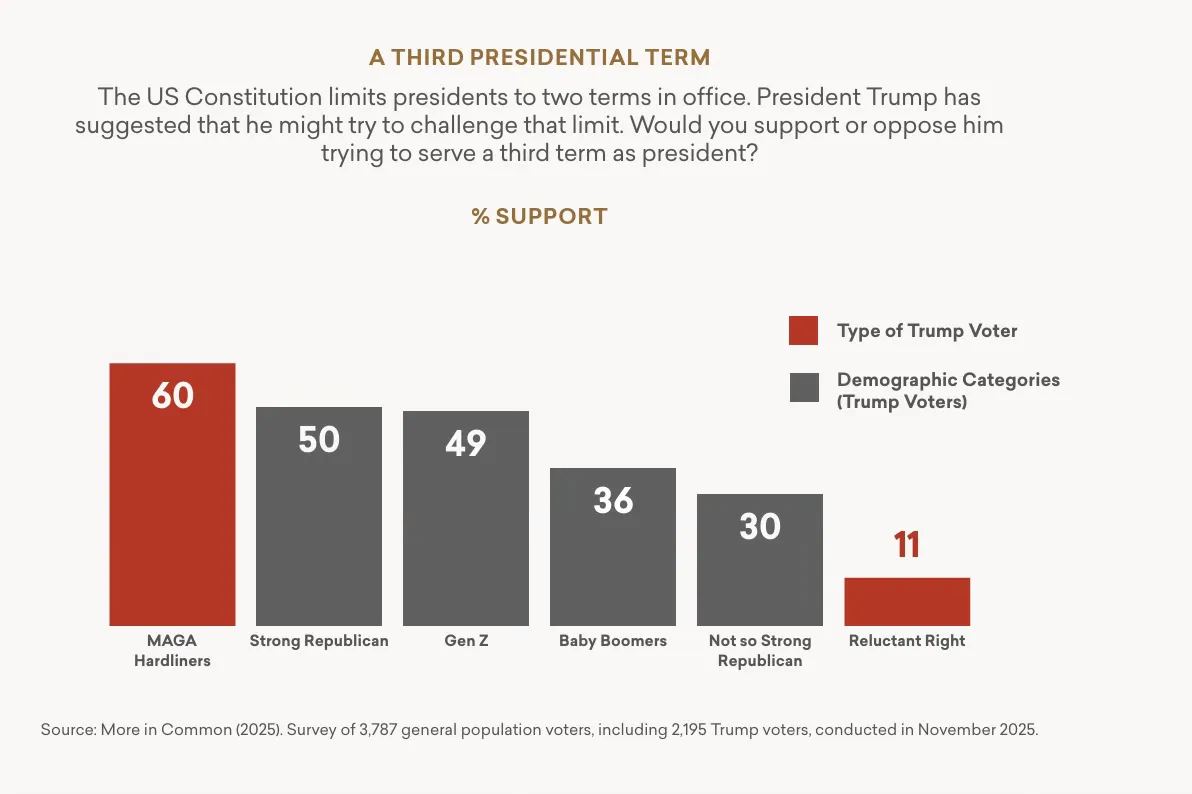
Similarly, MAGA Hardliners are more likely than “strong Republicans” and Gen Z Trump voters, including Gen Z men, to support President Trump pursuing a third term. The Reluctant Right are less than half as likely to support such a measure than even “not so strong Republicans” who voted for Trump.
https://substackcdn.com/image/fetch/$s_!s2Lq!,w_1456,c_limit,f_webp,q_auto:good,fl_progressive:steep/https%3A%2F%2Fsubstack-post-media.s3.amazonaws.com%2Fpublic%2Fimages%2Fa9e082b6-3f1b-462e-8e84-32e5329ba7f6_1233x952.jpeg
Similarly, 62 percent of MAGA Hardliners feel that President Trump should “punish his opponents for the damage they’ve done,” versus 8 percent of the Reluctant Right. Anti-Woke Conservatives and Mainline Republicans are again in the middle, albeit with minority levels of agreement: 33 percent and 30 percent, respectively.
Finally, 62 percent of MAGA Hardliners agree that “American culture today is too feminine; it needs more masculinity,” as compared to 22 percent of the Reluctant Right. Anti-Woke Conservatives are closer to MAGA Hardliners with 54 percent agreement, while Mainline Republicans are closer to Reluctant Right with 32 percent agreement.
Beyond the conventional categories
The report offers a lens on Trump voters beyond conventional categories such as age, religious affiliation, income, race, and gender. In fact, the four voter types are often better predictors than the demographic categories typically associated with those issues.
For instance, compared to Evangelicals and “very conservative” Americans, MAGA Hardliners are more likely to feel that the Left profoundly threatens America. Conversely, the Reluctant Right is less likely than Trump-voting college-educated women and Gen Z to feel the same way.
Similarly, MAGA Hardliners are more likely than “strong Republicans” and Gen Z Trump voters, including Gen Z men, to support President Trump pursuing a third term. The Reluctant Right are less than half as likely to support such a measure than even “not so strong Republicans” who voted for Trump.
 https://substackcdn.com/image/fetch/$s_!trGN!,w_1456,c_limit,f_webp,q_auto:good,fl_progressive:steep/https%3A%2F%2Fsubstack-post-media.s3.amazonaws.com%2Fpublic%2Fimages%2F6fa2e398-cc76-4fc9-ac10-5437d4929439_1192x794.heic
Similarly, MAGA Hardliners are more convinced of the merits of using the military for mass deportation than are self-described “very conservative” Trump voters. By contrast, the Reluctant Right are more opposed to this policy than Hispanic Trump voters, despite the impacts of these policies on Hispanic communities.
Our segmentation can therefore be used as a sharper tool to understand Trump voters’ attitudes and values. While demographics can help explain political attitudes, More in Common’s research has consistently found that bespoke typologies provide a more effective lens.
Much is at stake in better understanding the 77 million Americans who make up the Trump voter coalition. The coalition’s internal differences run through nearly every major issue facing the country. Yet these divisions within the Trump voter coalition exist alongside striking agreement: America is in crisis, the political establishment has failed, and the other side holds them in contempt. Whether the coalition endures may depend on whether these shared frustrations remain strong enough to override differences about deeply-held identities and about what lines should not be crossed.
What else do the Trump voter types tell us about our country?
Over the coming weeks, we will explore President Trump’s coalition in a multi-part series. Subsequent newsletters will focus on major thematic areas of our study: immigration, “wokeness”, perceptions of President Trump’s leadership, and, finally, a series of trends among younger Trump voters that we refer to as an emergent “new traditionalism.”
https://substackcdn.com/image/fetch/$s_!trGN!,w_1456,c_limit,f_webp,q_auto:good,fl_progressive:steep/https%3A%2F%2Fsubstack-post-media.s3.amazonaws.com%2Fpublic%2Fimages%2F6fa2e398-cc76-4fc9-ac10-5437d4929439_1192x794.heic
Similarly, MAGA Hardliners are more convinced of the merits of using the military for mass deportation than are self-described “very conservative” Trump voters. By contrast, the Reluctant Right are more opposed to this policy than Hispanic Trump voters, despite the impacts of these policies on Hispanic communities.
Our segmentation can therefore be used as a sharper tool to understand Trump voters’ attitudes and values. While demographics can help explain political attitudes, More in Common’s research has consistently found that bespoke typologies provide a more effective lens.
Much is at stake in better understanding the 77 million Americans who make up the Trump voter coalition. The coalition’s internal differences run through nearly every major issue facing the country. Yet these divisions within the Trump voter coalition exist alongside striking agreement: America is in crisis, the political establishment has failed, and the other side holds them in contempt. Whether the coalition endures may depend on whether these shared frustrations remain strong enough to override differences about deeply-held identities and about what lines should not be crossed.
What else do the Trump voter types tell us about our country?
Over the coming weeks, we will explore President Trump’s coalition in a multi-part series. Subsequent newsletters will focus on major thematic areas of our study: immigration, “wokeness”, perceptions of President Trump’s leadership, and, finally, a series of trends among younger Trump voters that we refer to as an emergent “new traditionalism.”

Thursday, January 22, 2026
Du Học Mỹ Năm 1975
https://vvnm.vietbao.com/a246578/du-hoc-my-nam-1975
Du Học Mỹ Năm 1975
26/05/2017
Chú Chín Cali
Tác giả: Chú Chín Cali
Bài số 5127-18-30807-vb6052617
Tác giả bắt đầu tham dự VVNM năm 2015 và được giải danh dự. Bài viết mới nầy là một bút ký viết về đời sống các sinh viên Việt Nam du học ở Mỹ trong lúc Miền Nam bị sụp đổ năm 1975. Tác Giả dạy học lúc còn ở VN. Du học Mỹ năm 1973. Ông làm việc cho Cơ Quan Phát Triển Quốc Tế (USAID) và Louisiana State University International Programs. Ở Mỹ ông là Water Resources Engineer cho Water Resources Dept, tiểu bang Arizona. Ông đã về hưu và đang định cư ở Orange County.
* * *
blank
Horsetooth reservoir (Fort Collins) và tác giả (1974).
Tôi bỡ ngỡ đứng trước George Town University (Washington DC) với hai cái va-li to tướngngơ ngác trước sự vĩ đại của trường đại học thì có mấy sinh viên, có lẽ là người ngoại quốc, xáp vào hỏi chuyện rất là thân thiện. Rồi họ xúm nhau đứa đẩy vali, đứa mang túi xách, giúp tôi đi đến khu International Programs để tìm hai người bạn đang học ở đây. Tôi vừa mới bước chân đến Mỹ.
An và Quí đẩy cửa bước vào phòng đợi gặp tôi. Vừa thấy tôi hai ông bạn trố mắt ngạc nhiên, mừng rở. Quí bật miệng trước:
- Ủa! Trời đất! Ông mới tới sao?
- Sao không gọi tụi tui? Anh An chen vô.
Tôi đang sung sướng thấy mình như vừa thoát qua một cơn ác mộng, trả lời đùa:
- Biết cách gọi điện thoại chết liền, rồi nói tiếp:
- Định nằm vạ ở phi trường, mấy xếp mình làm ăn cái kiểu gì kỳ cục quá, đem con bỏ chợ! Tôi đến phi trường Washington DC nhưng không thấy ai đón cả. Hên quá mò được tới đây gặp được hai ông!
Quí và An đưa tôi về Hartnett Hall, nhà trọ nơi hai anh đang tạm trú được tháng nay. Cái studio nhỏ xíu. Tôi ngủ tạm trên Sofa đêm ấy. Quí đã nhường cho tôi cái mền nhưng vẩn thấy lạnh thấu xương.
Đó là đêm đầu tiên tôi ở Mỹ, và cũng là cái đêm kỷ niệm lần đầu tiên tôi được nhìn tuyết rơi lả tả qua ánh sáng ngọn đèn đường trước nhà. Tuyết thật chứ không phải tuyết trong TV.
Suốt đêm trằng trọc vì bị “jet lag” lại bị lạnh cóng,tôi chỉ mong cho trời sáng mau để được ra ngoài sân xem tuyết. Vừa mở cửa ra sân tôi vội thục lùi vì không khí lạnh ùa vào phòng lạnh buốt. “Xứ gì mà lạnh quá”, tôi lầm bầm trong miệng. Tuy nhiên tôi không thể giữ được tiếng “wow! ” ngạc nhiên khi nhìn thấy cảnh tuyết trắng phủ đầy, ngoài sân, trong vườn, trên mái nhà, ngoài đường phố, bám đầy trên các cành cây trơ trụi, sáng rực một màu trắng long lanh. Tôi ngỡ như mình đang sống trong mơ vì mới ngày hôm qua tôi còn vẫy tay chào thân nhân đưa tiển ở phi trường TSN, mồ hôi nhễ nhại ướt cả cái áo “vét-ton” còn thơm mùi vải mới.
Rồi cả ba chúng tôi dọn về một “boarding house” khác ở đường Wyoming St, nơi đây chúng tôi sẽ ở trọ ba tháng để tiếp tục học Anh ngữ.
Thời gian ở Washington DC có lẽ là thời gian đẹp nhất của chúng tôi ở Mỹ. Tuổi trẻ vô tư, đầy sức sống. Tâm hồn trong sáng hồn nhiên với viễn ảnh rực rở về tương lai đang thênh thang rộng mở. Chúng tôi không biết lo biết buồn là gì. Ở thập niên 1970s được đi du học Mỹ là một đặc ânvàchúng tôi là những người may mắn nhất.
Xứ Mỹ bao la vĩ đại nhưng bị thu nhỏ lại trong phạm vi chúng tôi có thể đi bộ được: từ nhà đến trường cách xa chừng 3- miles, cái chợ “Safe Way” cách vài “blocks” và trạm xe buýt ở bên kia đường.
Ba ông “Hai Lúa Cần Thơ” lúc nào cũng đi chung, ngày ngày cắp sách đến trường, cuối tuần đi chợ hoặc đón xe bus xuống downtown Washington DC để lục lạo dưới basement tìm đồ “on sale” giá bèo.
Đi đâu bọn tôi cũng xách theo cây dù kể cả lúc trời không mưa không nắng. Có người thắc mắc hỏi sao lại xách dù đi phố? Xin thưa, chúng tôi dùng dù làm vũ khí tự vệ. Nếu lở có bị mấy đứa Mỹ đen đứng lù lù ở mấy gốc đường tấn công ẩu, ông sẽ dùng dù chĩa cho nó đổ ruột! Washington DC nhiều Mỹ đen thấy ghê lắm.
blank
Georgetown Univ. Tác giả (1st), An (3rd), Quí (4th),và các bạn cùng lớp.
Boarding house cung cấp bữa ăn sáng. Ông bà chủ tuy là Mỹ trắng nhưng vì sống lâu năm với đám người ngoại quốc nên làm biếng nói tiếng Mỹ, họ cứ “what” hoài mắc công giải thích. Mỗi thực khách được chọn hai quả trứng gà mỗi buổi sáng. Thay vì hỏi “How do you like your eggs (cooked)” rồi phải giải thích lòng vòng ông hỏi thẳng:
“Hard-boiled, scrambled or over easy? ”
Mình được chọn trứngmột trong ba kiểunầy: trứng luộc, trứng đánh chiên hoặc trứng chiên còn nguyên. Sữa tươi, cereal, coffee dùng thoải mái nhưng trứng thì chỉ có 2 quả. Ngày 2 quả, một tháng 60 quả. Thuở ấy làm gì có hàng quán Việt Nam để thay đổi món ăn sáng như mì, phở hay bún bò Huế! Ba chàng đếm quả hằng ngày nghe ớn đến cổ nên bàn nhau chuyện lén nấu món Việt Nam trong phòng ngủ.
Thức ăn được giữ trong tủ lạnh do kỹ sư Cần Thơ tự chế, làm bằng thùng carton để ngoài cửa sổ. Lúc ấy là mùa đông, trời Washington DC khá lạnh nên cái tủ lạnh tự chế “chạy” rất tốt, chứa đầy nước ngọt, bia, trái cây, rau cải, sữa bò.. đủ thứ. Chỉ cần mở cửa sổ, thò tay vào thùng carton là lấy được đồ trong tủ lạnh.
Đầu bếp chánh của chúng tôi là anh HànAn, chuyên nấu món gà rô ti. Anh “chuyên” món nầy vì đó là món duy nhất anh biết. Anh An, người cao lớn nhưng ốm nhom. Trước khi đi Mỹ, bà xã anh sợ ông chồng ốm yếu ở Mỹ thiếu ănnên dạy anh nấu món nầy tẩm bổ. Tôi và Quí là bếp phụ nên chiên xào đủ thứ, những món không tìm thấy trong sách dạy nấu ăn.
Thỉnh thoảng chúng tôi nhận thêm hội viên mới, từ Việt Nam sang Mỹ tu nghiệp ngắn hạn hoặc dự các hội nghị. Tuy ở Việt Nam cở hàng Giám Đốc, Trưởng Phòng, nhưng khi gia nhậphội chỉ có hai chức vụ,hoặc đầu bếp hoặc busboy, tự chọn. Anh Lợi (G. Đ. Phủ Tổng Thống) thêm vào menu món gà nấu cam, anh Dương Minh Đức (G. S. ) vừa tốt nghiệp xong, trên đường về Việt Nam) lảnh phần phục vụ, dọn dẹp. Trải báo ngồi dưới thảm mà ăn, mọi người hồn nhiên, vô tư như đám học trò nội trú.
Hàng ngày ba “cậu” đầu đội nón, cổ quấn khăn, trịnh trọng xách cặp Samsonite đến trường. Chúng tôi đi bộ trên những con đường nhỏ dọc theo những hàng cây trơ trụi. Hai bên đường là những dải nhà xưa cổ kính, xây bằng gạch đỏ, cửa đóng im lìm có treo vòng hoa Christmas. Ngoài đường không một bóng người đi lại. Thỉnh thoảng có ông già dẫn chó đi bộ. Đường phố vắng hoe. Lâu lắm mới có vài chiếc xe qua lại. Mùa đông ở Washington DC buồn đứt ruột.
Sau ba tháng học Anh văn ba “cậu” dọn nhà bếp về Fort Collins, CO. để vào đại học CSU. Trong suốt 2 năm đi học ở CSU, ba đứa tôi ở chung một nhà trọ. Nhờ vậy món gà rô ti độc nhứt vô nhị của anh An vẫn còn đủ ba người khách trung thành.
Tuy đã được huấn luyện Anh văn rất kỹ ở Hội Việt Mỹ ở Việt Nam và ở George Town University, phải đủ điểm Toefl trước khi vào đại học, trình độ Ang ngữ của chúng tôi còn rất yếu. Mấy “semesters” đầu tiên ở Đại Họctôi nghe thầy giảng như vịt nghe sấm. Thời gian học lại cố định nên phải lấy nhiều lớp một lúc mới kịp thời gian. Vì là sinh viên cao học nên tôi phải lấy những lớp cao nên “lội” thấy mà thương để theo kịp các sinh viên khác. Phải mượn “notes” của bạn bè. Phải tra tự điển từng từ ngữ một trong ngành chuyên môn. Tuy nhiên, kết quả thi cử lại thường rất là khích lệ vì sinh viên Việt Nam nổi tiếng là mọt sách. Trong khi các sinh viên khác “party” vui chơi, chúng tôi cậm cụi“cày”, lọ mọ ngày đêm trong thư viện.
Trước năm 1975, chưa có người Việt tị nạn nên người Việt ở Mỹ rất ít. Lúc ấy cũng chưa có từ ngữ “Việt Kiều”. Ở trường CSU, có khoảng mươi mấy sinh viên Việt nam, gồm đủ thành phần như trường Vỏ Bị Quốc Gia Đà Lạt, bộ Kinh Tế, ngân hàng Phát Triển Nông Nghiệp, Đại Học Nông Nghiệp… Hầu hết sinh viên đều có học bổng của USAID, được chăm sóc bởi một “Liaison Oficer”, Dr. Webber.
Trước khi đi Mỹ ba đứa tôi được xếp ngạch là Giảng Nghiệm Viên đại học, chỉ số lương 500, thuộc về hạng khấm khá, lương tháng khoảng 40,000 đồng ($340) trong khi ấy lương lính Dân Vệ khoảng 13,000 đồng. Đi du học theo kiểu công chức như bọn nầy, ngoài tiền lương ở VN gia đình lãnh đủ, còn được học bổng cho thêm $300 tiền mặt mỗi tháng để chi xài. Ăn uống tốn khoảng $100, tiền phòng mất $100, con dư $100 đô xài hoài không hết, tôi để dành mua xe hơi.
Chiếc xe đầu tiên tôi mua $300 đô, Pontiac Catalina 1969. Xe cũ nhưng tuyệt đẹp, nệm da, trong ngoài láng cón. Nó lớn đến nỗi nằm trên nệm sau khỏi phải co chân. Ông cố đạo bán xe cho tôi, đã lấy tiền bỏ túi nhưng không chịu đi, cứ đứng nhìn hoài tiếc rẻ chiếc xe! Trước khi đi, ông còn vỗ vào đầu xe mấy cái rồi trách móc “sao mầy nỡ bỏ tao! ” tuy rằng ông là người bán nó!
Chúng tôi có được chiếc xe làm chân, tôi làm tài xế cho các người Việt mới đến,cuối tuần đi đi câu cábẻ măng tây mọc hoang. Cá thì không thiếu, chỉ thiếu người làm cá!
Trong thời gian trường nghỉ xả hơi (school break), mấy đứa chúng tôi chất đầy xe đi khám phá xứ Mỹ vì sợ rằng một khi về VN sẽ không còn cơ hội trở lại nữa, như đi Grand Canyon, Yellow Stone, Golden Gate,Yoyemite, Dead Valley, Disney Land, Universial Studio, Sea World…
Đi chơi đến đâu chúng tôi ở tạm nhà các bạn bè, đều là sinh viên với nhau. Lúc ấy còn trẻ, tôi lái xe cả ngày đêm không biết mệt, khi buồn ngủ ghé qua các “rest areas” ngủ tạm. Cả bọn sống bụi đời, lại ỷ đông nên không biết sợ mấy tên bụi đời thứ thiệt ở đó. Bây giờ nghĩ lại mới thấy ớn.
blank
Gia đình anh chị Sáu Minh ở Fort Collins và đám sinh viên.
Tôi còn nhớ kỷ niệm lần đầu lái xe trên xa lộ ở California. Quen lái xe trong thành phố Fort Collins nhỏ xíu loe ngoe mấy chiếc xe nên khi lái lần đầu trên xa lộ ở California, hồn vía tôi muốn xuất. Tay đổ mồ hôi ướt mẹp. Không ngờ ở đây người ta chạy xe khiếp quá! Tôi là tài xế lái xe, mà như lái chiếc máy bay Boing 747, có hai phi công phụ, người đọc bản đồ, người phụ nhìn xe cộ.
- Ối cha, sao mà khiếp quá. Còn bao xa hả Quí? Tôi hỏi.
- 2 miles thì exit. Ông coi đổi lane thì vừa. Quí trả lời.
- Xe nhiều quá, coi đằng sau giùm tui anh An.
- Khoan… khoan, còn cả dọc xe, bật signal chưa?
- Rồi nhưng tụi nó không nhường
- Thì ông vọt lẹ lên đi, chạy tè tè như vầy làm sao sang lane được.
- Bảy chục rồi cha nội.
- Thì chậm lại cho nó qua. Không kịp bây giờ.
Quí, chuyên viên bản đồ, hoảng hốt la:
- Chết cha rồi, exit trước mặt đó.
Có tiếng An la:
- Ok, OK, nó nhường rồi, đổi lane đi, lẹ lên.
Tôi vừa đổi được lane là thấy cái exit lù lù trước mắt. Nếu bỏ cái exit nầy… thì phiền lắm. Quýnh quá tôi chơi luôn, quay nhanh tay lái nhào vô cái exit, làm xe chao mạnh. Mấy ông ngồi trong xe bị rớt khỏi băng, la trời như bộng. Quang vừa lồm cồm ngồi dậy, vừa cự nự giọng Bắc kỳ.
- Gớm… Ông lái ô tô cáí kiểu gì vậy? Lạng quạng bỏ mẹ!
Có tiếng anh Thạch càu nhàu:
- Kỳ tới đi xe ông tui đội nón bảo hiểm cho chắc ăn.
Thời bấy giờ tiểu bang Colorado rất ít người Việt. Có lần chúng tôi gặp được một đồng hương, chị tên Hương, còn trẻ, lấy chồng Mỹ. Gặp nhau mừng quá, chị bảo “Chỉ nghe các anh nói tiếng Việt thôi là đã thấy thương rồi”. Chị mời chúng tôi đến thăm nông trại của vợ chồng chị ở một làng nhỏ mà tôi quên tên, bên tiểu bang Wyoming giáp ranh với Colorado.
Một ngày cuối tuần đẹp trời, tôi lái chiếc “Boing 747” với 2 pilot phụ và phái đoàn, vượt ranh giới Colorado sang Wyoming thăm chị Hương. Phải lái xe ngoằn nghèo theo mấy con đường núi mất hai ba giờ mới tới.
Wyoming là xứ tuyết, ít dân nhất ở Mỹ. Năm 1975, cả tiểu bang chỉ có hơn 380 ngàn dân. Giữa mùa hè mà có nơi vách tuyết hai bên đường cao tới đầu. Bill, chồng chị Hương, đón chúng tôi tận ngoài đường cái. Muốn vào nông trại phải lội bộ qua một dòng suối nhỏ, nước chảy lấp xấp trong mùa hè khi tuyết tan. Chỉ có xe “four wheel drive” mới qua được suối.
Bill là một cựu quân nhân chiến đấu ở Việt Nam, giải ngũ trở về Mỹ với chiến lợi phẩm là một cô gái quê miền Nam vừa đẹp vừa hiền. Thấy chúng tôi lưỡng lự vì phải cởi giày, xăn quần lội qua suối nước lạnh như cắt da, anh đề nghị cõng từ đứa sang suối. Tôi ôm cổ Bill như con khỉ ôm cột nhà vì Bill cao hơn 6”, nặng trên 250 lb, trong khi tôi gầy đét ốm nhom như cây tre miễu, dù đã ráng uống sữa tẩm bổ cũng chỉ lên được 115 Lb. Tuy Bill hiền từ dễ thương nhưng tôi vẫn thấy đã nư trong bụng khi được anh cõng trên lưng, tự nhủ: “Mi đã biết lỗi nên ông tha cho cái tội chôm chĩa con gái Việt Nam”.
Vợ chồng chị Hương tiếp đãi chúng tôi thật nồng hậu. Wyoming là thiên đàng cho ai thích câu cá. Các dòng suối nước trong vắt nhìn thấy bầy cá Trout lội nhởn nhơ, mấy con cá chép cỏ (grass carp) cả chục pounds, lừ đừ trong các vũng nước đọng. Trên đồi, rau húng lủi, rau hẹ mọc hoang như cỏ dại. Dưới suối, rau xà lách son mọc từng dề xanh rì. Trong lúc chúc tôi mê mẩn câu cá, hái rau, Bill đã chuẩn bị sẵn một con trừu nướng cho bữa ăn trưa. Phái đoàn ăn một bữa hả hê!
Tội nghiệp chị Hương, nước mắt rưng rưng khi chúng tôi từ giã ra về. Chị bảo có lẽ cả năm nữa chị mới có dịp gặp được người đồng hương, mới được nói tiếng Việt! Tiếng Việt mình quí hiếm lắm.
Nơi chị Hương ở nghe nó xa vời như làng Cổ Cò ở xứ Năm Căn ở Đồng Tháp, hoặc làng Timbuktu bên xứ Mali ở Phi Châu. Không biết ngày nay chị có còn sống ở cái làng Timbuktu của chị không? Chắc chị có thêm nhiều bạn đồng hương mới để được nói tiếng Việt và không còn cô đơn nữa?
Biến cố 30 tháng 4 năm 1975 xảy ra như một cơn ác mộng, làm đảo lộn tất cả đời sống yên bình của những sinh viên du học Mỹ.
Họ mất ăn mất ngủ, nhốn nháo tìm nhau để bàn luận, trao đổi tin tức đã thu nhận được trong ngày. Mỗi tối họ tụ lại, yên lặng ngồi xem tin tức trên TV, nhìn bản đồ Việt Nam bị sơn đỏ theo sự bành trướng của Cộng Sản đang xâm chiếm miền Nam. Họ theo dõi những hình ảnh đau thương đầy máu lửa của cuộc chạy loạn miền Trung tiếp nối là cuộc di tản hãi hùng. Ai cũng sững sờ nhìn nhau mà nước mắt rưng rung. Không biết người Việt Quốc gia đã làm gì nên tội mà họ phải trả bằng một giá quá cao, bằng xương trắng máu đào và nước mắt của hàng triệu sinh linh vô tội mà trong đó có thân nhân gia đình của chúng tôi. Họ thấy bất lực, chỉ biết nhìn nhau ngỡ ngàng khóc không thành tiếng.
Tòa Đại Sứ VNCH đóng cửa, mọi thông tin liên lạc về Việt Nam hoàn toàn bị cắt đứt (và kéo dài 20 năm cho đến ngày 07/11/1995 mới bình thường hóa). Học bổng là nồi gạo của các sinh viên cũng bị chấm dứt.
Các sinh viên có gia đình còn vợ con ở Việt Nam là khổ tâm nhứt. Học hành dang dở, vừa lo kế sinh nhai vừa hoang mang lo lắng cho gia đình ở Việt Nam nên nhiều người không chịu nổi áp lực rơi vào tình trạng trầm cảm. Một số quyết định trở về Việt Nam với bất cứ giá nào, kể cả hy sinh tánh mạng của mình.
Tôi biết có sinh viên quyết tâm trở về qua chuyến tàu Việt Nam Thương Tín khởi hành từ Hawaii mang 1,600 người Việt hồi hương. Chuyến tầu vừa cập bến VN, tất cả đều bị đưa lên xe bít bùng về nơi tập trung, bị lột truồng lục soát, trấn lột. Tiếp theo là nhiều năm tù đầy, ít nhứt là 5 năm. Sau ngày mãn tù họ phải vượt biển lần thứ hai hoặc theo diện HO sang Mỹ trở lại.
Tôi có bạn du học ở Philippinnes trở về bằng tàu thương buôn và anh không bao giờ về đến Việt Nam. Anh bị cướp giết trên tàu rồi vất xác xuống bể.
blank
Tác giả 1975.
Tôi cũng có người bạn là du học sinh bên Pháp trở thành mất trí, lang thang ở các bến tàu và sau cùng bạn bè tìm được xác anh gục chết vì đói lạnh dưới một gầm cầu.
Cũng như các quân cán chính VNCH ở Việt Nam bị bỏ rơi, các sinh viên du học cũng cùng chung số phận, bị bỏ rơi như đàn gà con mất mẹ. Trong lúc Miền nam kêu gào giãy chết, những người Việt Quốc Gia hải ngoại trong đó có đám sinh viên du học như chúng tôi cũng giở khóc giở cười, ngậm ngùi cùng chia sẻ nỗi đau chung.
Đa số sinh viên phải bỏ học đi làm để sống. Một số khác may mắn hơn, được trường nhận làm GRA (Graduate Research Assistant) hoặc GTA (Graduate Teaching Asistant) để được tiếp tục sự học cho đến ngày ra trường. Trong số nhỏ may mắn nầy có ba đứa tôi. Các người bạn khác đều phân tán, không biết bây giờ lưu lạc ở đâu.
Lần lượt có nhiều gia đình người Việt được các nhà thờ Tin Lành bảo trợ dọn đến vùng Fort Collins, và các tỉnh nhỏ lân cận như Greeley, Loveland, Longmont. Khi vừa đến Mỹ ai cũng có tâm trạng ngỡ ngàng lạc lõng nên quí lắm khi gặp được đồng hương. Số người Việt lại quá ít nên tình đồng hương rất là khắng khít đậm đà. Nhiều gia đình thương chúng tôi là những sinh viên cô đơn nên được mời về chơi, được cho ăn đủ các món Việt Nam, không như xưa chúng tôi nấu ăn không có nước mắm. Tôi vẫn còn thấy như mình còn mang một món nợ với gia đình anh chị Sáu Minh với 6 đứa con nhỏ. Anh chị quí mến và đối xử với chúng tôi như người trong nhà. Mấy đứa con không có bạn để chơi, để nói tiếng Việt nên quấn quít bên chúng tôi, thương lắm. Từ khi có anh chị Minh về đây, món gà rôti của anh An trở nên ế ẩm, rồi dẹp tiệm luôn!
Ngày xưa, đi Mỹ du học là giấc mơ vàng son của tuổi trẻ. Sự sụp đổ của Miền Nam đã chôn vùi tương lai của cả một dân tộc, trong đó có những giấc mơ bé nhỏ của bọn sinh viên chúng tôi. Bao nhiêu ước vọng về tương lai, bao nhiêu mộng mơ đã xây dựng đều sụp đổ tan tành thành mây khói.
Trong tình trạng nhiễu nhương lúc bấy giờ, tập trung tư tưởng để tiếp tục học hành không phải là chuyện dễ. Tôi cố gắng học để tốt nghiệp thật nhanh, mong sao sớm xếp lại chương cuối cùng của quá trình học vấn đầy biến cố. Tôi học miệt mài ngày đêm, mệt mỏi, căng thẳng, gần như kiệt quệ.
Ngày ra hội đồng tốt nghiệp, tôi hồi hộp ngồi đợi kết quả của hội đồng giám khảo đang hợp kín. Đây là giây phút quyết định cuộc đời tôi. Nếu thất bại lần nầy, tôi sẽ bỏ cuộc tất cả. Bao nhiêu công sức, tâm huyết đã đầu tư bấy lâu coi như vô dụng. Cho đến nhiều năm sau tôi vần còn bị ám ảnh bởi giây phút nầy. Nếu chẳng may thi rớt…
Tư tưởng vẩn vơ bị cắt đứt, tôi đứng bật dậy khi ông Department Head mở cửa phòng hợp kín đến bắt tay tôi nói: “Congratulations…”
Tôi không cần nghe thêm gì nữa ngoài “Congatulations”, một danh từ nhiệm mầu, mà tôi hằng chờ đợi!
Bao năm học tập miệt mài, bao cố gắng và tâm trí đã đầu tư, tôi chỉ mong đợi được nghe một chữ nầy thôi. Và tôi đã được nghe nó từ miệng của ông Phân Khoa Trưởng.
Như vừa được tháo gỡ gánh nặng nghìn cân, tôi chưa bao giờ có được cái cảm giác lạ lùng vậy, hệt như kẻ sắp chết đuối đã ngoi lên mặt nước kịp thời, trước khi vĩnh viễn chìm sâu dưới đáy biển. Tôi thở ra, như kẻ sống sót, không phụ lòng của bao người thân yêu đã đặt nhiều kỳ vọng vào mình.
Gom góp hành trang, với cái ba lô và thùng sách cũ, tôi lái xe ra đi, bỏ lại tất cả phía sau. Tôi muốn làm một chuyến lãng du, tìm cho tôi nguồn sinh khí mới để thở. Tôi chẳng màng đến chuyện dự lễ ra trường và từ giã bạn bè trước trước khi ra đi. Cũng vì vậy, tôi không có hình đội mũ tốt nghiệp để chưng ở phòng khách! Tôi tốt nghiệp sớm nhất (MS-1976), sau đó là Quí (MS). Anh Hàn An ở lại trường, tiếp tục học cho đến ngày tốt nghiệp Ph. D.
Nhớ hôm nào tôi hí hửng vẫy tay chào giã biệt Việt Nam lên đường đi Mỹđể mưu cầu công danh sự ngiệp. Có ai ngờ cái vẫy tay tạm biệt lại trở thành cái chào vĩnh biệt.
Nhớ thêm lần vẫy tay chào giã biệt thành phố Fort Collins, tôi còn thấy ngậm ngùi. Một mình lái xe, dấn thân vào một con đường mới, đâu biết được con đường ấy sẽ dẫn mình tới đâu?
Rồi sẽ còn bao nhiêu lần nữa tôi phải vẫy tay chào giã biệt trong cuộc sống nầy? Đời là một dòng sông chảy một chiều. Một khi đã ra đi mấy người quay trở lại?
Tôi viết những trang hồi ký nầy năm 2017, khi đã 72 tuổi. Lê Đình Quí 70 và Hàn An 76 tuổi. Hiện tại tôi đã về hưu ở thành phố Garden Grove, cách Santa Ana thành phố Quí ở 15 phút lái xe. Chúng tôi vẫn thường xuyên gặp nhau. Dr. HanAn về hưu ở tiểu bang Idaho. Thỉnh thoảng gia đình anh có đến California thăm chúng tôi. Năm vừa qua (2016) tôi trở lại Fort Collins thăm trường cũ sau 41 năm từ ngày bỏ đi. Trường cũ hoàn toàn thay đổi và tôi chỉ gặp được một người bạn xưa, anh Quang Nguyễn, người duy nhất vẫn còn ở lại nơi đây.
Chú Chín Cali
Tuesday, January 20, 2026
Diets Revisited
Basic ideas for nutritious and enjoyable meals:
Whole and fresh/ not old or highly processed foods and beverages;
Variety (not focusing on only one kind of food or beverage);
Balance (all groups of nutrients: plant and/or animal protein, carbohydrate, good/healthy fat and dairy products, minerals and vitamins, and water);
Adequacy (right amounts, depending on the individual's body/physical needs);and moderation listening to the body cues, not too much nor too little.
Monday, January 19, 2026
Advances in Medicine
Andrew Lam, MD
Author of The Masters of Medicine: Our Greatest Triumphs in the Race to Cure Humanity's Deadliest Diseases (Dallas, TX: BenBella Books, Inc., 2023)
Bacterial and Viral Infection pp.75-168
Virus and Viral Infection
Smallpox A book in China published in 1549: human effort to enhance the body's immune system through exposure to a pathogen, a technique believed to have been practiced since the 10th century. Pustule samples collected from smallpox survivors were dried and crushed into powder and later blown into the nostrils. Another method was to rub the material into a superficial incision on the hand or the arm. The practice (called variolation) was reported to the Royal Society in Londonthrough an employee of the East India Company, who had been working in China.
In the late 18th century - Edward Jenner - cowpox and smallpox: Jenner's 7-year apprenticeship with a country doctor named Daniel Ludlow led him to embark on his own career in the 1770s. He first
collected samples, then later published, cases of patients who had had cowpox and did not contract smallpox even though they exposed to smallpox patients. In 1796 he inoculated live virus from the sores of a smallpox patient to James Phipps, a boy who had previously gotten some fluid from a cowpox pustule instilled into the two incisions in the boy's arm. Phipps did not die of smallpox, and the experiement showed that cowpox could be used to protect humans from smallpox -a practice later called vaccination (the Latin word "vacca" means cow). Jenner became famous throughout Europe and North America. But at that time nobody knew or understood virus and the human immune system, and how vaccination worked.
Adolf Mayer, a German chemist, and the findings of viruses in the late 19th century:
The Wonder Drug Penicillin 1921-1929 p.103 the mold; 1938-1941 pp.104-116 from Oxford in London to New York City in the USA; and the Nobel Prize 1945 pp.116-120.
Alexander Fleming, Howard Florey, Ernst Chain, and Norman Heatley pp.97-125
Rockefeller Foundation's Medical Sciences Division in NY City, and the Northern Regional Research Laboratory in Peoria, IL.
Heart Disease pp.6-45
Heart disease was not a pressing concern to medical practitioners for centuries past, because infectious diseases were far more deadly. By 1930 average American longevity had increased to 60 years, and heart disease became the leading cause of death. Today heart disease is responsible for about 25% of all deaths in the USA, approximately 659,000/year, greater than mortality due to all types of cancer combined.
1912 a Chicago internist named James Herrick postulated that a thrombus/clot blocked a coronary artery and prevented oxygen-rich blood from reaching cardiac muscle, resulting in tissue death. => the first time doctors began to understand the importance of the three coronary coronary arteries.
1929 a young German medical intern named Werner Forssmann theorized that a catheter could be threaded up into the heartthrough a vein in the arm. This might be an effective way of injecting drugs directly into the right atrium. He experimented on himself to the awe of all present. The X-ray taken of his chest showed the catheter he threaded from his left arm into the right side of his heart with no chest pain and no fatal arrythmia => the first time medicines might be delivered directly into the heart, imaging dyes could display blood flow thru the heart, and cardiac abnormalities could be visualized in life. Forssmann was later shared the Nobel Prize in medicine in 1956. During WWII he was a medical officer serving on the Eastern Front for the Nazi Party, captured by the Americansnear the war end, and sent to an American POW camp. After released, he worked as a lumberjack, and later resumed his medical work as a urologist in West Germany. During the 1950s and up to the early 1960s:the key event that triggers a heart attack is not simply stenosisof a coronary artery, nor a clot elsewhere in the body that becomes lodged in one of the coronaries. It starts with an atherosclerotic plaque [after years of hypertension, smoking, or high cholesterol...plaques form when the endothelium which lines the inside of the artery is damaged]. Plaques slowly shrink an artery's aperture, but it is plaque rupture that triggers heart attacks, manifesting as hemorrhage, ulceration, or fissuring of a plaque. It only takes a few minutes for potent clot-forming factors and chemicals from the contents of the plaque to aggregate and form a thrombus/clot that completely occludes an artery, and cell death can begin within 60 seconds. The most fortunate heart attack victims benefit from the prompt arrival of emergency medical personnel who are able to defibrillate a patient out of an arrhythmia, and speed the patien to the emergency room.
1963 a radiologist at the Univ. of Oregon named Charles Dotter and Dr. Melvin Judkins developed a series of stiffer catheters with incrementally increasing diameters to relieve the obstruction by dilating the blood vessel until blood could flow freely again.
Coronary Angioplasty Late 1960s an East German physician named Andreas Gruntzig attended a lecture about Charles Dotter's techniques, and developed them into intravascular balloons. With the help of an emeritus chemistry professor who had worked on polyvinyl chloride (PVC), Gruntzig could develop a catheter with a balloon glued to the end and a hole thru which imaging dye could be emitted. The catheter would travel to the aorta over a stiffer guide wire that could be pre-maneuvered to the desired location (the cathete was too flimsy and flexible to be threaded on its own).
He first tried his technique called balloon angioplasty in dogs' coronary arteries successfully, then for the first time on a human in 1974, and in 1977 the first coronary bypass surgery by balloon on a human.
By the early 1980s, leading doctores adopted Gruntzig's technique to treat coronary artery disease=> now from the emergency room the patient suffering a heart attack is rushed to the cardiac catheterization lab, where an interventional cardiologist can perform balloon angioplasty (using a balloon to deploy a miniture wire stent). Gruntzig's coronary angioplasty has saved millions of lives to date.
Cardiac Surgery - Open Heart Surgery During the first half of the 20th century little to no further headway in cardiac surgery was made. After WWII Dr. Dwight Harken, a Harvard-trained US Army surgeon, used his finger-plugging method to stem the bleeding for wounded soldiers with severe chest wounds. Later he learned to pre-place sutures around the metal fragment (in the chest wound) in a purse-string configuration so that he could more rapidly close the hole after pulling out the fragment. After the war this method proved the foundation for the next leap forward, the first attempt to venture inside the heart itself to treat mitral stenosis.
Dr. Charles Bailey, another WWII veteran from Philadelphia, was the first to attempt to use Harken's method of purse-string technique to pre-place a ring of sutures in the left atriumjust above the mitral valve in November 1945 on a patient dying from mitral stenosis. Although in several cases the patients died, both surgeons were pioneers of cardiac surgery. But until someone devised a way to provide oxygenated blood to the body without using the heart, the 4-to-12 minute constraints would consign the nascent filed of cardiac surgery to only the most simplistic maneuvers.
In 1951 a Canadian surgeon, Dr. William Mustard, used monkey lungs to try his new approach to extracorporeal oxygenaione of blood. After that he tried on 12 children with life-threatening cardiac abnormalities, some of them survived after the operations for some time, one with almost 2 weeks, thus proving that it was possible to oxygenate a patient's blood outside the body.
Dr. Walt Lillehei from the University of Minnesota tried the method of cross-circulation first on dogs, then on children with congenital heart defects. The idea stemmed from his knowledge of fetal circulation. In 1954 the procedure worked but still its triumph was premature.
Dr. John Gibbon, a surgeon and a researcher from Boston, built a prototype machine to keep cats alive on complete heart-lung bypass for up to 25 minutes in 1939. Thomas Watson, a CEO of IBM, learned about Gibbon's vision and supported him with funding and engineers to improve his prototype machine. On May 6 1953 at Jefferson Medical College in Philadelphia, Dr. Gibbon successfully performed the first case using what would become the modern heart-lung machine. Within 8 years the first coronary artery bypass graft operation (CABG) had been performed. In the late 1960s CABG techn iques were improved by Dr. Rene Favaloro, an Argentina surgeon working at the Cleveland Clinic, by using a leg vein as a graft to convey blood from the aorta to the diseased coronary artery past the point of obstruction. Today bypass surgery is the mainstay of the cardiac surgery.
Heart Transplant December 3, 1967 Dr. Christiaan Barnard performed the first heart transplant in history at Groote Schuur Hospital in Capetown, South Africa. But the story of this remarkable accomplishment begins with the pioneering work of Dr. Norman Shumway, a surgeon from Stanford University who labored for over a decade to develop the ideas and techniques that made Bernard's surgery possible. Louis Washkansky a 57-year-old diabetic, received the heart of Denise Darvall, a young woman declared brain-dead after a car killed her while she was walking in a crosswalk. Although Washkansky died from pneumonia 18 days after the surgery, his transplanted heart displayed no signs of failure or rejection. Dr. Norman continued his work to perfect the post-operative care that would allow transplant recipients to live longer and better lives. In 1981 Dr. Norman was a key member of the surgical team that performed the world's first combined heart-lung transplant.
At present, about 3,800 cardiac transplants are performed annually in the USA. The system of organ donation is tightly regulated by the United Network for Organ Sharing (UNOS), which pairs donors and recipients according to numerous factors, while thousands of patients remain on the waitlist. Each year, about 805,000 Americans have a heart attack or 1 every 40 seconds.
Implanted difibrillators/Implanted Cardioverter-defibrillators (ICDs) depend on wires and batteries with limited lifespans. Implanted wireless pacemakers are tiny capsules that contain batteries.
Possible Future Advances:
A future alternative to batteries could be the use of a small radiofrequency generator implanted on the chest wall, which can transmit energy to the pacemaker the same way a wireless station charges a smartphone.
Stem cell to develop many different cell types in the body => regenerative medicine to improve cardiac functions, to seed 3D-printed, biodegradable scaffolds to create functional heart valves and blood vessels. In 2016 a decellularized cadaveric heart was postulated with stem cells, infused with nutrients, and grown in a bioreactor that simulated conditions inside the body like the stress of high ventricular pressure. When stimulated with electricity, the new cardiac muscle exhibited contractions => the futuristic goal of fabricating replacement hearts.
Cancer pp. 169-213
Old Approaches:
To Cut or Irradiate, Dr. William Halsted, Johns Hopkins Hospital 1894 pp.172-173; 1895 Wilhelm Rontgen and the discovery of X-rays and Pierre and Marie Curie and the discovery of radioactive substances, radium (1902) and polonium (1898).
Recent Approaches:
Chemotherapy after WWII, and the mustard gas and the nitrogen mustard gas treatment with "Mustargen" approved by FDA in 1949 (after the "Second Pearl Harbor" Dec 2, 1943 at the harbor of Bari, Italy). Dr.Steward Alexander and Colonel Cornelius Rhoads chief of the medical division of the Chemical Warfare Service. Mustargen: a vanguard of a class of chemotherapy drugs called alkylating agents, still used today.
Anti-folate and Other New Treatment in the late 1940s Dr. Sidney Farber on childhood leukemia patients at Boston Children's Hospital; raising fund for millions of dollars required to mount a serious research effort to defeat leukemia : the Children's Cancer Research Fund 1948, in collaboration with a charity "the Variety Club of New England," inspired by the National Foundation for Infantile Paralysis. Twelve-year-old boy named Einar Gustafson/"Jimmy" (from Maine) 1948 Saturday evening radio program Truth or Consequences $231,000 "The Jimmy Fund" for Farber's research. 1952 Boston's brand-new Jimmy Fund Building with clinical space and research laboratories devoted to investigating and treating childhood cancer. 1949 a superior folic acid antagonist called methotrexate proved more effective and less toxic than aminopterin. 1950s-1960s: more chemotherapeutic agents discovered and developed. How to kill rapidly dividing cancer cells? "New successes/treatments" were poisons that killed all human cells, both normal and cancerous, with side effects: Methotrexate damaged the liver and the lungs, 6-mercaptopurine prompted nausea and vomiting, Vincristine precipitated low blood sodium, peripheral neuropathy, and constipation; actinomycin D produce debilitating fatigue and skin necrosis if any of the drug extravasated outside a vein.
Dr. Emil Frei and Dr. Emil Freireich at the National Cancer Institute starting cancer treatment with multiple drugs at the same time, called "VAMP," in 1961. Horrible as it was, 60% of the children leukemia patients achieved remission of remission, higher than attained with single-drug treatment. By 1975 the 5-year survival rate for childhood leukemia has risen to 53%. National Cancer Act in 1971: the USA declaring war on cancer. Today childhood leukemia is curable about 90%. p.191.
50 years of chemotherapy, but basic questions remain: Where did cancer come from? How did it thrive? What made it sprread?
Defined by Heterogeneity
Hormones and the Androgen Deprivation Therapy: 1930s Dr. Charles Huggins, a Chicago urologist: cancer could be influenced by hormones. Back in 1896 Dr. George Beason, a Scottish surgeon: removing ovaries could reduce the sizes of the patients' breast cancer tumors => Elwood Jensen, a chemist and the development of Tamoxifen, an estrogen antagonist that would work on a specific target, on estrogen receptor-positive tumors (60-80% of breast cancers are receptor-positive) during 1960s till 1971.
Theory of Angiogenesis: 1967 Dr. Judah Folkman, a 34-year-old surgeon at Boston Children's Hospital,and research on the role blood vessels play in cancer tumors. 1983 his lab isolated a molecule that made the vascular endothelial cells of blood vessels grow called "fibroblast growth factor" published in Science (1983) => shrinking tumors by diminishing their blood supply=> the development of interferon alpha and the first FDA-approved anti-angiogenesis drug Avastin that blocked a protein called vascular endothelial growth factor (VEGF). Avastin is used to treat colon cancer, malignancies of the lungs, kidney, and brain.
Cancer Cause - the External Factors Theory: The prevention approach with screening tests: from 1920s with Dr. George Papanicolaou a cytologist at Cornell University Medical College, and his "Pap smear" pre-cancerous test against cervical cancer in 1928, and the National Cancer Institute's large scale trial in 1952.
Viral Causes Theories: 1911 Dr. Peyton Rous, a virologist at the Rockefeller Institute in New York City, studied sarcoma in chickens and hypothesized that a virus caused cancer => the Rous sarcoma virus (RSV). Then in 1957 Dr. Denis Burkitt, an Irish surgeon, and the study of aggressive lymphoma (Burkitt's lymphoma) in children in the warm and wet weather regions of sub-Saharan Africa. With other doctors' help (virologists Michaerl A. Epstein in Britain, Yvonne Barr, pathologist Bert Achong), the Epstein-Barr virus, the cause of infectious mononucleosis, was identified.
Nobel prize in medicine awarded to Dr. Peyton Rous and Dr. Charles Huggins in 1966.
Bacterial Cause: 1984 2 Australian doctors, Barry Marshall and Robin Warren, discovered a bacterium (Helicobacter pylori) that causes stomach inflammation leading to stomach cancer, and won the Nobel Prize in 2005.
How Viruses Cause Cancer - Molecular Underpinnings: in 1970, 2 virologists, Howard Temin (UW-Madison) and David Baltimore (MIT) independently discovered certain RNA viruses used an enzyme (reverse transcriptase; opposite of what normally happens to our cells) to convert RNA into DNA copy (the usual direction of transcription is to make an RNA message from our DNA genome, which is then transported to a ribosome to instruct the production of a specified protein). So an RNA virus with reverse trancriptase could insert its RNA genetic code -converted into a DNA copy- into a host's cell's native DNA, changing a cell's genome, with the result being endless cell division. Temin and Baltimore received the Nobel Prize in 1975, sharing it with Renato Dulbecco (CalTech Lab), with whom they had worked since the 1950s. p. 199
More discoveries on oncogenes: Harold Varmus and Michael Bishop (UCSF): new theory that oncogenes were present but not necessarily activated in all of our cells. Thus, the cause: cancer originated from activating oncogenes; the viruses carrying proto-oncogenes were not the cause. Example the cancer-causing gene src/pronounced "sarc") in the Rous sarcoma virus.
In the 1980s: at least a hundred oncogenes and tumor suppressor genes were discovered => new knowledge and new drugs aiming at specific molecular targets (for breast cancer, leukemia, multiple myeloma, cancers of the head and neck, lung and pancreatic cancers...)
Massive Genome Atlas (2005-2018): sequence the total genome of more than 10 thousand tumors representing over 30 of the most common and dealy cancers => possible future "personalized" medicine. But chemotherapy with all its drawbacks, continues to be the mainstay of treatment for most cancer cases today. We still need new weapons in the fight against cancer.
Immunotherapy
Dr. William Coley (Harvard Medical School) began to study sarcoma tumor in 1891. Although his approach of injecting "toxin"/bacterial inoculations to cancer patients and induced high fever to galvanize the body to purge the malignacy, was ridiculed and criticized in the late 19th century, his patients (at least up to 500 of these) experienced some degree of tumor regression. In the 20th century a subfield of oncology that Dr. W.Coley initiated emerged known as cancer immunotherapy: the immune system is harnessed to treat cancer. Cancer cells, like most cells, display unique proteins, or antigens, on their surfaces that are exposed to their outside environemnt and can be bound by other proteins, such as antibodies. Whereas can cells may mutate and develop the ability to evade chemotherapy drugs, they cannot elude the properly stimulated immune system, which, like them, can evolve and adjust to the threat of different adversaries.
Dr. Steven Rosenberg (National Cancer Institute) resurrected W.Coley's ideas in mid-1970s.
From 1980s and 1990s to 21 st century => Rosenberg confirmed an important principle: T cells of the immune system could help defeat cancer. In Texas Jim Allison'work on T-cells of the immune system and the T-cell receptor. Today a patient's blood sample can be sent to a lab to analyze the cancer cell's genome, and identify a unique surface protein, and determine the DNA sequence required to make the protein. A virus vector carries the DNA into T cells, which then produce chimeric antigen receptors (CAR) capable of targeting the cancer cells. These customized CAR-T cells, grown in the lab until they number in the billions, are then infused back into the patient where they seek and destroy the tumor. These CAR-T cells multiply and remain in circulation for years, potentially maintaining indefinite remission.
=> CAR-T Therapy, promising personalized cancer vaccine and screening test for both cancer and cancer recurrence after treatment. p. 211
The defeat of cancer will not be a matter of if but when. p. 213
Diabetes pp.46-74
Type 1 diabetes: ~5=10% of diabetic patients worldwide. Three possible causes: 1. a genetic defect that inhibits proper cell function, 2. an autoimmune disorder in which the body's own inflammatory cells attack and disable the islets of Langerhans/tiny clusters of endocrine cells (making up 1-2% in the pancreas) crucial for blood sugar regulation by producing hormones vital to metabolism, like insulin (in beta cells) and glucagon (in alpha cells), and 3. a viral infection that causes damage to the cells.
Type 2 diabetes:>422 million diabetics worldwide, >37.3 million Americans (10% of the population); >1/3 or >96 million American adults are prediabetic, 70% of these prebiabetics will eventually develop diabetes. Tyoe 2 patient's tissues cannot use insulin to its full effect. Causes: 1. genetics, 2. lifestyle, the most important factor, particularly with regard to obesity (80-90% of type 2 diabetics are obese; increased fat metabolism leads to a reduction of insulin receptors on cell surfaces).
Treatments: in the 1950s=> oral medications (sulfonylureas to stimulate insulin release, and to lower blood glucose; metformin to reduce the release of glucose by the liver, and decrease intestinal absorption of glucose). 21st century=>orla drugs like GLP-1 agonists and DPP-4 inhibitors to mimic or boost hormones (incretins) thatstimulate increased production of insulin; SGLT-2 inhibitors to enhance kidney's ability to excrete glucose, thus lowering blood glucose.
Transplantation of islet cells can be performed but not common.
Use of Insulin: 1967 S\Dorothy Crowfoot Hodgkin, a scientist, used X-ray diffraction to determine insulin's precise chemical structure. In 1978 Genentech, a biotech company, was the first to produce synthetic insulinusing recombinant DNA technology, brand named Humulin, approved by FDA in 1982. Today patients use either short-acting or long-acting formulations of insulin to meet their needs, as well as wearable insulin pumps (invented in 1970s). More recently, the CGM monitor (continuous glucose monitor/ a sensor applied to the arm pr the belly with an adhesive patch, which takes readings and transmit data to a pump, smartphone or other device for precise and effective insulin dosing). Companies like Medtronic and Tandem already manufacture insulin pumps that integrate sensor readings with automatically dosed insulin to sonme extent.
Potent game-changing development: the implantation of stem cells induced to become islet cellsthat produce insulin. November 2021 the first Type-1 diabetic patient received stem-cell-derived islet cells in a new clinical trial.
Subscribe to:
Comments (Atom)