https://moreincommon.substack.com/p/beyond-maga-the-four-types-of-trump
Beyond MAGA: The Four Types of Trump Voters
More in Common US
Jan 20, 2026
Summary: Today, January 20th, 2026, the first anniversary of President Trump’s second term, More in Common is releasing the most comprehensive study to date of the Americans who voted for President Trump in November 2024. Beyond MAGA: A Profile of the Trump Coalition provides a detailed segmentation of these voters and their views on the major issues confronting our country and the world. The report marks the first in a three-part series revisiting our seminal Hidden Tribes work from 2018.
Read the full report, explore profiles, and engage with related content at beyondmaga.us. To hear directly from the researchers behind the report, sign up for our Beyond MAGA webinar on February 12th, 1:30 PM ET. Registration link here.
This newsletter is the first in a multi-part series on Beyond MAGA. In this post, we will introduce the four types of Trump voters, including their profiles and key characteristics.
A coalition, not a cult
There is an image at the heart of American politics: a sea of red-hat-wearing MAGA supporters at a Trump campaign rally, representing the millions of Americans who voted for him
over the past three elections — 63 million in 2016, 74 million in 2020, and 77 million in 2024.
Yet this image is misleading. President Trump has built a coalition, not a cult.
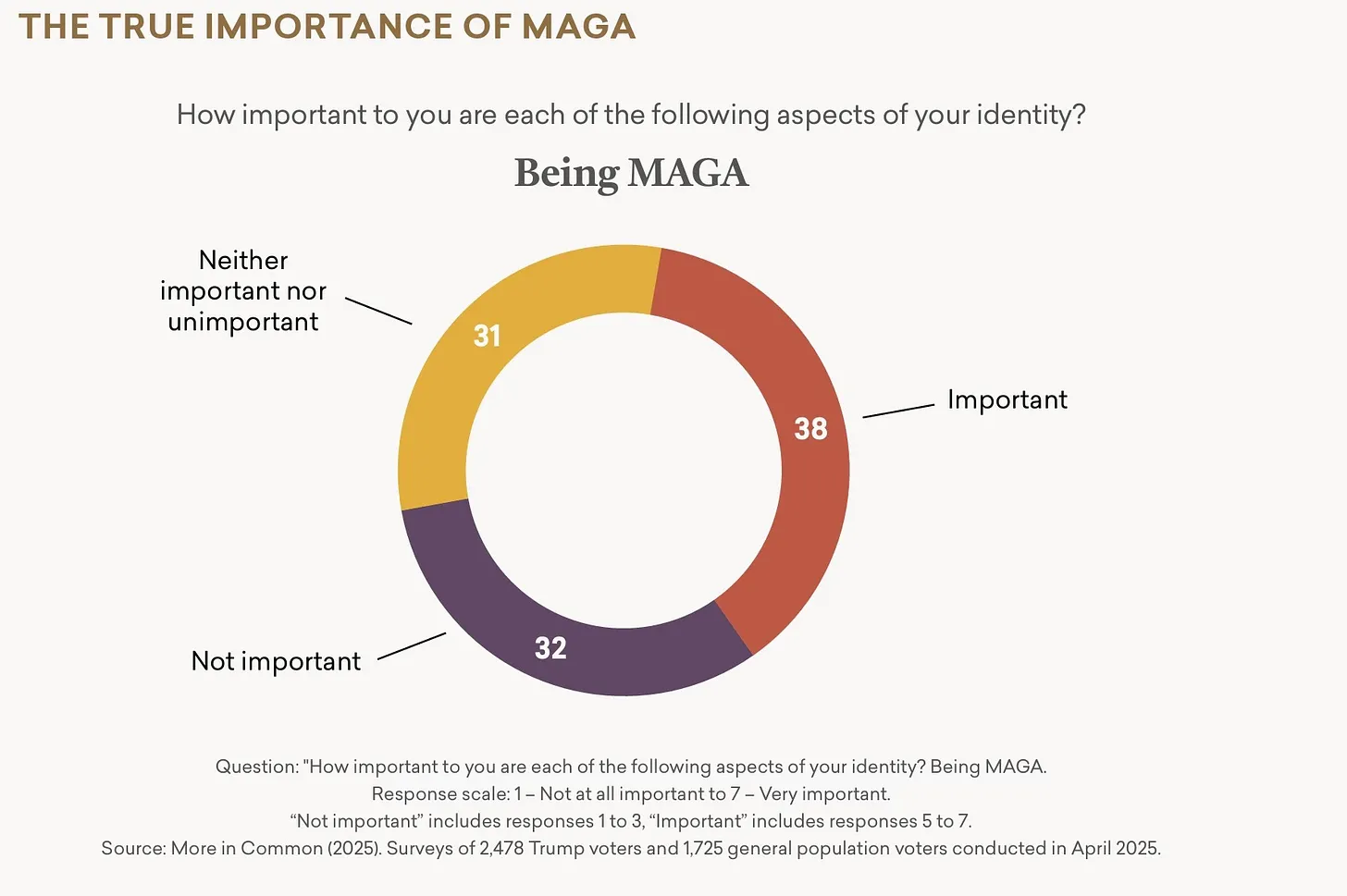
This coalition shares many concerns, from immigration to progressive overreach to American decline. But it also contains groups with distinct identities, competing priorities, and clashing worldviews. And while there is a strong core of ardent Trump supporters whose identity is wrapped up in the MAGA movement, they represent a minority:
only 38 percent of Trump voters say that being MAGA is important to them.
https://substackcdn.com/image/fetch/$s_!GU4V!,w_1456,c_limit,f_webp,q_auto:good,fl_progressive:steep/https%3A%2F%2Fsubstack-post-media.s3.amazonaws.com%2Fpublic%2Fimages%2F2833f8ea-c57c-4e0b-91a6-807cd2db5621_1156x1363.jpeg
•
MAGA Hardliners represent the fiery core of Trump’s base. They are fiercely loyal, deeply religious, and animated by a sense that America is in an existential struggle between good and evil, with God firmly on their side.
•
Anti-Woke Conservatives are relatively well-off, politically engaged, and deeply frustrated by the perceived takeover of schools, culture, and institutions by the progressive left.
•
Mainline Republicans are middle-of-the-road conservatives who play by the rules and expect others to do the same. Most do not follow politics closely. For them, Trump’s strength is that he advances familiar conservative priorities: securing the border, keeping the economy strong, and preserving a sense of cultural stability.
•
The Reluctant Right is the most ambivalent cohort of Trump’s coalition, and the group most likely to have voted for Trump transactionally: the businessman who was “less bad” than the alternative. Many feel disconnected from national politics and believe politicians do not share their priorities.
https://substackcdn.com/image/fetch/$s_!aXYa!,w_1456,c_limit,f_webp,q_auto:good,fl_progressive:steep/https%3A%2F%2Fsubstack-post-media.s3.amazonaws.com%2Fpublic%2Fimages%2F36253b49-c8f5-4c92-9533-1c6602b8b580_1780x1185.jpeg
Drawing on surveys, interviews and group conversations conducted with over 10,000 Trump voters over 10 months that concluded in early 2026, this study finds four distinct types of Trump voters: MAGA Hardliners, Anti-Woke Conservatives, Mainline Republicans, and the Reluctant Right.
When it comes to core cultural attitudes and policy issues, Trump voters express different opinions. MAGA Hardliners often hold the most extreme stances, followed by Anti-Woke Conservatives and Mainline Republicans, while the Reluctant Right typically holds the least partisan viewpoints.
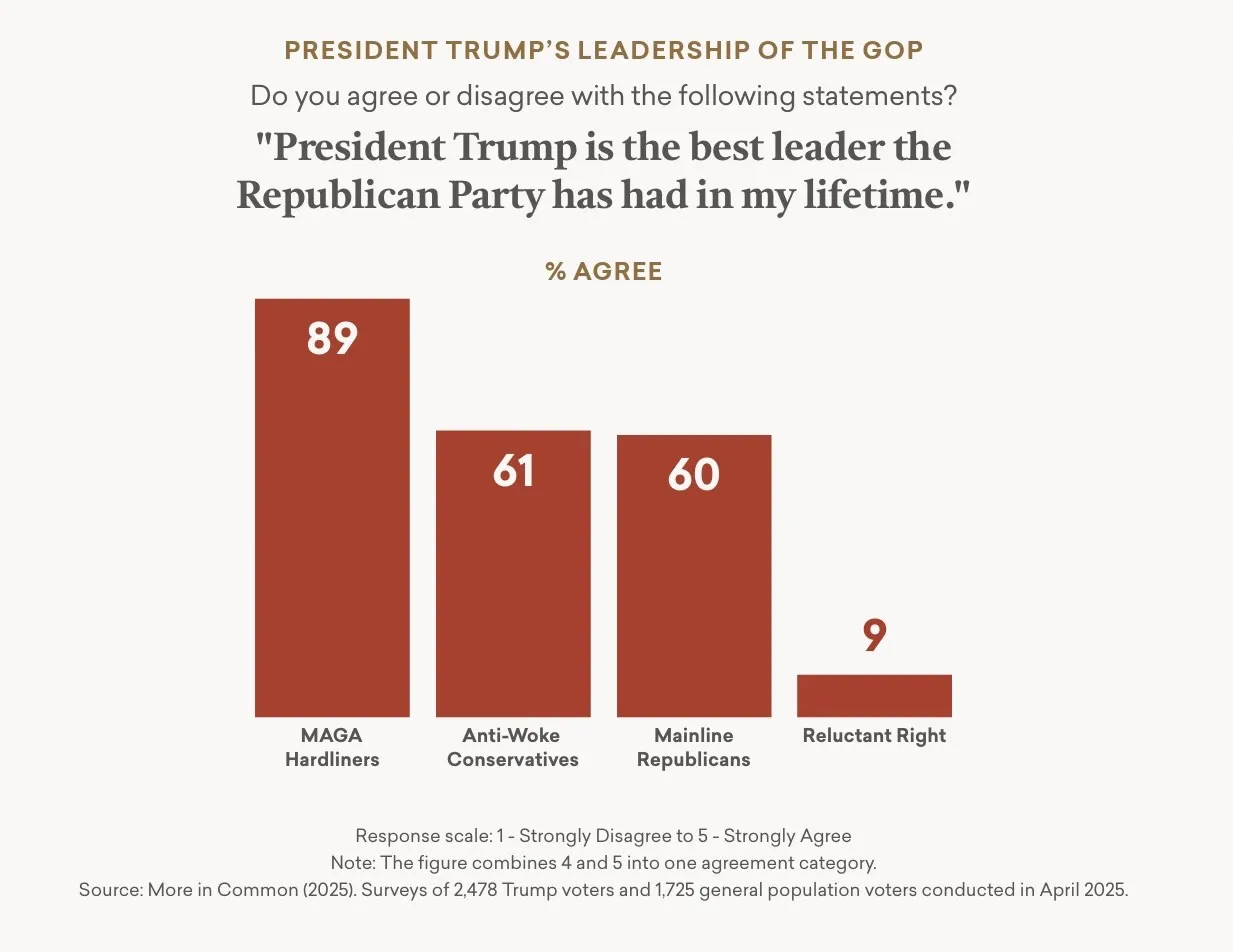
For example, 89 percent of MAGA Hardliners agree that President Trump “is the best leader the Republican Party has had in my lifetime” as compared to only 9 percent of the Reluctant Right. Anti-Woke Conservatives and Mainline Republicans fall in between, with 61 percent and 60 percent agreement respectively.
https://substackcdn.com/image/fetch/$s_!s2Lq!,w_1456,c_limit,f_webp,q_auto:good,fl_progressive:steep/https%3A%2F%2Fsubstack-post-media.s3.amazonaws.com%2Fpublic%2Fimages%2Fa9e082b6-3f1b-462e-8e84-32e5329ba7f6_1233x952.jpeg
Similarly, 62 percent of MAGA Hardliners feel that President Trump should “punish his opponents for the damage they’ve done,” versus 8 percent of the Reluctant Right. Anti-Woke Conservatives and Mainline Republicans are again in the middle, albeit with minority levels of agreement: 33 percent and 30 percent, respectively.
Finally, 62 percent of MAGA Hardliners agree that “American culture today is too feminine; it needs more masculinity,” as compared to 22 percent of the Reluctant Right. Anti-Woke Conservatives are closer to MAGA Hardliners with 54 percent agreement, while Mainline Republicans are closer to Reluctant Right with 32 percent agreement.
Beyond the conventional categories
The report offers a lens on Trump voters beyond conventional categories such as age, religious affiliation, income, race, and gender. In fact, the four voter types are often better predictors than the demographic categories typically associated with those issues.
For instance, compared to Evangelicals and “very conservative” Americans,
MAGA Hardliners are more likely to feel that the Left profoundly threatens America. Conversely, the Reluctant Right is less likely than Trump-voting college-educated women and Gen Z to feel the same way.
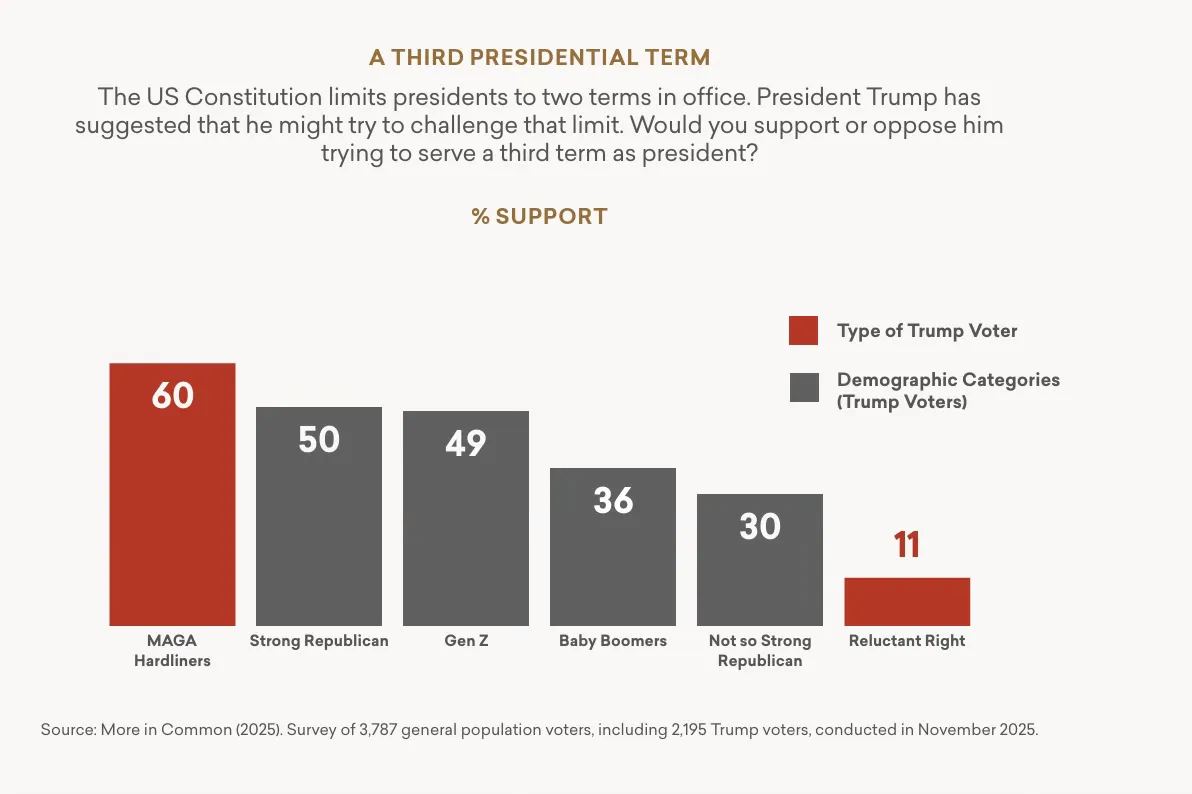
Similarly, MAGA Hardliners are more likely than “strong Republicans” and Gen Z Trump voters, including Gen Z men, to support President Trump pursuing a third term. The Reluctant Right are less than half as likely to support such a measure than even “not so strong Republicans” who voted for Trump.
https://substackcdn.com/image/fetch/$s_!trGN!,w_1456,c_limit,f_webp,q_auto:good,fl_progressive:steep/https%3A%2F%2Fsubstack-post-media.s3.amazonaws.com%2Fpublic%2Fimages%2F6fa2e398-cc76-4fc9-ac10-5437d4929439_1192x794.heic
Similarly, MAGA Hardliners are more convinced of the merits of using the military for mass deportation than are self-described “very conservative” Trump voters. By contrast, the Reluctant Right are more opposed to this policy than Hispanic Trump voters, despite the impacts of these policies on Hispanic communities.
Our segmentation can therefore be used as a sharper tool to understand Trump voters’ attitudes and values. While demographics can help explain political attitudes, More in Common’s research has consistently found that
bespoke typologies provide a more effective lens.
Much is at stake in better understanding the
77 million Americans who make up the Trump voter coalition. The coalition’s
internal differences run through nearly every major issue facing the country. Yet these divisions within the Trump voter coalition
exist alongside striking agreement: America is in crisis, the political establishment has failed, and the other side holds them in contempt. Whether the coalition endures may depend on whether these shared frustrations remain strong enough to override differences about deeply-held identities and about what lines should not be crossed.
What else do the Trump voter types tell us about our country?
Over the coming weeks, we will explore President Trump’s coalition in a multi-part series. Subsequent newsletters will focus on major thematic areas of our study:
immigration, “wokeness”, perceptions of President Trump’s leadership, and, finally, a series of trends among younger Trump voters that we refer to as
an emergent “new traditionalism.”