Thursday, October 22, 2026
Tuệ Giác Phật giáo
https://thuvienhoasen.org/a44192/lua-chon-trong-chanh-niem-tue-giac-phat-giao-truoc-lan-song-thong-tin-mua-bau-cu-ban-bien-tap
Mỗi kỳ bầu cử giữa kỳ tại Hoa Kỳ không chỉ là một sự kiện chính trị quan trọng mà còn là một "trận địa" truyền thông nảy lửa. Sự bùng nổ của trí tuệ nhân tạo, các thuật toán mạng xã hội cùng các chiến dịch thao túng thông tin đã tạo ra một ma trận "thật giả lẫn lộn". Tin giả (fake news), những video cắt ghép, những thuyết âm mưu và các phát ngôn kích động xuất hiện với mật độ dày đặc, hướng trực tiếp vào cảm xúc con người.
Đối với người Phật tử đang sinh sống tại Mỹ nói riêng và cộng đồng Phật tử theo dõi sự kiện này nói chung, bối cảnh ấy đặt ra một thách thức lớn: Làm thế nào để giữ được tâm bình an, không bị lôi kéo bởi dòng xoáy chia rẽ, đồng thời vẫn thực hiện trọn vẹn trách nhiệm công dân bằng sự sáng suốt?
Câu trả lời không nằm ở sự né tránh hay dửng dưng với thời cuộc, mà nằm ngay trong kho tàng Tuệ giác Phật giáo—những nguyên lý ứng xử đã vượt thời gian hàng ngàn năm.
1. Tự Lực Kiểm Chứng: Tinh Thần Kinh Kalama Trong Thời Đại Số
Hơn 2.500 năm trước, tại thị trấn Kesaputta, Đức Phật đã để lại cho nhân loại một "bản tuyên ngôn về tự do tư duy" nổi tiếng—Kinh Kalama (Thượng tọa Bộ, Tăng Chi Bộ Kinh). Ngài dạy các thanh niên dòng họ Kalama rằng:
“Đừng vội tin vào điều gì chỉ vì nghe tin đồn; đừng vội tin vì theo truyền thống; đừng vội tin vì số đông nói theo; và cũng đừng vội tin chỉ vì điều đó hợp với định kiến hay ước muốn của chính mình.”
Trong mùa bầu cử, các chiến dịch truyền thông thường khai thác tối đa "định kiến xác nhận" (confirmation bias)—nghĩa là con người có xu hướng tin ngay vào những thông tin chỉ trích đối thủ mà mình ghét, hoặc ca ngợi ứng cử viên mà mình thích, bất chấp tính trung thực của tin tức đó.
Thực hành tinh thần Kinh Kalama hôm nay chính là việc người Phật tử thiết lập một "bộ lọc chánh niệm":
Trầm tĩnh trước tin tức giật gân: Khi đọc một tiêu đề gây sốc hay phẫn nộ, hãy dừng lại một nhịp thở (Pause). Nhận diện rằng cảm xúc phẫn nộ đó đang bị thao túng.
Đối chiếu nhiều nguồn: Tự mình kiểm chứng thông tin qua các cơ quan báo chí trung lập, độc lập trước khi vội vã tin tưởng hoặc đưa ra kết luận.
2. Thực Hành Chánh Ngữ Và Chánh Mạng Trên Không Gian Mạng
Trong Bát Chánh Đạo, Chánh Ngữ (lời nói chân thật, hòa nhã, có ích) và Chánh Mạng (nghề nghiệp và lối sống chân chính) không chỉ giới hạn ở giao tiếp đời thực mà cần được áp dụng triệt để trên môi trường số.
Một hành động bấm nút Chia sẻ (Share), Thích (Like) hay Bình luận (Comment) trên Facebook, YouTube hay X (Twitter) trong thời đại này đều mang một năng lượng nghiệp (Kamma) rõ rệt:
Không gieo rắc sự dối trá: Việc vô tình hay cố ý chia sẻ một bài viết chưa kiểm chứng, một tin đồn thất hại chính là hành vi tiếp tay cho sự giả dối, gieo rắc sự sợ hãi và hoang mang cho cộng đồng. Đó là sự vi Pham Chánh Ngữ.
Tránh sa đà vào "Khẩu nghiệp số": Những cuộc tranh luận nảy lửa dưới các bài đăng chính trị thường nhanh chóng biến thành những lời lăng mạ, nhạo báng và công kích cá nhân. Người Phật tử cần ý thức rằng: Chiến thắng trong một cuộc cãi vã trên mạng không mang lại bình an, nhưng lời nói chứa nọc độc chắc chắn sẽ để lại vết thương cho cả người nói lẫn người nghe.
3. Nhận Diện Bản Chất "Duyên Sinh" Và Tránh Cái Bẫy Nhị Nguyên
Sự nguy hiểm lớn nhất của truyền thông bầu cử là xu hướng phân cực xã hội—chia thế giới thành hai phe đối lập tuyệt đối: "Chúng ta" (đúng, tốt, chính nghĩa) và "Họ" (sai, xấu, tà ác).
Dưới góc nhìn Duyên Sinh (Paticcasamuppada) của Phật giáo:
- Mọi hiện tượng xã hội, chính sách hay con người đều là kết quả của vô số duyên phức tạp. Không một ứng cử viên hay đảng phái nào sở hữu sự hoàn hảo tuyệt đối, và ngược lại.
- Việc rơi vào cái bẫy "nhị nguyên" (đúng - sai, tốt - xấu rạch ròi) chỉ làm tăng trưởng tâm phân biệt, sự giận dữ và lòng hận thù.
Khi nhìn đời sống bằng đôi mắt quán chiếu Duyên Sinh, người Phật tử sẽ thấu hiểu rằng: Những người có quan điểm chính trị trái ngược với chúng ta cũng đang hành động dựa trên những trải nghiệm, niềm tin và sự lo riêng của họ. Nhìn được như vậy, tâm ta tự nhiên chuyển từ phẫn nộ sang thấu hiểu và thương xót.
4. Bỏ Phiếu Bằng Bồ Đề Tâm: Sự Kết Hợp Giữa Từ Bi Và Trí Tuệ
Có quan niệm sai lầm cho rằng người tu Phật thì nên đứng ngoài các vấn đề xã hội. Tuy nhiên, lịch sử Phật giáo cho thấy Đức Phật chưa bao giờ đứng đứng ngoài sự khổ đau của quần chúng; Ngài từng nhiều lần gián tiếp hòa giải các xung đột chính trị và tư vấn cho các vị vua về cách quản trị đất nước bằng tinh thần Từ Bi và Công Chính.
Lựa chọn ứng cử viên trong kỳ bầu cử giữa kỳ là cơ hội để người Phật tử thể hiện tinh thần Bồ Tát Hạnh trong đời sống đời thường:
Lựa chọn bằng Trí Tuệ (Panna): Thay vì bị lôi cuốn bởi những khẩu hiệu hoa mỹ hay những chiến dịch bôi nhọ, hãy dành thời gian tìm hiểu kỹ chính sách thực tế của các bên về những vấn đề sát sườn: y tế, giáo dục, môi trường, an sinh xã hội, hòa bình thế giới.
Bỏ phiếu bằng Từ Bi (Karuna): Đừng chỉ hỏi "Chính sách này có lợi gì cho cá nhân tôi hay phe nhóm của tôi?", mà hãy hỏi "Quyết định này có giúp giảm bớt khổ đau cho những người yếu thế, bảo vệ môi trường sống và mang lại sự hòa hợp lâu dài cho xã hội hay không?"
5. Thiết Lập "Ranh Giới Truyền Thông" Để Bảo Vệ Tâm Bình An
Hiện tượng "kiệt sức vì tin tức" (Media Exhaustion) hay "trầm cảm vì chính trị" là có thật trong các mùa bầu cử. Sự liên tục nạp vào tâm trí những thông tin tiêu cực sẽ tiêu thụ năng lượng an lành của chúng ta.
Để giữ được định lực, người Phật tử nên chủ động thực hành "Tiết chế giác quan" (Indriya-samvara):
Ấn định thời gian tiêu thụ tin tức: Chỉ xem tin tức 1-2 lần một ngày vào những khung giờ cố định (ví dụ: 15 phút buổi sáng và buổi chiều). Tránh xa điện thoại trước khi đi ngủ và ngay sau khi thức dậy.
Trở về với Hơi thở và Thiền định: Dành thời gian quay về chăm sóc tâm mình. Nhớ rằng: Dù ai thắng hay ai thua trong cuộc bầu cử, quy luật Bất Thường (Anicca) và Nhân Quả (Kamma) vẫn là thứ duy nhất vận hành thế giới này.
Lời Kết: Ngọn Đèn Bình An Giữa Bão Tố Thông Tin
Trước ngày bầu cử giữa kỳ tại Hoa Kỳ, giữa một đại dương thông tin thật giả lẫn lộn và sóng gió phân cực, món quà quý giá nhất mà người Phật tử có thể đóng góp cho gia đình và xã hội không chỉ là tấm phiếu bầu, mà chính là sự bình an và sáng suốt của bản thân.
Bằng cách thực hành Kinh Kalama để chọn lọc thông tin, giữ gìn Chánh Ngữ trên mạng xã hội, quán chiếu Duyên Sinh để bao dung và bước vào thùng phiếu với Từ Bi & Trí Tuệ, chúng ta không chỉ làm tròn trách nhiệm của một công dân tốt, mà còn đang thắp sáng ngọn đèn Chánh pháp ngay giữa lòng đời sống đương đại.
"Này các Tỷ-kheo, hãy là hòn đảo cho chính mình, hãy là nơi tựa cậy cho chính mình, không tìm kiếm nơi tựa cậy nào khác."
— Kinh Đại Bát Niết Bàn
Ban Biên Tập


Wednesday, October 21, 2026
Meet the researchers leaving the US because of Trump’s funding cuts and politicization of science
https://apnews.com/article/trump-science-research-funding-cuts-9f4c34581f4343f316a5e72852a71b51
NEW YORK (AP) — Halley
Froehlich was sure she’d spend her scientific career in the United
States. Her family has been in America since the 1700s.
But over the past two years, delayed federal grants and fears about the future motivated her to pack her life into boxes. She moved to Finland with her husband and daughter and is continuing her research — studying how fish, shellfish and seaweed that humans eat are responding to climate change — at the University of Helsinki.
When the Trump administration began upending U.S. scientific research last year, dismantling the federal grant-giving process and attempting to exert more political influence over what projects get funded, foreign universities saw an opportunity. They adopted programs to lure U.S. researchers abroad, promising more stable streams of funding and academic freedom.
Since then, many have taken the bait. While there is no way to quantify the overall change across the nation, scientists, researchers and professional groups say the shift is clear, unprecedented and concerning.
“You can almost talk to any vice president for research at a university and they will tell you of one or two top faculty that they’ve lost,” said Tobin Smith, senior vice president of government relations and public policy for the Association of American Universities.
White House spokesperson Liz Huston said Trump is “ending waste” and is “committed to keeping America the world leader in scientific innovation, and that means funding real science.”
But more than half of American states have lost scientists to recruitment programs in other countries, according to an April report from the Business for Federal Research Funding Coalition. Last March, early-career biomedical scientists were about 20 percentage points less likely to say they would “now” stay in the U.S., compared to their recollection of how they felt six months earlier. And physics Ph.D. graduates in 2025 left the U.S. at the highest rate in 30 years, according to the American Institute of Physics.
Countries including Canada, France, Belgium and Finland are touting their recruits from U.S. institutions, a disturbing and surprising development, scientists say, for a country that far and away leads the world in Nobel prizes for medicine, physics and chemistry.
“It used to be the shining city on the hill where we all want to go,” said Christine Stawitz, now at the University of Birmingham in England. “That reputational loss, I think, is hard to quantify, but also really damaging.”
Some American scientists are moving abroad. Here’s why
Stawitz left her job at the U.S. National Oceanic and Atmospheric Administration last year to become a research software engineer in the United Kingdom. She said NOAA no longer aligned with her values, especially after she was asked to strip websites of references to climate change and diversity, equity and inclusion topics.
She says the upheaval in U.S. science is a common subject at scientific meetings. “People talk about the U.S. at conferences in the U.K. now like, I don’t know what’s going on there. It’s not good,” she said.
Froehlich’s decision to leave was a slow burn. She was already concerned about school safety and gun violence in the U.S. when the nation’s research landscape was overturned. Then, at the University of California, Santa Barbara, her colleagues’ grants kept getting postponed or canceled. Student researchers burst into her office in tears, unsure how to navigate their futures. She worried about future federal funding for her own research, which involves climate change.
“The cumulative effect of those things ultimately ended up making us really serious about, I don’t think here is our home anymore,” said Froehlich. She was recruited through an initiative by the Research Council of Finland and now has five years of guaranteed funding totaling about $3 million. She moved into a flat by the Baltic Sea in Helsinki and is taking Finnish lessons offered by the university.
And international scientists are leaving the US
International researchers who were drawn to the U.S. for its reputation as a global leader in science are also seeking different places to do their work.
Married biologists James Letts and Maria Maldonado were recruited to Australia’s Monash University and left behind their posts at the University of California, Davis. Letts is from Canada, and Maldonado from Argentina. Both got their doctoral degrees in New York and spent over a decade doing science in the U.S.
Grant-related uncertainty — including having to lay off a staff scientist while waiting for stalled funding — made them take the leap.
“All I want to do is do great science and make discoveries, but I want my work to mean something as well. And the opportunity to do that seemed very difficult in the U.S.,” Letts said.
Forty percent of the U.S. science Nobel Prizes were won by immigrants. Omar Yaghi, a 2025 Nobel Prize winner for chemistry, left his post at the University of California, Berkeley this year to direct an artificial intelligence lab at China’s Tsinghua University.
The consequences of losing scientific talent
The U.S. is still a science powerhouse, full of institutions around the country with robust research communities and well-resourced institutions that attract foreign scientists. Even if every European country threw open its doors, there still wouldn’t be enough capacity to accommodate every American scientist.
And not everyone is leaving. Many scientists are choosing to stay, searching for new sources of research funding or pivoting to jobs in industry.
But the erosion of reputation and the talent drain may not be over. The Trump administration has cut or frozen up to $174 billion in federal grants since the president’s second term began, according to a tracking tool released by the States United Democracy Center and the organization Grant Witness. And a proposed rule from the Office of Management and Budget could give political appointees more control over what future projects are funded. A resolution approved by Congress has delayed a final decision on the rule until December.
Scientists who have moved away and those still in the U.S. are worried about what’s left behind. They say the next generation of scientists may struggle with fewer graduate programs, money and mentorship — and it could take a decade or longer for the U.S. scientific enterprise to truly feel those effects.
Major research institutions accepted 15% fewer applicants for fall 2026 doctoral programs compared to last year, according to admissions data collected by the Association of American Universities. One of the students impacted was a mentee of Smith’s.
“What is one of my pieces of advice to that young man? Next year, look in Canada,” he said.
___
The Associated Press’ health and science coverage receives financial support from the AP Fund for Journalism and private foundations. AP is solely responsible for all content. Find AP’s standards for working with philanthropies, a list of supporters and funded coverage areas at AP.org.
What if an AI bubble bursts — and that accelerates AI job losses?
What if an AI bubble bursts — and that accelerates AI job losses?
October 20, 20266:30 AM ET
What if an AI bubble bursts, triggering a recession, and that recession ends up accelerating the replacement of workers with AI? Call it the AI double whammy.
I know. Dark thoughts.
I've long been skeptical of sweeping claims about how AI will transform the world. I still am. We don't really know. But as this technology advances, I've found myself worrying more about what it could mean for our livelihoods.
Two strands of economic research have given me reason to take this double whammy seriously. One concerns the history of financial bubbles. The other concerns a surprising relationship between recessions and automation, when businesses use technology to do tasks that were previously done by humans.
When revolutionary technology fuels a bubble
First, the bubbles. In 1978, the economist Charles Kindleberger published an influential book titled Manias, Panics, and Crashes: A History of Financial Crises. Drawing on the theoretical work of economist Hyman Minsky, Kindleberger went through centuries of economic history and saw a recurring pattern.
Often the bubble starts with some big potential change to the economy. A revolutionary new technology, for example, that promises to transform industries and create enormous wealth. Investors have a good reason to be excited by it. But they get overly excited. During the upswing, they bet tons of money expecting basically that the sky is the limit. And they often build up debt in the process, borrowing money to make even bigger bets and thereby helping to further fuel the boom. That debt can become a ticking time bomb. When reality sets in, asset prices fall, but those debts remain. Borrowers struggle to repay, lenders suffer losses, and a market crash can spiral into a financial crisis and a painful recession.
One crucial insight is that a technology can truly be revolutionary, yet still fuel a bubble that ends in a financial crash. For example, the railroads. I wrote about that bubble in a previous Planet Money newsletter — and how its collapse triggered "The Panic of 1873." The ensuing economic turmoil helped foment a populist uprising and the first major immigration crackdown in American history.
AI is now basically propping up the U.S. stock market. An analysis from J.P. Morgan earlier this month found that just 42 AI-related companies accounted for around two-thirds of the S&P 500's stock price gains since early 2024. Meanwhile, AI-related companies are borrowing hundreds of billions of dollars to help finance data centers and the energy infrastructure to power them.
None of this proves that what we're witnessing is a bubble or that this debt is a ticking time bomb for the financial system. The bursting of the dot-com bubble helped usher in a relatively mild recession. Debt played a smaller role in that boom, helping to limit the financial fallout. Its collapse did not trigger a systemic financial crisis like the one that followed the housing market bust around 2008.
Even without a financial crisis, though, there could be a painful reckoning. Will all these companies ultimately make enough money to justify all their borrowing and spending? Will each company survive? Technology analyst Benedict Evans has warned that fierce competition between companies offering similarly capable AI models could drive down the prices they can charge and leave little room for profit — even as they're spending ungodly amounts of money to develop and run these models.
When recessions accelerate automation
If an AI bust triggers a recession, that would be painful enough. But this is where a few studies add to my anxieties. Because they suggest that recessions can be the very moment when businesses turn to new technologies to replace workers.
We tend to imagine automation as a gradual process. Technology improves, businesses adopt it, and jobs slowly change or disappear, theoretically while new jobs appear in other parts of the economy. But this research suggests that automation can happen in bursts, and those bursts tend to cluster around recessions.
One study, by economists Nir Jaimovich and Henry Siu, found that jobs vulnerable to previous waves of automation saw most of their decline around recessions. Between 1990 and 2017, 88% of the decline in the share of Americans employed in these jobs occurred during recessions or in the months immediately before or after them.
And here's the unsettling irony: fierce price competition could keep AI companies from delivering the profits investors expect, while making their technology cheaper for other businesses to use to replace workers. If an AI bust triggers a recession, that downturn could accelerate worker replacement. Investors could lose their money, and workers could still lose their jobs.
It's a nightmare scenario. First, the bust hammers our retirement savings. Then, as businesses scramble to cut costs, many of our jobs are permanently lost.
Of course, we still don't know whether AI will deliver enough profits to justify all the borrowing and spending, whether a bust would trigger a painful recession, or whether the automation patterns found in past recessions will repeat themselves with AI. A downturn could leave businesses with less money to invest in AI. And AI could still prove more useful for helping workers get more productive than outright replacing them.
Whether AI delivers one whammy or two whammies or none, there are policies that can limit the damage when workers lose their jobs. Obviously, unemployment insurance and other policies like that. And people like Bill Gates are proposing that we should tax AI and robots, making it more economical to continue employing humans while generating revenue that the government can spend to enhance the safety net. That idea is something we might explore in a future newsletter.
So, yeah, there are reasons this nightmare might never come true, and there are ways to limit the damage if it does. That, however, hasn't stopped me from worrying about it.
But it felt cathartic writing this down — getting these worries out of my head and onto the page.
LIVE VIRTUAL EVENT FOR NPR+ SUPPORTERS
Wondering what AI could mean for your livelihood? Join Adrian Ma from The
Indicator from Planet Money on Wednesday, October 28, for a virtual
"Ask an Economist" event about AI and jobs. It will feature Daron
Acemoglu, a Nobel Prize-winning professor at MIT, and Erik Brynjolfsson, a
professor at Stanford and director of the Stanford Digital Economy Lab. During
the event, we'll invite you to share your thoughts and ask questions! This is
for our NPR+ supporters, join here, and find more details on the event here.
P.S. Charles Kindleberger's life was super fascinating. As we've written before, he worked for the CIA's wartime predecessor and helped design the Marshall Plan. Someone should probably make a Hollywood movie about him.
Tuesday, October 20, 2026
‘Cung điện bông gòn’ Pamukkale, Thổ Nhĩ Kỳ
https://www.nguoi-viet.com/doi-song/du-lich/cung-dien-bong-gon-pamukkale-tho-nhi-ky/
‘Cung điện bông gòn’ Pamukkale, Thổ Nhĩ Kỳ
October 16, 2026 : 5:31 AM
Modified date: October 15, 2026 : 7:32 PM
Trần Nguyên Thắng/ATNT Tours & Travel
Thổ Nhĩ Kỳ là một quốc gia nằm bên cạnh biển Địa Trung Hải và Hắc Hải, có một phần nhỏ lãnh thổ thuộc về Âu Châu và một phần lớn thuộc về Á Châu. Đây là một đất nước có một vị trí chiến lược hết sức quan trọng cho hai lục địa Âu-Á và rất đa dạng về mọi mặt, từ tài nguyên cho đến văn hóa, di tích lịch sử Thiên Chúa Giáo, Hồi Giáo, và có nhiều thắng cảnh thiên nhiên nổi tiếng trên thế giới. Những điều này đã hấp dẫn và thu hút du khách khắp thế giới đến thăm Thổ Nhĩ Kỳ, vùng đất của một thời là cái nôi của đế quốc Hồi Giáo Ottoman.
https://cdn-ilfafjj.nitrocdn.com/iaFmIEecBEIHoOqpbmYONXKDUaaaCNzU/assets/images/optimized/rev-1025a6c/www.nguoi-viet.com/wp-content/uploads/2026/10/DL-Pamukkale-1.jpg
Eo biển Bosphorus nơi phân chia lục địa Âu-Á tại Istanbul. (Hình: ATNT Tours & Travel)
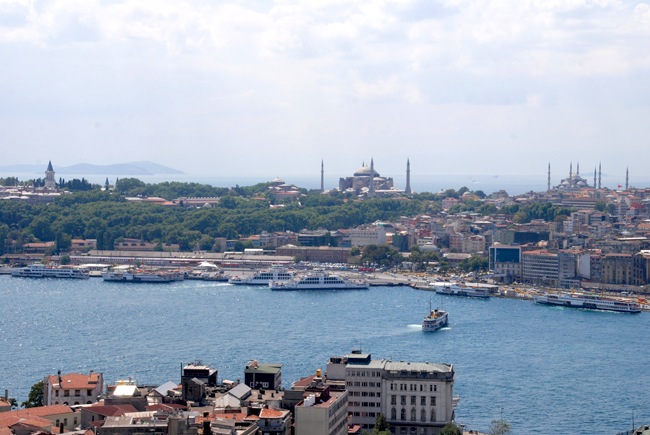
Về thành phố lịch sử nổi tiếng trên thế giới phải kể đến thành phố Constantinople (tức là Istanbul ngày nay), được chọn làm kinh đô của Thổ Nhĩ Kỳ trong nhiều thế kỷ. Cho đến 1923, thủ đô của xứ này đã được dời về Ankara, một thành phố non trẻ so với lịch sử lâu đời của Thổ. Tuy nhiên, không vì thế mà Istanbul mất đi vị thế lịch sử của mình. Istanbul vẫn giữ một vai trò rất quan trọng trên bình diện chính trị, vị trí chiến lược, thương mại, kinh tế và du lịch. Người ta có thể không đến thủ đô Ankara, nhưng đã đến Thổ Nhĩ Kỳ mà không đến Istanbul thì xem như chúng ta chưa biết gì về đất nước Thổ Nhĩ Kỳ.
Về chiến tranh Thổ, nổi tiếng trên thế giới phải kể đến các trận chiến như con ngựa thành Troy thời cổ đại và trận Gallipoli vào đầu thế kỷ 20 đã làm lu mờ hình ảnh của đế quốc Anh. Nhưng về thắng cảnh thiên nhiên thì không thể bỏ qua những địa danh như “Cung điện bông gòn” Pamukkale, và Cappadocia mà tạo hóa đã ban cho đất nước Thổ Nhĩ Kỳ. Ngược dòng lịch sử đế quốc La Mã, một trong những thắng cảnh thiên nhiên phải nói đến là thắng cảnh Pamukkale. Đây là một khu vực suối nước nóng đã được các vua chúa La Mã thời đó tận dụng biến thành một khu đô thị “Hierapolis” để làm nơi nghỉ ngơi, dưỡng bệnh cho giới quan quyền quí tộc. Vùng này nằm về phía Tây Nam Thổ Nhĩ Kỳ, nơi mà ngày nay được mệnh danh là Pamukkale của xứ Thổ.
Trong ngôn ngữ Turkey, “Pamukkale” có nghĩa là “cung điện bông gòn trắng,” một vùng đồi núi cách xa thành phố biển Kusadasi khoảng hơn hai tiếng xe. Từ xa nhìn về vùng Pamukkale ai cũng tưởng đó là một ngọn đồi tuyết phủ trắng in trên triền núi bao quanh trông như một cung điện nguy nga trắng toát, càng đến gần Pamukkale ai cũng tin chắc đó là những ngọn núi tuyết phủ.
https://cdn-ilfafjj.nitrocdn.com/iaFmIEecBEIHoOqpbmYONXKDUaaaCNzU/assets/images/optimized/rev-1025a6c/www.nguoi-viet.com/wp-content/uploads/2026/10/DL-Pamukkale-2.jpg
“Cung điện bông gòn” Pamukkale nhìn từ xa. (Hình: ATNT Tours & Travel)
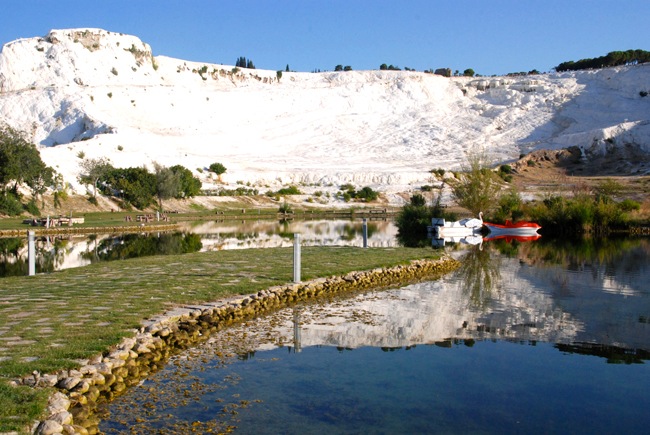
Tuy nhiên, phải đến tận nơi, đặt chân xuống mặt đất mọi người mới biết đó không phải là tuyết. Đó là một loại hỗn hợp khoáng chất và nước tạo thành một “chất màu trắng” đặc biệt phủ khắp lên trên đồi núi tại khu vực này. Hình ảnh cả một vùng đồi núi trắng toát, cong lượn theo hình dáng núi tạo cho du khách có cảm giác như những tảng “bông gòn” phủ trên các đỉnh đồi. Tuyệt diệu hơn nữa là các “hình ảnh tuyết trắng” in hình xuống mặt hồ gương trước chân đồi càng làm tăng nét tuyện mỹ của “cung điện bông gòn Pamukkale.”
Pamukkale là một ngọn đồi khá cao thuộc khu vực núi lửa, khoảng 200 m so với mặt biển và ngày nay được công nhận là một trong những công viên quốc gia nổi tiếng của Thổ Nhĩ Kỳ. Một sự ngẫu nhiên Pamukkale nằm trên một vùng đất đặc biệt có chứa nhiều khoáng chất calcium bicarbonate (CaCO3) và may mắn thay, có một dòng suối nước nóng chảy qua. Khi chảy qua vùng đất này, hai yếu tố đó gặp phải luồng không khí mát lạnh nên đã phân giải ra Nước (H2O), carbondioxide (CO2) và calcium carbonate (Ca). Phản ứng hóa học này vô tình đã tạo ra một thắng cảnh thiên nhiên trắng toát tuyệt vời cho vùng Pamukkale. Những thềm hồ nước xếp theo hàng trên dưới, những khoang trũng tạo ra những hồ nhỏ bên triền núi, những vùng đất trắng toát và sốp như bông gòn nằm thành một chuỗi đất dài hơn 2.5 km, bề ngang rộng hơn 600 m. Điều này đã biến vùng đất thiên nhiên Pamukkale thành một thắng cảnh rất đẹp, hấp dẫn và thu hút du khách thế giới đến đây thưởng ngoạn.
https://cdn-ilfafjj.nitrocdn.com/iaFmIEecBEIHoOqpbmYONXKDUaaaCNzU/assets/images/optimized/rev-1025a6c/www.nguoi-viet.com/wp-content/uploads/2026/10/DL-Pamukkale-3.jpg
Pamukkale Town nhìn từ đỉnh Pamukkale. (Hình: ATNT Tours & Travel)
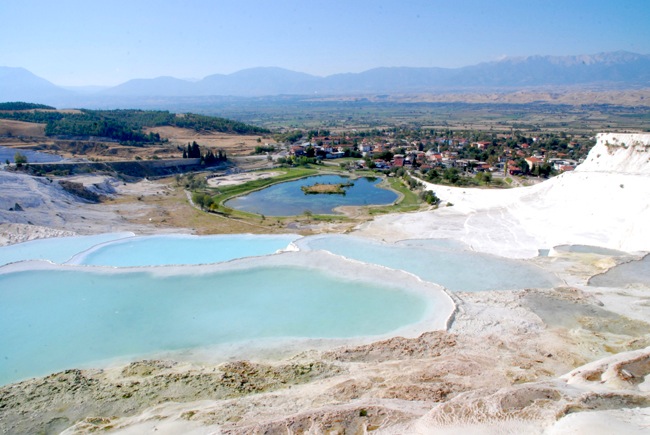
Những ai đã có dịp đến Mammoth Hot Spring của Yellowstone bên tiểu bang Wyoming đều đã có dịp thưởng ngoạn cảnh đẹp nơi đây. Nhưng Mammoth Hot Spring hãy còn nhường nhiều bước trước Pamukkale.
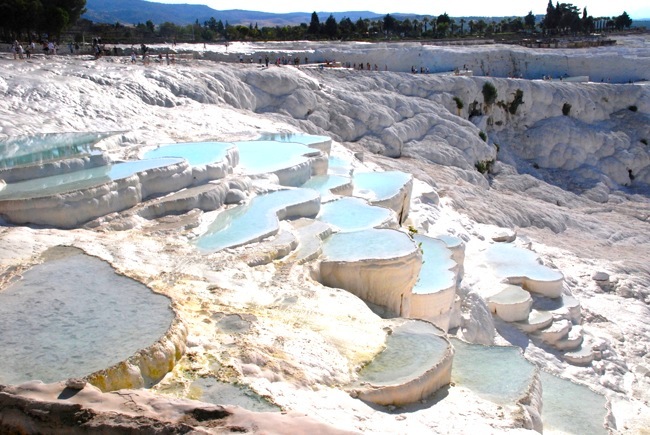
Nhiều du khách đến Pamukkale nghỉ ngơi vì họ tin rằng những khoáng chất của các ngọn suối ôn tuyền có thể giúp cho họ thêm sức khỏe và yêu đời hơn. Hơn nữa, đến đây du khách chưa một ai mà không đứng ngây người với không gian thiên nhiên lạ lùng trước mắt. Cả một vùng đồi trắng tinh, từng khoanh hồ lớn đọng nước màu xanh lam nhạt xếp chồng lên nhau tạo thành từng bậc thềm hồ cao thấp nối tiếp nhau, trải dài xuống thung lũng tạo thành một không gian trắng toát xen lẫn với từng khoanh hồ xanh và những “thạch nhũ” lơ lửng rũ xuống như những dòng tuyết chảy. Du khách có thể bước xuống ngâm chân, có người ngâm cả người vào hồ để tìm cảm giác khác lạ ở không gian “tuyết trắng.” Đây là những hình ảnh khó quên nhất của Pamukkale.
https://cdn-ilfafjj.nitrocdn.com/iaFmIEecBEIHoOqpbmYONXKDUaaaCNzU/assets/images/optimized/rev-1025a6c/www.nguoi-viet.com/wp-content/uploads/2026/10/DL-Pamukkale-4.jpg
“Các khoanh hồ nước nóng” bậc thềm nối tiếp nhau. (Hình: ATNT Tours & Travel)
Không phải đến thế kỷ này người ta mới biết về suối nước nóng Pamukkale. Người La Mã đã biết về nó suốt hơn 2,000 năm trước. Không phải do sự ngẫu nhiên mà thành phố cổ Hierapolis được xây dựng trên đỉnh đồi Pamukkale. Vào thế kỷ thứ 2 trước Công Nguyên, nhà vua Attalos II của xứ Pergamon sau khi chiến thắng kẻ địch đã cho xây các đền thờ ở đây và nơi đây được xem như là Thánh địa của xứ này thời đó. Sau đó, vua Eumenes cho đổi tên lại thành Hierapolis (thành phố của Hiera, tên hoàng hậu của Telephos, truyền thuyết cho là một vị vua sáng lập ra xứ Pergamon. Di tích Pergamon vẫn còn tồn tại về phía nam thành Troy và đây cũng là một trong những trọng điểm du lịch dành cho du khách thích thú tìm hiểu về nền văn hóa cổ Hy Lạp).
Nhưng một trong những lý do chính yếu để xây dựng Hierapolis là vì những nguồn suối nuớc nóng khoáng chất chảy qua đây. Những di tích còn để lại của Hierapolis là những khu phòng tắm, những nơi nghỉ ngơi dưỡng bệnh của những vua chúa và các nhà quý tộc. Người ngày xưa không biết sự cấu thành của các khoáng chất nên họ cho là nước của thần Heracles, thần của suối nước nóng và sức khoẻ. Người ta tin rằng không có gì tốt hơn là về ở gần thần để thần gìn giữ và bảo vệ sức khỏe cho mình là bảo đảm nhất. Đó cũng là lý do chính yếu (lợi dụng lòng tin thần thánh của tín đồ) mà các y sĩ ngày xưa đã chọn Hierapolis là trung tâm chữa trị và dưỡng bệnh cho các bệnh nhân.
https://cdn-ilfafjj.nitrocdn.com/iaFmIEecBEIHoOqpbmYONXKDUaaaCNzU/assets/images/optimized/rev-1025a6c/www.nguoi-viet.com/wp-content/uploads/2026/10/DL-Pamukkale-5.jpg
“Khuôn mặt trũng hồ” Pamukkale. (Hình: ATNT Tours & Travel)
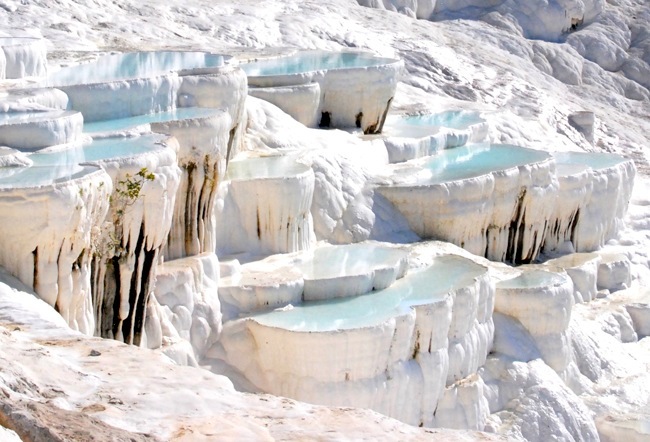
Nhưng Pamukkale không chỉ là một thắng cảnh thiên nhiên mà còn là một di tích cổ đáng xem cho những ai lưu tâm đến lịch sử. Chỉ duy nhất là “nhà hát Hierapolis lộ thiên” là còn được bảo tồn khá tốt. Nhà hát ngoài trời này được kiến trúc xây theo hình bán nguyệt, có khoảng 45 tầng ghế. Thành phố Hierapolis cổ cũng đang được trùng tu lại để du khách có thể có cái nhìn rõ ràng hơn về một di tích đã bị thời gian và động đất vùi dập. Từ năm 1988, Pamukkale và Hierapolis được UNESCO thừa nhận là di sản thế giới. Hiện tại, Pamukkale trở thành một trung tâm du lịch nổi tiếng của Thổ Nhĩ Kỳ. Nhiều hotel được xây dựng với các dòng suối nước nóng khoáng chất để du khách có thể ngâm mình nghỉ ngơi dưỡng sức.
Thổ Nhĩ Kỳ là một đất nước rộng lớn gần 800,000 cây số vuông (5% thuộc về Âu Châu và 95% thuộc về Asia Minor) với nhiều thắng cảnh tuyệt đẹp mà tạo hóa ưu đãi. Các ảnh hưởng văn hóa kiến trúc Hy Lạp-La Mã-Byzantine-Ả Rập đã để lại đây những di tích vô cùng quý giá như thành Troy, Pergamon, Ephasus, Cappadocia.
https://cdn-ilfafjj.nitrocdn.com/iaFmIEecBEIHoOqpbmYONXKDUaaaCNzU/assets/images/optimized/rev-1025a6c/www.nguoi-viet.com/wp-content/uploads/2026/10/DL-Pamukkale-6.jpg
Di tích cổng chính Hierapolis. (Hình: ATNT Tours & Travel)
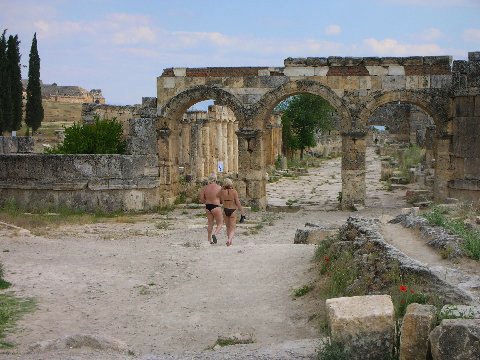
Trong số các nước mà đa số dân theo Hồi Giáo, có lẽ Thổ Nhĩ Kỳ là một đất nước mà tôi cho là ôn hòa và có một nền dân trí cao. Ngươì dân Thổ Nhĩ Kỳ mang ơn ông Mustafa Kemal, người đã tạo dựng ra nước Cộng Hòa Thổ Nhĩ Kỳ (Turkish Republic) vào năm 1923, người đã đủ uy tín và can đảm tách thần quyền Hồi Giáo ra khỏi chính quyền, luật pháp công lý thay thế kinh Koran, người đã tạo ra thế đứng vững vàng cho Thổ Nhĩ Kỳ ngày nay. Chúng ta đang sống trong một xã hội có nhiều thành kiến với các đất nước Hồi Giáo, làm sao có thể vơi bớt đi các thành kiến này nếu chúng ta không thực sự một lần nhìn thấy tận mắt. Các nhóm Hồi Giáo cực đoan đã bôi xấu đi hình ảnh Hồi Giáo khá nhiều. Một con sâu làm rầu nồi canh. Vớt bỏ con sâu đi, người ta sẽ thấy nồi canh vẫn ngon ngọt như tất cả các nồi canh khác.
Thổ Nhĩ Kỳ là đất nước không thể thiếu trong thế giới du lịch của người du khách sành điệu của thế kỷ. [hp]
Subscribe to:
Posts (Atom)