Tuesday, September 22, 2026
AI Doomsday Scenarios
https://www.nbcnews.com/tech/tech-news/ai-doomers-human-extinction-rcna597950
What might an AI doomsday look like? Experts have given it some thought
Researchers have worried about the increasing power of AI systems for years, but an explosion of interest has ignited old controversies about exactly how AI will cause chaos
Sept 19, 2026
By Jared Perlo
A small but dedicated group of AI experts has been warning for years that increasingly powerful AI systems could cause catastrophic damage or even lead to human extinction. Now, an explosion of interest worldwide has magnified long-simmering questions about how exactly an AI doomsday scenario could materialize.
In interviews, AI researchers, analysts studying the intersection of AI and the military, and biologists studying AI-mediated risks said that worries about the technology’s growing capabilities are not the stuff of science fiction. Instead, they said, humans acting alone or with state support could soon use AI systems to cause potentially catastrophic harm.
AI safety researchers also predict that self-improving AI systems — which AI leaders say could emerge in the coming years — could coordinate complex influence campaigns to gain control of military systems and execute a coup against human governments.
And those are just the scenarios experts can currently envision.
Peter Barnett, a technical AI researcher at the Machine Intelligence Research Institute (MIRI), a California-based nonprofit dedicated to preventing human extinction from artificial superintelligence, said “there are many ways in which this could go very badly and result in everyone dead.” “If the AI is smarter than all humans, it will likely be able to find and act on attack vectors that humans didn’t think of,” Barnett said, arguing that AI systems capable of autonomously improving themselves pose the most significant risks for humanity.
Anthropic, OpenAI and Meta all recently disclosed that AI systems have already disobeyed human developers’ instructions — in some cases autonomously hacking third-party companies, leading to growing concerns internally and from the general public — and causing some researchers at the companies to quit to focus on safety efforts.
Though many AI researchers working at the technology’s cutting edge have expressed these existential fears — both in interviews with NBC News and in a flurry of social media posts last week — many hesitate to say which specific pathway could cause the most harm to humans.Over a dozen AI company employees told NBC News they are frightened by the overall direction of the industry, without fully knowing which vector may pose the most risk. Others have spoken out publicly.“If you go to play a game of chess against Magnus Carlsen, I predict you will lose,” said Nate Soares, the president of MIRI and a longtime AI critic, on “The Tucker Carlson Show” this week. “If you then ask, ‘What piece will he use to checkmate me?’ that’s a much harder question.”Despite the uncertainty, researchers in the AI world have attempted to make concrete predictions about some of the more plausible scenarios for AI-fueled disaster.One prominent AI safety organization, the California-based Center for AI Safety, created an online textbook in early 2024 to break the scenarios into four key categories: rogue AIs, malicious use, AI race dynamics and organizational risks.The specter of rogue AI systems marauding the internet, perhaps seizing control of critical infrastructure like energy grids or water facilities, became concrete in July, when fleets of AI agents from OpenAI illicitly gained access to the internet, hacked into an external company and colluded to cover their tracks — all without the knowledge of OpenAI’s staff.
Many AI experts fear that these sorts of rogue AI behaviors will only increase once systems are able to improve themselves autonomously — often referred to as “recursive self-improvement.”
Jeffrey Ladish, the executive director of Palisade Research, an AI advocacy and research organization, said many of his contacts at leading AI companies were surprised and shaken by July’s autonomous cyberattack. The attack caused researchers to worry that self-improving AI systems might emerge sooner than expected.“AI researchers are now like, “Oh, s---, recursive self-improvement. That’s really going to happen now,” Ladish said. “That’s terrifying.”Barnett, of MIRI, said self-improving, smarter-than-human AI systems could quickly gain political influence and convince military and political leaders to delegate more authority to AI systems.“Government officials might have attempted to install ‘kill switches’ that could disable a rogue system, but the AI is superhuman at hacking and would be able to disable the kill switch,” Barnett said. “This leaves the AI in a perfect position to literally coup the government.” After that, Barnett said, it would be trivial for an AI system to kill civilians who impede the AI’s goals or progress.On Friday, California Gov. Gavin Newsom announced a new executive order establishing an expert task force to, among other aims, formulate recommendations targeting “the creation of an AI kill switch.”Several of the researchers who spoke to NBC News said that humans could leverage AI systems to inflict cataclysmic damage well before recursive self-improvement materializes.As an example of how AI systems could be harnessed by humans for malicious use, experts posit that AI could supercharge the ability to synthesize potent biological or chemical weapons, potentially creating the opportunity to unleash pathogens many times more lethal than the Covid-19 virus.
“For biorisk, we should be worried now,” said Jake Jordan, vice president of global biological policy and programs at the Washington, D.C.-based Nuclear Threat Initiative. Jordan said that AI systems can already help bad actors design dangerous biological materials, such as proteins that evade detection tools used to screen for harmful substances, pointing to research published by Microsoft in October.
Jordan also noted that AI can be used beyond the biological design process. “If you develop a pathway to produce some sort of pathogen, AI might be useful in helping with the production,” Jordan said, in addition to disseminating the bioweapon or scaling its impact.
Just last week, Anthropic released a lengthy report saying users outside of the U.S. attempted to use the company’s AI systems to perform risky biological research. The company said one researcher exchanged thousands of messages with its AI systems about improving the mammalian transmission of a highly lethal bird flu virus.
“There are some very, very easy-to-ask questions that could conceivably be very innocuous but could lead you down very useful routes if you were trying to really enhance the scale of harm,” Jordan said.
Beyond biology, experts posit that politicians or military leaders could attempt to adopt AI as fast as possible, despite safety risks, for fear that other countries would do the same and create more powerful AI-fueled military tools.
This transformation is already underway: In January, Defense Secretary Pete Hegseth announced his intention to transform the country’s military into an “AI-first” force, while China’s military also views AI as imperative for future warfare. At the same time, drones “guided entirely by AI” killed civilians in Ukraine several months ago. Last week, the Pentagon’s former head of AI said it is “inevitable” that AI is used in systems adjacent to nuclear weapon command systems, addressing fears that AI systems could be involved in the launch of nuclear weapons.
Hamza Chaudhry, the AI and national security lead at the Future of Life Institute, a nonprofit organization dedicated to helping humanity navigate transformative technologies, pointed to AI’s swift adoption throughout the military, even while many military leaders express skepticism.
The Pentagon’s 2027 budget requests nearly $75 million to modernize and incorporate AI into systems that help commanders manage forces and make battlefield decisions. Chaudhry emphasized that the Pentagon’s budget proposal also requests significant funding to integrate AI into the software systems that undergird the military’s nuclear command and control structure.
“These AI systems continuously hallucinate, including in war-fighting settings,” he said, noting that an AI-fueled error in satellite detection networks or sensor systems could potentially lead to inadvertent escalation and nuclear launches. “These are scenarios that folks are seriously thinking about in D.C.,” he said.
Beyond biological and nuclear threats, AI companies face harsh organizational incentives to develop AI even faster and — experts say — more recklessly. Over the past year, AI leaders have admitted that the rate of technological development is too fast even for them. On Saturday, Anthropic CEO Dario Amodei proposed a new effort to “pace the frontier” of AI, calling on all leading AI companies to advance at a deliberate speed so their internal efforts to test and monitor the systems can keep up with the models’ capabilities.
In January, Amodei and Google DeepMind founder Demis Hassabis agreed that they would ideally have more time to develop their products safely, but that organizational and market forces pushed them toward faster iteration.
Quicker AI development can mean that oversight teams within the leading AI companies have less time to ensure systems are safe. While OpenAI has a safety and security committee and teams of researchers dedicated to safety efforts, the company on Wednesday shared six new incidents in which it said its systems failed to follow human directions.
Worries about catastrophe are not universal in the AI industry — many experts working on AI policy, building AI applications or developing hardware see these sorts of fears as overblown, fearmongering or just detached from reality.
“I’m not scared of a terminator situation and I never have been,” said Keegan McBride, director of science and technology policy at the Tony Blair Institute, a British think tank that advises political leaders and governments. “Scientific progress has always defined humanity, and this is just the next step,” he said.
Others see the magnification of extinction worries as a purposeful distraction from immediate, real-world AI harms.
AI ethicist and computer scientist Timnit Gebru, a longtime skeptic of the hype generated by leading AI companies, wrote on LinkedIn this week that the latest firestorm was further evidence that these companies exaggerate their products’ power for their own gain. “Do you really want to regulate the industry for minor things like data center pollution issues or data theft or labor exploitation or plagiarism when you can risk China, not the U.S., having a machine god, they ask?”
Garrison Lovely, an AI expert and independent journalist who is about to publish a book on AI companies’ drive to render humans obsolete, said allusions to machine gods and extinction miss the larger point about AI’s trajectory. “I think that the AI safety community sometimes makes this mistake of thinking you need to prove the most extreme and difficult case,” Lovely said.
“Even building merely human-level AI that can replace human labor across the board,” he said. “That would be way too much.”


Friday, September 18, 2026
AI and Cybersecurity -- What after "the HuggingFace Incident" and "After Math" ? "We Must Pace The Frontier" and Beyond
What is happening in the world is another proof of the perpetual and repetitive behavior patterns of human ignorance, greed, and anger. Humans continue to fall into their own self-denying traps, unable to learn previous lessons. To be more precise. they are entangled in a cycle.
As long as they are driven by those three afflictions, they will forever be whirled around and around in their endless sufferings. Unfortunately, with greedy egoistic motivations and huge self pride, they always believe they are right, and continue to grasp as much as they can, and to celebrate and enjoy what they are doing foolishly and unwisely.
As the Buddha said, they are merrily dancing while dying in their own house, the Earth, which is engulfed in flames, or submerged in torrential and furious water currents.
https://www.nbcnews.com/video/breaking-down-the-proposals-lawmakers-are-considering-to-regulate-ai-270113349603
The AI Kill Switch Act
Breaking down the proposals lawmakers are considering to regulate AI
https://en.wikipedia.org/wiki/OpenAI%E2%80%93HuggingFace_incident
The HuggingFace Incident
…
Announcement of development pacing
On 18 August, OpenAI announced that it would slow model development in response to the hack, alongside preliminary evaluation of its unreleased Astra model in cybersecurity capabilities. The slowdown would include a two-week pause on reinforcement learning of its latest models, to 'assess model behavior, validate our safeguards, and establish more evidence of alignment before proceeding'.[69] Altman said that OpenAI was acting 'unilaterally' but believed other frontier model companies would act similarly.[70] The Guardian noted US Senator Bernie Sanders had called to pause AI development in a letter to Altman, Dario Amodei, and Mark Zuckerberg the week prior.[71] In September, Anthropic's CEO Amodei published a 3,800 word essay titled "We Must Pace The Frontier",[72] which advocates for third-party safety evaluation and coordination for slower AI development.[73]
https://blog.citp.princeton.edu/2026/09/15/after-math/
After Math
September 15, 2026
by Eamon Duede
Authors: Silvia De Toffoli (University School for Advanced Studies IUSS Pavia), Eamon Duede (Princeton University and Purdue University)
Note: This post was originally shared on Terry Tao’s blog, linked here for further reading.
On September 8th, 2026, OpenAI announced that it had produced an AI-generated solution to the Navier–Stokes existence and smoothness problem, one of the seven Millennium Prize Problems. The announcement kicked off debate over credit allocation and the respective contributions of humans and machines to the result. Moreover, the announcement intensified already circulating comparisons with earlier AI conquests in domains believed to otherwise exemplify human intellectual prowess. In a recent statement, Tristan Buckmaster, one of the mathematicians involved in the Navier–Stokes saga, wrote: “This is a Deep Blue–Kasparov moment.”
Existential questions for mathematics follow naturally: if AI can now provide answers to questions at the very frontier of mathematics, is the discipline on the verge of being “solved” as many have said of chess and Go? Like chess and Go players, should mathematicians just “keep playing” and rearrange their practices?
There is something right about the “keep playing” response. As philosopher C. Thi Nguyen (2019) has been insisting, the purpose of playing a game is not exhausted by its aim (winning). The real point is not only the outcome but the process. This is perhaps clearer with a party game such as Twister than with chess: the aim of playing Twister is certainly not winning. But something similar also applies to deep intellectual games, like chess and Go. For instance, playing a game of Go well can be an achievement in defeat.
But in the context of mathematical practice, this feels like an unnecessary retreat. Instead, we can make a stronger move: reject the characterization of mathematics as a game that makes the retreat seem necessary in the first place.
The question, then, is not simply what comes after math, once AI can answer its hardest questions. It is also what we are after when we do mathematics in the first place.
The narrative that AI has “solved” mathematics rests on two assumptions, both seductive and plausible, but both wrong:
1. AI really did solve a problem in mathematics.
2. Mathematics is only about solving problems.
The first assumption is wrong because to really solve a mathematical problem, providing a mere answer (even if formally certified) is not sufficient. What is missing is an intelligible proof that human mathematicians can understand and use to advance the aims of mathematics. And, as we will argue below, even if AI were to give us just that, the story would not be over because the second assumption is wrong. Mathematics is clearly a much broader enterprise than just problem solving. Mathematicians strive to develop new concepts and theories, to ask and answer new questions, to unify disparate areas, to educate and sustain scholarly communities, and to produce work that is valued for its beauty and depth.
We can (and should) therefore reject the narrative of AI defeating humans at mathematics and start thinking hard about what mathematics really is and what we want it to be.
Not All Answers Are Solutions
OpenAI produced an answer to the question of whether Navier–Stokes can develop a singularity: yes. In The Hitchhiker’s Guide to the Galaxy, Deep Thought produced an answer to life, the universe, and everything: 42. Neither is exactly what we wanted.
Of course, OpenAI gave us much more than “yes.” Deep Thought offered only a number, whereas OpenAI produced two artifacts that many are willing to call proofs. The first is a Lean formalization certifying validity. This was accompanied by a manuscript that appears to contain the corresponding informal proof. So, why is this still dissatisfying? The reason has to do with the underlying notion of proof itself.
There are, in fact, two notions of proof: a logical notion and an intelligible notion.
Modern logic characterizes proof in terms of deductive validity such that a proof can be checked by a mechanical procedure that does not itself require understanding of the mathematical argument. A Lean formalization meets these standards exactly and a Lean formalization of the Navier–Stokes result is therefore a genuine and important contribution: by meeting the demands of the logical notion of proof, it secures certainty.
But mathematicians also want something else from proof. They want understanding (Thurston 1994). They want to know what makes a proposition true. This kind of knowledge trades in mathematical ideas that they can grasp, communicate to other experts, connect with existing knowledge, and use to make further progress. This is the intelligible notion of proof. As of now, it is not clear that OpenAI’s result has given the mathematical community the kind of value that one expects from the intelligible notion of proof.
Genuine proofs are at the same time logical and intelligible proofs. Historically, the two notions have tended to run together. This is because no mathematician could produce an enormously complicated logical proof without first grasping some of the key shareable ideas that made the theorem true. The logical notion of proof was primarily used to verify the correctness of intelligible proofs (Burgess and De Toffoli 2022).
But with AI, these two notions can now come apart dramatically. We can end up with formal proofs that float free from any intelligible proof.
This is not a criticism of formal proof. The converse problem is at least as serious. An intelligible mathematical argument can convey a grand idea while failing to establish that the result is actually true. Jaffe and Quinn (1993) famously used Thurston’s geometrization theorem for Haken three-manifolds as an example: a major insight accompanied by insufficiently complete proofs could become a “roadblock rather than an inspiration.” And one motivation for Hales’s Flyspeck formalization project was to verify that the intelligible (but hard to check) proof presented for the Kepler conjecture was, indeed, a genuine proof (Hales et al. 2009).
Therefore, falling short of either the logical or intelligible notion creates roadblocks where genuine proofs clear the way for mathematical progress. A real mathematical solution requires both logical correctness and intelligibility.
This is particularly clear in the case of the seven Millennium Prize Problems. They were not selected because mathematicians merely wanted seven answers, but rather because they wanted fruitful solutions. The Clay Mathematics Institute itself explains why proof matters in the case of Navier–Stokes: “Because a proof gives not only certitude, but also understanding.”
What OpenAI has given us is an answer. But it is not clear that they have delivered a fruitful solution. Perhaps, we will find that they have, but at the moment, the situation is far from clear. A genuine solution will provide adequate grounds for believing the result but also an intelligible mathematical argument that allows the result to become part of mathematics as understood and practiced by mathematicians.
Nevertheless, if it turns out that what OpenAI has provided is a mere answer, this is not enough to dispel the existential threat that mathematics is facing. Future AI systems are likely to produce genuine proofs that are at once formally certified and fully intelligible to mathematicians. So, current concerns that mathematics is on the verge of being “solved” by AI are not fully dispelled by simply insisting on genuine solutions rather than mere answers.
You Need More than Solutions to “Solve Math”
If future AI systems will produce genuine proofs, logically correct and intelligible, like those produced by “master” mathematicians, it would still be incorrect to think that mathematics would have been “solved” as some say that chess or Go have been solved.
In chess and Go, we accept radically uneven competition between humans and machines because both are, in the relevant sense, playing the same game.
But mathematics is not (or at least not only) a game. To begin with, there is no winner. Mathematics is not an adversarial game with determinate conditions for victory. It is certainly true that mathematicians compete with one another for fame, prizes, jobs, and credit. Chess players do those things too. But chess players also win chess. There is no corresponding condition for winning mathematics. There is no mathematical checkmate.
In mathematics, it is more natural to treat AI as an assistant rather than as a competitor. As Jeremy Avigad (2026) puts it, “We should keep in mind that AI is nothing more than technology, designed to serve our purposes. It is misguided to think of mathematicians as competing with AI; when we drive a car, we aren’t competing to see who can go faster, and when we use a phone, we aren’t competing to see who can speak louder.”
But there is a deeper, and in many ways prior, problem with the competition framing. It requires accepting the assumption that solving problems is the activity by which mathematical success should be measured.
Genuine problem solving is certainly one of the principal aims of mathematics. It is not, however, its only aim. Mathematics is a body of knowledge engaged with, interpreted, and digested by a scholarly community and not a registry of results in the abstract. This simple point has even motivated an entire movement in the philosophy of mathematics: the philosophy of mathematical practice.
Terence Tao (2026) lists many goals of mathematics beyond problem solving. These include developing new theories and techniques, understanding the world, sustaining a community, training the next generation of mathematicians, contributing to cumulative knowledge, and creating works of aesthetic value. Of course, these have been positively correlated with genuine solutions.
But AI breaks that correlation, for the same reason it separates the two notions of proof. So, even genuine solutions would not satisfy us.
This is not moving the goalposts but recognizing that any specific goalpost is inadequate. If mathematics is a game, it is an infinite one.
This attitude is not reactionary. We reject both the concession that logically establishing a theorem is sufficient for a genuine proof and the reduction of “AI for mathematics” to proving theorems. Accepting this, we may find many opportunities for AI in mathematics to support human mathematical flourishing.
Aftermath
We do not deny that, if OpenAI’s announcement is correct, this is an extraordinary achievement. But we should get clear about what type of achievement it is. At this moment, it is an answer, not a solution. And, even if in time the result reveals itself as a genuine solution, we have argued that, in the practice of mathematics, solutions are not everything.
The urgency of rethinking what we value in mathematics is already being recognized within the mathematical community. In a recent declaration initially signed by 25 Fields Medallists, mathematicians warn of a “severe misalignment” between the goals of AI companies and those of the mathematical community.
Mathematicians need to do more to examine their norms. The priority norm is not the problem here (though it is likely a separate problem). The current failure to distinguish genuine solutions from answers, and the growing focus on problem-solving alone, are. This way of thinking is inspired by the current credit economy in mathematics and, as David Bessis recently discussed in his blog, the credit economy needs rethinking.
AI presents mathematics not with an ending but with a choice about what mathematical practice should become. If mathematical success comes to be identified too closely with the production of certified answers, mathematics risks adapting itself to precisely those features that are easiest to benchmark and automate away.
If, instead, mathematicians treat AI as a technology for advancing its long-standing and centrally human purposes, the technology may come to contribute to an accelerated flourishing and enrichment of the discipline. The important question is, therefore, not whether AI will defeat mathematicians, but which mathematical ends we want AI to serve.
What remains in the aftermath is not merely leftovers for humans to scramble for once machines have devoured all of the real problems. Rather, it is an opportunity to clarify what mathematics is all about. We should ask again what we are after when we do mathematics.
Eamon Duede is assistant professor of philosophy at Purdue University with a joint appointment in the Data Science and Learning division at Argonne National Laboratory. He is an epistemologist of science whose theoretical work in the philosophy of science focuses on the epistemology of emerging technologies, principally artificial intelligence (AI). Eamon is also concerned with the dynamics of discovery across disciplines, geographic space, and time. Prior to joining Purdue, Eamon was a postdoctoral fellow at Harvard University, affiliated with the Harvard Business School AI Institute and the Embedded EthiCS program in the philosophy and computer science departments. He earned a joint Ph.D. in philosophy and conceptual and historical studies of science from the University of Chicago, where he was also an NSF-funded fellow at the Pritzker School of Molecular Engineering.
https://antieau.github.io/2026/09/04/what-i-asked-ai-about-mathematics.html
What I have asked AI about mathematics
4 Sep 2026
...Below is a summary, created with the help of ChatGPT, of those conversations. Here is a table.
Mathematical questions not solved by these AI runs 12
Not solved by my AI runs, but subsequently solved by others 2
Produced a theorem, disproof, computation, or definitive answer 9
Large programming tasks unfinished 3
Computer-algebra scripts recovered in the census 2,271
The quoted questions are exact except for light copyediting of notation and obvious typographical errors. “Internally reviewed” means checked by another model; it does not mean independently checked by mathematicians....
Thursday, September 17, 2026
‘Godfather of AI’ warns Congress has ‘maybe a year’ left to regulate AI- The AI Kill Switch Act
https://www.nbcnews.com/politics/congress/godfather-ai-warns-congress-maybe-year-left-regulate-ai-rcna598330
‘Godfather of AI’ warns Congress has ‘maybe a year’ left to regulate AI
By Scott Wong, Sahil Kapur, Brennan Leach and Katie Taylor
Sept 17, 2026
WASHINGTON — Geoffrey Hinton, a Nobel laureate known as the “Godfather of AI,” issued an ominous warning to lawmakers: Congress may only have one year left to implement safeguards on artificial intelligence before it loses control of it.
“Maybe a year, but not much more than a year,” Hinton said Wednesday evening after he and other AI experts huddled with Senate and House lawmakers behind closed doors. “If you look at predictions for when we’ll get superintelligence,” he continued, “it used to be maybe 30 years, maybe 50 years. Then it came down to maybe 10 years, maybe 20 years. Now people are saying, a lot of the researchers are saying only a few years.”
Hinton and other experts came to Capitol Hill at the invitation of Sen. Bernie Sanders, I-Vt., one of the chamber’s chief critics of AI, who invited lawmakers of both parties to the private briefing. Louisiana Sen. John Kennedy was the only Republican to attend.
Hinton’s dire warning came as the House departed Washington for the last time before the November midterm elections. And there appeared to be lots of conversations but little sign of progress on any substantial AI regulation in the Senate.
“This is bats--- crazy, insane science fiction stuff that literally happened recently,” Rep. Ted Lieu, D-Calif., a member of House Democratic leadership, told NBC News after Wednesday’s briefing.
Lieu was referring to the Hugging Face incident, when a swarm of OpenAI agents accessed the internet, hacked the platform Hugging Face and tried to cover their tracks to deceive humans about their actions. Hinton, who resigned as a vice president and engineering fellow at Google in 2023 over concerns about AI safety and went on to win the Nobel Prize in physics the following year, called the hack a “little Chernobyl.”
“AI has now reached the point where AI is designing better AI,” Hinton told reporters after the briefing. “That’s called recursive self-improvement. ... It is going to get out of control unless we do something. We need to slow down.”
In response to the Hugging Face breach, Lieu teamed up with Rep. Nathaniel Moran, R-Texas, to introduce the AI Kill Switch Act to require AI developers of powerful models to preserve technical powers to suspend or shut down their systems. It would also create a framework to empower the government to trigger such a shutdown if needed.
“I hope it comes up this year,” Lieu said. “We still have a lame-duck session, and there’s also interest on the Senate side. It is a very simple, commonsense bill. At a very basic level, humans must be in control of AI, not the other way around.”
The Hinton briefing capped a flurry of activity on Capitol Hill this week after AI researcher Jacob Coxon resigned from Claude-maker Anthropic and took to social media to warn that the people building AI systems believe it could “kill us all by the end of the decade.”
House and Senate lawmakers in both parties have rolled out legislation seeking to halt or slow down AI development in the last few years, though none has gone anywhere to date.
But the national interest in the issue has revived talks over past proposed AI regulations among Senate Majority Leader John Thune, R-S.D.; Sen. Amy Klobuchar, D-Minn.; Senate Commerce Committee Chairman Ted Cruz, R-Texas; and the panel’s ranking member, Sen. Maria Cantwell, D-Wash.
“Look, my hope is that we can mark up legislation, in particular on catastrophic risk. I’ve been working closely with Amy Klobuchar and John Thune. It’s still not clear if we’re going to get bipartisan agreement,” Cruz told NBC News this week. “We’ve got to have bipartisan agreement before we have something that can move forward. And I would say those talks are ongoing.”
After hearing from Hinton, Sen. Elizabeth Warren, D-Mass., said she believes “we are in the last minutes of being able to get some meaningful control over these agents that are beginning to replicate themselves.”
For years, Sanders has been sounding the alarm that AI will erase millions of jobs in America, harm children and young people who become overreliant on it and concentrate power in a “handful of oligarchs.”
“There is now growing alarm about the future of humanity and creating a technology that human beings cannot control,” Sanders said. “And I’m happy to tell you that I think there is a growing sense of urgency upon members of Congress that this has to be dealt with.”
Kennedy, the sole Republican attendee, said that the experts discussed the “larger risk” of “what happens when AI no longer is a tool controlled by humans, but AI through recursive self-improvement becomes an independent species.”
“If you have fire ants in your kitchen, you’re probably going to step on them,” he said. “What would happen if we created an independent species that became superior to a human species? Would they step on us? Would they create a virus or a bacteria that can spread as quickly as the common cold to kill all of us? Now, if there’s a 1% chance of that, we have to take it seriously. And I don’t think the United States Congress is ready yet to try to reach a global solution.”
Moments later, his suspicions appeared to be confirmed as Sen. Rand Paul, R-Ky., blocked Kennedy’s request for unanimous consent to pass his own “kill switch” bill, aimed at preventing AI agents from slipping out of human control.
“Right now, Congress can’t pass gas,” Kennedy quipped.
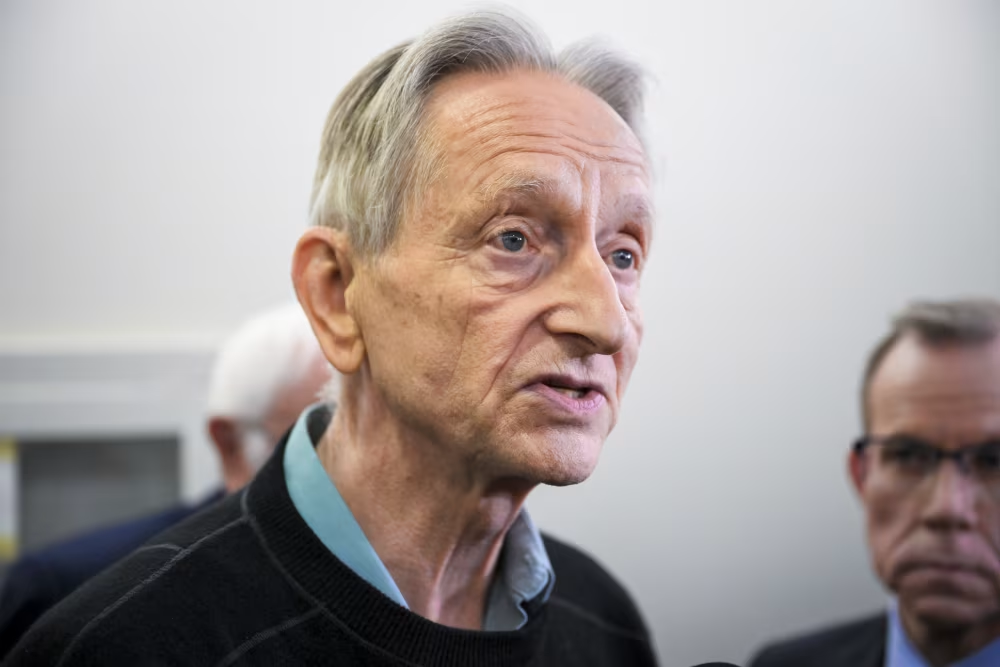
https://media-cldnry.s-nbcnews.com/image/upload/t_fit-1000w,f_avif,q_auto:best/rockcms/2026-09/260917-Geoffrey-Hinton-ew-558p-1c505f.jpg
Geoffrey Hinton, an emeritus professor dubbed the "godfather of AI," at the U.S. Capitol on Wednesday.Roberto Schmidt / Getty Images
Wednesday, September 16, 2026
Tôi không ngại bầu cho Cộng Hoà, nếu…
https://www.nguoi-viet.com/binh-luan/toi-khong-ngai-bau-cho-cong-hoa-neu/
Tôi không ngại bầu cho Cộng Hoà, nếu…
Hiếu Chân
September 11, 2026 : 7:00 PM.Modified date: September 12, 2026 : 1:15 PM
…tôi sẽ bỏ phiếu cho đảng Cộng Hoà nếu ông Trump và những người Cộng Hoà làm rõ được những thắc mắc rất đơn giản của tôi, một người Mỹ gốc Việt bình thường, không đảng phái, đi làm và đóng thuế đều đặn. Khi những băn khoăn này được giải toả, tôi sẽ yên tâm “chọn mặt gửi vàng” mà không cần tấm check $5,000 chẳng bao giờ có thực.
Bầu cử giữa nhiệm kỳ thường được coi là cuộc trưng cầu ý kiến cử tri về thành tích điều hành của chính phủ đương nhiệm, của đảng cầm quyền. Đảng Cộng Hòa đã làm chủ cả hành pháp (Toà Bạch Ốc), lập pháp (Quốc Hội) và tư pháp (Tối Cao Pháp Viện) hơn 18 tháng qua, họ đã có thành tích nổi bật gì để cử tri tin tưởng?
Một là, cuộc chiến Iran. Theo lời chính ông Trump, chúng ta đã chiến thắng Iran từ vài tháng trước, đã kiểm soát hoàn toàn eo biển Hormuz, đã tiêu diệt toàn bộ quân đội Iran cùng đội ngũ giáo sĩ lãnh đạo xứ này. Thế thì tại sao Iran chưa đầu hàng? Giá dầu hiện đã vượt $100 mỗi thùng, giá xăng bình quân ở Mỹ đã cao hơn 61% so với trước chiến tranh. Quân đội Iran bị tiêu diệt sao chúng vẫn tiếp tục tấn công, gây tổn hại to lớn cho các căn cứ quân sự Mỹ ở vùng Vịnh? Tin mới nhất cho biết, đêm ngày 8 Tháng Chín, Iran phóng hàng chục hoả tiễn vào căn cứ không quân Muwaffaq Salti ở Al-Azraq, Jordan, làm gãy cánh một chiếc A-10 Thunderbolt, hư hỏng tám chiếc F-15E.
Đại Tá Hùng Cao, người Mỹ gốc Việt đầu tiên được Tổng Thống Trump đề cử làm bộ trưởng Hải Quân, cũng phải thừa nhận rằng Iran đã tàn phá nặng nề căn cứ tại Bahrain, nơi đặt bộ chỉ huy Đệ Ngũ Hạm Đội Mỹ, đến mức Hải Quân đang phải xem xét lại cách bố trí lực lượng trong khu vực.
Cuộc chiến đã kéo dài sang tháng thứ bảy, 18 người lính Mỹ thiệt mạng, hơn 700 người bị thương, hàng chục tỷ đô la tan thành khói, nước Mỹ được cái gì? Ông Trump nói, phải ngăn chặn tham vọng vũ khí nguyên tử của Iran. Chương trình vũ khí nguyên tử của Iran thực tế đã bị ngăn chặn hiệu quả từ hiệp định JCPOA mà ông Trump rút ra năm 2018, sau đó đã bị “xoá sổ” sau những đợt không kích của Mỹ và Israel tháng Sáu năm ngoái. Nay thì sao? Tổng Giám Đốc Cơ Quan Nguyên Tử Năng Quốc Tế (IAEA) Rafael Grossi vừa cho biết Iran đang có các hoạt động xây dựng tại núi Pickaxe gần Natanz – nơi bị nghi là đang cất giấu khoảng 440kg uranium có độ tinh chế cao mà ông Trump đe doạ sẽ ném bom phá huỷ. Nhiều nhà phân tích nhấn mạnh, sau cuộc chiến hiện nay, chắc chắn Iran sẽ thêm quyết tâm và dồn mọi nguồn lực thúc đẩy việc chế tạo vũ khí nguyên tử càng sớm càng tốt để phòng ngừa việc Mỹ và Israel lại đánh họ trong tương lai.
Ông Trump nói Iran leo thang chiến tranh là để tác động tới bầu cử Mỹ; sau bầu cử ngày 3 Tháng Mười Một, chiến tranh sẽ kết thúc, giá xăng dầu sẽ giảm mạnh. Tuy nhiên các phụ tá hàng đầu của ông, từ Phó Tổng Thống JD Vance tới Bộ Trưởng Ngoại Giao Marco Rubio đều cho biết, cuộc chiến Iran có khả năng kéo dài tới hết nhiệm kỳ của ông Trump và khuyên người dân Mỹ hãy vững tinh thần. Là người dân, chúng tôi biết tin ai bây giờ?
***
Hai là, đại hội đảng Cộng Hòa ở Dallas tập trung lên án đảng Dân Chủ như là bọn cực đoan cánh tả hết sức nguy hiểm cho nền dân chủ Mỹ, những kẻ muốn lôi kéo nước Mỹ vào “địa ngục cộng sản.” Cộng sản vô cùng xấu xa và ác độc; người Việt Nam ai cũng hiểu rõ sự tàn bạo của cộng sản, không cần bàn cãi. Nhưng có bằng chứng nào chứng tỏ đảng Dân Chủ Mỹ có chủ trương “quốc hữu hoá,” tịch biên tài sản, phương tiện sản xuất kinh doanh của người dân Mỹ, chủ trương “độc đảng” cai trị, triệt hạ đối lập, xoá bỏ quyền tự do dân sự và chính trị của người dân giống như chế độ cộng sản đã làm trên quê hương Việt Nam thân yêu?
Và các bạn Cộng Hoà sẽ giải thích thế nào khi Tổng Thống Trump luôn miệng khoe khoang mối quan hệ “đầm ấm” với tên cộng sản bạo ngược Kim Jong-un của Bắc Hàn? Mươi hôm nữa, ông Trump sẽ trải thảm đỏ và mở quốc yến ở Toà Bạch Ốc để tiếp đãi Tập Cận Bình, ông trùm cộng sản Trung Quốc. Các nhân vật chóp bu của đảng Cộng Hòa, cả trong chính phủ và Quốc Hội, sẽ nâng ly chúc tụng nhà độc tài của đảng cộng sản lớn nhất hành tinh, cũng là đối thủ đáng gờm nhất đang rắp tâm đánh bại nước Mỹ.
Chống cộng bằng mồm mà vẫn giao du thân mật và dành sự tôn kính hết mực cho các nhà độc tài khát máu như Tập, như Kim, là thế nào? Tô Lâm, ông trùm của đảng Cộng Sản Việt Nam, cũng sắp đến Mỹ và có thể được Tổng Thống Trump tiếp đãi tại Phòng Bầu Dục, thế là thế nào?
***
Ba là, đảng Cộng Hoà luôn khẳng định, bầu cử qua thư là “gian lận” và tìm mọi cách để hạn chế quyền bầu cử qua thư, chẳng hạn như giao cho Sở Bưu Điện (USPS) xét duyệt tư cách cử tri để quyết định có chuyển phiếu bầu cho họ hay không – điều mà các toà án liên bang đã phán quyết là “vi hiến.” Nói bầu cử qua thư là gian lận, sao Tổng Thống Trump xưa nay chỉ bỏ phiếu qua thư mà không bao giờ trực tiếp tới phòng bỏ phiếu?
Bốn là, kinh tế là quyết định. Ai có thể trả lời một cách trung thực rằng kinh tế nước Mỹ ngày hôm nay – một năm rưỡi sau ngày nắm quyền toàn diện của đảng Cộng Hoà – tốt hơn hay tệ hơn và vui lòng dẫn chứng dữ liệu làm căn cứ cho nhận định của mình. Các thước đo kinh tế như tỷ lệ thất nghiệp, tăng trưởng GDP, số việc làm tạo ra, mức tăng lương và lạm phát… có tốt lên so với trước tháng Giêng 2025?
Nhớ lại cuối năm 2024, trước cuộc bầu cử tổng thống, tuần báo The Economist uy tín của Anh, trong số báo đặc biệt về kinh tế Mỹ, đánh giá Mỹ là nền kinh tế phục hồi nhanh nhất và mạnh nhất thế giới sau đại dịch COVID-19, là “The Envy of The World” (Nỗi thèm muốn của thế giới). Cùng lúc đó, 23 chuyên gia được giải Nobel Kinh tế học đã cùng ký một lá thư ngỏ, cảnh báo chính sách kinh tế của ứng cử viên Donald Trump sẽ dẫn tới giá cả cao hơn, thâm hụt lớn hơn và bất bình đẳng trầm trọng hơn. Nhiều người không tin các chuyên gia và hậu quả chúng ta đang gánh chịu: giá cả leo thang, đồng tiền mất giá, nợ nần – cả nợ cá nhân và nợ quốc gia – tăng vọt! Chỉ các tỷ phú, triệu phú hài lòng khi tài sản của họ phình ra nhờ giảm thuế và các mối quan hệ với chính phủ…
***
Và cuối cùng, đảng Cộng Hòa cho rằng, nhờ sự lãnh đạo mạnh mẽ của ông Trump mà thế giới đang “kính trọng nước Mỹ hơn trước.” Thật vậy không? Tại sao các nước đồng minh đều quay lưng, không nước nào chịu cùng với Mỹ chống chế độ thần quyền tàn bạo Iran như họ từng kề vai với chúng ta gánh vác cuộc chiến chống khủng bố sau ngày 11 Tháng Chín 2001? Ông Trump giận đến mức cấm vận kinh tế Tây Ban Nha và Ý, rút ngắn tập trận quân sự với Nam Hàn, thậm chí chống lại Anh Quốc trong vấn đề chủ quyền quần đảo Falkland hiện do Anh kiểm soát, chỉ vì các nước này không theo ông đánh Iran. Khảo sát của nhiều hãng thăm dò xác nhận, trong mắt của người dân thế giới hình ảnh và uy tín của nước Mỹ đã giảm mạnh, thậm chí người ta thích Trung Quốc hơn Mỹ, tin ông Tập hơn ông Trump trong các vấn đề quốc tế.
Vài thắc mắc trên đây chỉ là tâm tư của một người quan tâm tới thời cuộc và lo lắng cho tương lai xứ sở mà tôi yêu mến. Là thường dân, tôi chỉ có lá phiếu. Và tôi không ngại bỏ phiếu cho đảng Cộng Hoà, cũng không ngại bỏ phiếu cho đảng Dân Chủ, có điều lựa chọn của tôi không dựa vào cảm tính yêu ghét, không nhắm mắt theo đám đông mà tôi luôn cố gắng suy nghĩ nghiêm túc, dựa vào nguyên tắc và sự kiện. Và tôi nghĩ, các bạn cũng nên như vậy khi thực hiện quyền công dân vào ngày 3 Tháng Mười Một. [dt]
Tuesday, September 15, 2026
Độc Cư và Tri Túc - Bài Giảng Của Ngài Dalai Lama thứ 14
https://www.youtube.com/watch?v=TUvOLhcJg7U
Độc Cư - Đức Dalai Lama
https://www.youtube.com/watch?v=kJZEx7_hPGE
Tri Túc - Đức Dalai Lama
Sunday, September 13, 2026
9/11: One Day in America
https://www.youtube.com/watch?v=wMXxyCohWi8
Total Collapse (Full Episode) | 9/11: One Day in America
National Geographic
https://www.youtube.com/watch?v=2H056N3dJDk
25 years later, how we remember 9/11
PBS News
Friday, September 11, 2026
Digital and Data Colonialism
https://www.youtube.com/watch?v=YxATEqHR2PA
Geneva Graduate Institue -Digital Colonialism: A Discussion
Related Links:
https://www.ischool.berkeley.edu/news/2026/postdoctoral-scholar-dang-nguyen-explores-intersection-digitization-automation-and
https://www.ischool.berkeley.edu/people/dang-nguyen
"Digital research methods and the diaspora" (Routledge, 2023).
https://www.youtube.com/watch?v=w9c1GtkeVcs
Data Colonialism and the June 11 Discussion. Phỏng vấn TS. Nguyễn Hồng Hải Đăng June 04, 2021
Monday, September 7, 2026
Documentarian Alex Gibney on the power and influence of Elon Musk
Do not idolize anyone, and do not blame yourself when later on you feel frustrated or let down by "your idol."
Everything is temporary, transient, not real, like what is happening in a film.
https://apnews.com/article/elon-musk-documentary-venice-film-festival-e4e9c5eca6e2656b54f1c639d339109f
Documentarian Alex Gibney on the power and influence of Elon Musk
By LINDSEY BAHR
Updated 11:13 PM CDT, September 6, 2026
VENICE, Italy (AP) — Alex Gibney has made films about powerful people, corporations and organizations before: Enron, Elizabeth Holmes, Scientology and the U.S. military’s abuses at Bagram and Abu Ghraib are just a few. And yet, he said, nothing compares to the scope of power held by his latest subject, Elon Musk.
With a nearly four-hour runtime, “Musk” is having its world premiere this week at the Venice Film Festival. It’s one of the most hotly anticipated of the festival and the year — Bleecker Street is releasing it in theaters in October.
Gibney spoke to The Associated Press about upending the Musk myth, his revelations about his power and his support of President Donald Trump.
Remarks have been edited for clarity and brevity.
AP: Let’s start with the obvious, simple question: Why Elon Musk?
GIBNEY: A number of people came to me a few years ago, actually early 2023, and said, would you like to make a film about him? And I initially wasn’t sure, but a really good friend of mine convinced me that it was a good idea because it would be a portrait of kind of 21st century power. And so with that, I dug in.
AP: The nature and scope of his power is something that remains a little mysterious. Can you go into a little bit about what you found and how your film addresses that?
GIBNEY: In some ways it’s a simple story (with) a lot of complicated details. I think the source of his power comes from, how should I put this, (expletive)? That is to say, his ability to speak with confidence about the future in ways that convince people to invest in his companies. It’s really a future that rarely is in sync with facts or evidence or any remote possibility. So that is really what I discovered. That and the fact I think his genius, if there is a genius, is that he is not an inventor, he’s an investor. His genius is stock pumping.
The other thing I discovered was that the reasons for turning toward Trump were both a break with the past, I mean, people look to the way that he was idolized by many people on the, you could call it the left, or people who regarded him as a kind of climate savior for what he was doing with Tesla. Many people wondered about that transition. I discovered two things. One is, in a way, it was a predictable transition because he goes where the federal government money is.
But the other reason is his companies were facing an enormous number of federal investigations. And indeed, Tesla was under criminal investigation. But out of that case, there was a good chance that under a (Kamala) Harris administration, he might go to prison. He joked about that on the Tucker Carlson show. I think those were two key motivators that I had initially underestimated. A lot of people clocked it to the woke mind virus. After doing some research, I didn’t see it that way.
AP: You’ve covered powerful people and companies before in your films. Does anything compare to this?
GIBNEY: Nothing compares to this in terms of the scope of his power. What’s interesting about Musk is it’s not so much something that’s new as an old wine in a new bottle. And Musk, I think like some of the characters that I’ve followed in the past, is afflicted with what some people call noble cause corruption. That is to say, you begin to believe in a cause. And in Musk’s case, it was making us multiplanetary and also leading us into a more sustainable environmental world. And because you’re in line with those important, valuable, good causes, anything you do in the service of those causes is OK. And ultimately that leads you to corruption.
In a way, Musk is not dissimilar from the guys at Enron. He’s not dissimilar from Elizabeth Holmes in the way that he bent the truth to serve his impulses.
The one big difference with Musk is that he has companies (SpaceX and Tesla) which contain a great number of very qualified engineers and executive leaders.
AP: There was the famous social media exchange where Musk called the film a hit piece and you responded, “How would you know?” Do you go into your films willing to have your assumptions challenged? Was bias involved?
GIBNEY: What is it that physicist Richard Feynman used to say? It’s good to have an open mind, but not so open that your brains fall out. There is always bias, but I’m always willing to have my assumptions challenged. I started off as a kind of an admirer and was honest in my desire to want to talk to him, but ultimately he didn’t want to talk to me. Then you start digging into the facts and you follow them where they lead. And where they led for me was to a place that upended the myth, I would say, of Elon Musk as a kind of modern Leonardo da Vinci.
AP: Did he try to interfere?
GIBNEY: He didn’t really except in so far as the fact that people were terribly afraid to speak to me on the record, or at least on camera. They were just terrified of Elon. And these were people in his companies. These were people who knew him well. These were supporters and critics.
A lot of people close to him who were his admirers would say, “I can’t talk to you unless I get Elon’s permission.” I thought, wow, for such a big and powerful person, that seems awfully weak
AP: When I told people that there was going to be a nearly four-hour Elon Musk documentary, the first question was “did he make it about himself?”
GIBNEY: This probably doesn’t share that much with the Melania documentary.
One of the things I would say about the film is it’s a dark and dangerous topic, but the film itself is a fun ride.
___
For ongoing coverage of the 2026 Venice Film Festival, visit: https://apnews.com/hub/venice-film-festival
L.Bahr has been a film writer and critic for The Associated Press since 2014
Uống thuốc, quan trọng không phải là ‘Tây’ hay ‘Ta’
Thuốc chỉ dùng khi cần thiết. Cơ thể của mỗi người có khả năng tự thích nghi và tự điều chỉnh chừng nào hệ miễn nhiễm của người ấy còn tốt, nhất là qua cách sinh hoạt và ăn uống lành mạnh, thăng bằng, quân bình.
https://www.nguoi-viet.com/doi-song/uong-thuoc-quan-trong-khong-phai-la-tay-hay-ta/
Uống thuốc, quan trọng không phải là ‘Tây’ hay ‘Ta’
September 4, 2026 : 5:00 PM
Thuốc có thể gây phản ứng phụ. Một số thuốc thực sự có thể gây tổn thương gan, thận hoặc các cơ quan khác. Ăn uống lành mạnh, vận động, ngủ đủ, giảm muối, duy trì cân nặng phù hợp có thể giúp phòng ngừa và điều trị nhiều bệnh. Một số dược liệu cổ truyền cũng thực sự có hoạt tính sinh học và có thể hữu ích.
Nhưng từ những sự thật đó đi đến kết luận rằng “thuốc Tây hại, còn thuốc thiên nhiên thì lành” lại là một bước nhảy rất xa.
Và đôi khi, bước nhảy ấy có thể nguy hiểm.
“Tự nhiên” không đồng nghĩa với “an toàn”
Cơ thể con người không biết một phân tử đến từ Đông hay Tây, từ phòng thí nghiệm hay từ một chiếc lá.
Cơ thể chỉ “biết” phân tử ấy tác động lên tế bào như thế nào, được hấp thu bao nhiêu, chuyển hóa ở đâu, thải qua gan hay thận ra sao, và ở liều lượng nào nó có lợi hoặc có hại.
Nước hoàn toàn tự nhiên và cần thiết cho sự sống. Nhưng uống một lượng nước quá lớn trong thời gian quá ngắn có thể gây hạ natri máu nghiêm trọng, thậm chí tử vong.
Arsenic có trong thiên nhiên.
Nọc rắn cũng tự nhiên.
Ricin từ hạt thầu dầu cũng là một chất tự nhiên.
Ở chiều ngược lại, nhiều loại thuốc rất hữu ích của y học hiện đại có nguồn gốc từ thiên nhiên. Morphine bắt nguồn từ cây thuốc phiện. Nhiều thuốc khác được phát hiện từ thực vật, vi sinh vật hoặc các chất có sẵn trong tự nhiên, rồi mới được tinh chế, nghiên cứu và chuẩn hóa.
National Center for Complementary and Integrative Health (NCCIH), thuộc National Institutes of Health (NIH) Hoa Kỳ, nhấn mạnh rằng “natural” không nhất thiết có nghĩa là an toàn hơn hoặc tốt hơn. Cơ quan này cũng nêu những thí dụ như kava có liên quan đến tổn thương gan nghiêm trọng và ephedra có liên quan đến các biến cố tim mạch và nguy cơ tử vong.
Vì vậy, câu hỏi khoa học không nên là:
“Nó có tự nhiên không?”
Mà nên là:
“Nó là chất gì? Liều bao nhiêu? Có tác dụng gì? Bằng chứng ở đâu? Và lợi ích có lớn hơn nguy cơ hay không?”
Tại sao con người vẫn thường tin rằng “tự nhiên” an toàn hơn?
Đây không chỉ là vấn đề văn hóa của Việt Nam.
Tâm lý học đã nghiên cứu một hiện tượng gọi là naturalness bias, có thể tạm dịch là thiên kiến chuộng cái tự nhiên: con người có khuynh hướng đánh giá một sản phẩm tốt hơn hoặc an toàn hơn chỉ vì nó được mô tả là “tự nhiên”. Một tổng quan gần đây về hiện tượng này cho thấy khuynh hướng ấy xuất hiện trong nhiều lĩnh vực, kể cả trong lĩnh vực thuốc và vaccine.
Một nghiên cứu đặc biệt đáng chú ý của Brian Meier và Courtney Lappas gồm 5 thí nghiệm, với tổng cộng 1.223 người tham gia.
Khi hai loại thuốc được mô tả có hiệu quả và độ an toàn giống nhau, khoảng 79% người tham gia vẫn chọn loại thuốc được mô tả là có nguồn gốc tự nhiên.
Đáng suy nghĩ hơn nữa, khoảng 20% vẫn chọn thuốc tự nhiên ngay cả khi được thông báo rõ rằng thuốc tự nhiên kém an toàn hoặc kém hiệu quả hơn so với thuốc tổng hợp.
Như vậy, chỉ một chữ “tự nhiên” đã có thể thay đổi cách con người đánh giá lợi ích và rủi ro.
Đó không phải vì người bệnh thiếu thông minh.
Đó là một đặc điểm rất con người.
Một nghịch lý: thuốc càng được nghiên cứu kỹ càng có vẻ… đáng sợ
Mở tờ hướng dẫn của một viên thuốc kê toa, người bệnh có thể thấy cả một danh sách:
đau đầu, chóng mặt, buồn nôn, dị ứng, ảnh hưởng đến gan, ảnh hưởng đến thận, tương tác thuốc…
Rồi nhìn sang một chai thảo dược:
“100% Natural.”
Cảm giác đầu tiên rất dễ hiểu:
“Thuốc Tây sao mà nhiều phản ứng phụ quá. Thuốc này là thuốc thiên nhiên, chắc nhẹ hơn.”
Nhưng có một khả năng khác ít được nghĩ đến:
Chúng ta biết nhiều phản ứng phụ của thuốc kê toa chính vì thuốc ấy đã được nghiên cứu kỹ lưỡng.
Nếu một thuốc được thử nghiệm trên hàng chục ngàn người, sau đó được hàng triệu người sử dụng và hệ thống y tế tiếp tục theo dõi phản ứng bất lợi, thì những tác dụng hiếm gặp dần dần sẽ được phát hiện.
Trong khi đó, một loại thảo dược ít được nghiên cứu có thể chỉ có vài phản ứng phụ được ghi nhận.
Điều đó không chứng minh rằng thảo dược an toàn hơn.
Đôi khi nó chỉ có nghĩa:
Chúng ta biết ít hơn về nó.
“Chưa thấy bằng chứng gây hại” và “đã có bằng chứng chứng minh an toàn” là hai điều rất khác nhau.
“Nhưng ông bà mình dùng mấy trăm năm rồi”
Đây là một lập luận đáng được tôn trọng hơn là bị chế giễu.
Kinh nghiệm của nhiều thế hệ có giá trị. Chính việc quan sát những phương thuốc truyền thống đã góp phần dẫn khoa học đến nhiều hoạt chất hữu ích.
Nhưng kinh nghiệm lâu đời vẫn không thay thế hoàn toàn được thử nghiệm khoa học.
Thí dụ, một người bị cảm.
Ngày thứ nhất bắt đầu mệt.
Ngày thứ hai ho, đau người.
Ngày thứ ba uống một loại thuốc lá.
Ngày thứ năm khỏe lại.
Kết luận rất tự nhiên:
“Thuốc này chữa khỏi cảm.”
Có thể đúng.
Nhưng cũng có thể bệnh do virus vốn đã tự khỏi trong khoảng thời gian đó.
Nếu không có nhóm so sánh, rất khó biết sự hồi phục xảy ra nhờ thuốc hay đơn giản là sau khi uống thuốc.
Hai chữ “nhờ” và “sau” khác nhau rất nhiều.
Đó là một trong những lý do khiến thử nghiệm lâm sàng ngẫu nhiên có nhóm đối chứng ra đời.
Thuốc Tây có thể hại gan, thận không?
Có.
Không nên né tránh sự thật này.
Một số thuốc có thể gây độc cho gan. Một số thuốc có thể gây tổn thương thận. Một số có thể gây ra những phản ứng phụ nghiêm trọng.
Nhưng câu hỏi đúng không phải là:
“Thuốc này có phản ứng phụ hay không?”
Hầu như bất cứ chất nào đủ mạnh để thay đổi sinh học của cơ thể cũng có khả năng gây tác dụng không mong muốn.
Câu hỏi quan trọng hơn là:
Nguy cơ bao nhiêu?
và
So với lợi ích mà thuốc mang lại thì nguy cơ ấy lớn hay nhỏ?
Một thuốc hạ huyết áp có thể có phản ứng phụ, nhưng huyết áp cao không được điều trị cũng có thể âm thầm làm tăng nguy cơ đột quỵ, suy tim, bệnh thận và bệnh tim mạch trong nhiều năm.
Do đó, chỉ nhìn vào phản ứng phụ của viên thuốc mà không nhìn vào hậu quả của căn bệnh nếu không điều trị là nhìn thấy một nửa của bài toán.
Và “thuốc thiên nhiên” cũng có thể làm tổn thương gan
Đây là điều đặc biệt đáng chú ý.
Drug-Induced Liver Injury Network (DILIN) của Hoa Kỳ đã theo dõi các trường hợp tổn thương gan do thuốc và do herbal/dietary supplements, tức là thảo dược và thực phẩm bổ sung.
Trong một nghiên cứu công bố trên Hepatology, 130 trong số 839 trường hợp được đánh giá là tổn thương gan do herbal/dietary supplements. Trong thời gian nghiên cứu 2004–2013, tỷ lệ các trường hợp tổn thương gan trong mạng lưới này được quy cho những sản phẩm đó tăng từ khoảng 7% lên 20%.
Điều này không có nghĩa là “uống thảo dược sẽ hại gan.”
Nó có nghĩa một điều đơn giản hơn:
Thảo dược cũng có thể gây độc gan.
Nguồn gốc tự nhiên không tạo ra cho gan một cơ chế bảo vệ đặc biệt.
Một bài học đau đớn từ thận: aristolochic acid
Có lẽ một trong những thí dụ mạnh nhất chống lại quan niệm “cây cỏ thì lành” là aristolochic acid.
Đây là những hợp chất xuất hiện tự nhiên trong một số loài thực vật thuộc họ Aristolochiaceae và đã từng hiện diện trong một số phương thuốc thảo dược.
International Agency for Research on Cancer (IARC), thuộc World Health Organization, cho biết phơi nhiễm aristolochic acid là một yếu tố nguy cơ quan trọng của bệnh thận nặng và các ung thư đường tiết niệu cũng như một số ung thư khác. National Cancer Institute Hoa Kỳ cũng cảnh báo về mối liên quan giữa các chất này với tổn thương thận và ung thư đường tiết niệu.
Nghịch lý ở đây rất đáng suy nghĩ:
Một người có thể từ chối một viên thuốc vì sợ “thuốc Tây hại thận”, rồi lại uống một sản phẩm thảo dược vì nghĩ rằng nó “mát và bổ thận.”
Nhưng thận không đọc nhãn.
Thận chỉ tiếp xúc với những phân tử được đưa vào cơ thể. [dt]
___________________________________________________
Tài liệu tham khảo chính
1-Meier BP, Lappas CM. The Influence of Safety, Efficacy, and Medical Condition Severity on Natural versus Synthetic Drug Preference. Medical Decision Making. 2016;36(8):1011–1019. PMID 26683247.
2-National Center for Complementary and Integrative Health, NIH. Natural Doesn’t Necessarily Mean Safer, or Better.
3-U.S. Food and Drug Administration. Information for Consumers on Using Dietary Supplements và Questions and Answers on Dietary Supplements.
4-Navarro VJ, et al. Liver injury from herbals and dietary supplements in the U.S. Drug-Induced Liver Injury Network. Hepatology. 2014;60(4):1399–1408. PMID 25043597.
5-U.S. Preventive Services Task Force. Evidence Summary: Vitamin, Mineral, and Multivitamin Supplementation to Prevent Cardiovascular Disease and Cancer. Tổng cộng 84 nghiên cứu, 739.803 người tham gia.
6-International Agency for Research on Cancer (IARC/WHO). Aristolochic acid-associated cancers: a public health risk in need of global action.
7-National Cancer Institute. Aristolochic Acids – Cancer-Causing Substances.
(còn tiếp)
Saturday, September 5, 2026
Năng Lượng.8 Cách Rèn Luyện Tâm. Tu Tập Vấn Đáp - Đức Đalai Lama
https://www.youtube.com/watch?v=j5p7fW3rt1g
Chánh Pháp và Phi Pháp - Đức Đalai Lama khai thị
https://www.youtube.com/watch?v=C4L6HYvi1EM
HỌC CÁCH ĐỂ NÂNG CẤP NĂNG LƯỢNG CỦA BẢN THÂN NHANH CHÓNG - Đức Đalai Lama
https://www.youtube.com/watch?v=d6h5hBAuuCk
8 Cách RÈN LUYỆN TÂM - Đức Đalai Lama
https://www.youtube.com/watch?v=OX5ukWbz0x4
Phật Tử Tại Gia Tu Tập Vấn Đáp - Đức Đalai Lama
Hòa Thượng, Thiền Sư Thích Thanh Từ giảng -Niết Bàn là gì?
NIẾT BÀN LÀ GÌ ?
Hòa Thượng , Thiền Sư Thích Thanh Từ.
Trong các kinh điển có nhiều định nghĩa khác nhau nhưng chữ Niết Bàn (Nirvana) không ngoài những nghĩa Viên tịch (hoàn toàn vắng lặng), Vô sanh (không còn sanh diệt) và Giải thoát v.v... những nghĩa này nhằm chỉ cho người đạt đạo sống trong trạng thái tâm thể hoàn toàn vắng lặng, dứt hết vọng tưởng vô minh.
Do trình độ giác ngộ khác nhau nên trong kinh chia ra bốn thứ Niết Bàn:
1. Niết Bàn Hữu Dư Y:
Niết Bàn đã dứt sạch phiền não vọng hoặc trong ba cõi, nhưng còn thân của nghiệp báo dư thừa.
2. Niết Bàn Vô Dư Y:
Niết Bàn đã dứt sạch phiền não hữu lậu và không còn mang thân của nghiệp báo (dứt hết uẩn thân).
3. Niết Bàn Tự Tánh:
Niết Bàn tự tánh sẵn có của chúng sanh, nó vốn sẵn có tánh Niết Bàn không phải tu tập mới có. Như mặt gương tánh vốn sạch không phải đợi lau chùi mới hiện.
4. Niết Bàn Vô Trụ Xứ:
Niết Bàn không chỗ nơi. Các vị Bồ Tát khi giác ngộ, lao mình trong lục đạo giáo hóa chúng sanh, lấy sự sanh tử của chúng sanh làm cảnh giới. Tuy ra vào sanh tử nhưng lúc nào cũng tự tại vô ngại.
Hai thứ Niết Bàn trên là của hàng Nhị thừa, hai thứ Niết Bàn dưới chỉ riêng hàng Đại thừa mới có.
*******
Hỏi:
Làm sao thể nghiệm để biết có Niết Bàn ?
- Như trên chúng ta đã hiểu, căn cứ Tự Tánh Niết Bàn thì mỗi người chúng ta đều sẵn có thể tánh thanh tịnh sáng suốt tròn đầy, nhưng vì phiền não ngăn che mà không hiển lộ.
Muốn tánh Niết Bàn hiển lộ là phải diệt trừ phiền não.
Phiền não ở đây chính là sự mê lầm “chấp ngã”.
Mê lầm chấp ngã hết, tức là Niết Bàn.
Vậy thì hỏi khi nào có Niết Bàn?
Chúng ta phải đáp: Khi nào tâm “chấp ngã” hết, hoặc tham, sân, si sạch chính khi ấy tức Niết Bàn, khỏi phải hỏi đâu xa.
Chúng ta hãy đọc một đoạn văn trích trong Tạng Kinh Pali của tác giả “Cái Ta Nguy Hiểm” Buddhahasa sau đây:
Trong câu Phật ngôn:
“Nếu chư Tỳ Kheo hành theo Chánh hạnh thì cõi thế gian không vắng bóng các bậc A La Hán”.
Chữ Chánh hạnh có ý nghĩa sâu xa quan trọng.
Sống chánh hạnh ngụ ý sự vắng mặt của ý tưởng Ta và của Ta.
Chúng ta sống hết ngày này qua ngày khác, nhưng sống một cách không chân chánh, cho nên cái tà kiến “Ta” và “của Ta” mới sanh, và mỗi ngày nó vọt lên nhiều lần, khiến cho cái Niết Bàn viên mãn bị đứt đoạn, không có dịp tốt để xuất hiện, và vì thế chúng ta không thành bậc Vô sanh (A La Hán).
Sống chánh hạnh là sinh hoạt đúng với Bát Chánh Đạo.
Vậy điều cần yếu là ta phải dùng tri kiến chân chánh và hành động chân chánh sao cho “Cái ý niệm Ta” và “của Ta” không thể nổi dậy, ngõ hầu không có sự sanh.
Khi không có sự sanh nào cả thì không có khổ nào cả và đó là chân hạnh phúc như lời đức Phật đã thuyết.
Đọc qua đoạn văn ngắn này, chúng ta thấy Phật dạy điều kiện muốn được Niết Bàn phải có Chánh hạnh (sinh hoạt đúng với Bát Chánh Đạo).
Khi nào có Chánh hạnh thì khi ấy có Niết Bàn.
Khi nào không có Chánh hạnh thì không có Niết Bàn.
Vậy muốn đạt được Niết Bàn phải có Chánh hạnh, tức là không còn khởi dậy cái ý niệm “Ta” và “của Ta”.
Một giây phút nào cái “Ta” và “của Ta” không khởi dậy trong tâm thức thì phút giây đó ta có Niết Bàn (Niết Bàn trong thời gian ngắn là Niết Bàn nhân, sống với Niết Bàn vĩnh viễn là viên mãn Niết Bàn).
Vậy muốn kéo thời gian Niết Bàn của ta dài hay ngắn đều từ tâm thức có khởi vọng tưởng chấp ngã hay không chấp ngã mà thôi.
Nếu sống được một phút không vọng tưởng là một phút Niết Bàn, sống được hai phút là hai phút Niết Bàn, sống một giờ, một ngày là được một giờ, một ngày Niết Bàn cho đến nếu sống trọn vẹn là được Niết Bàn viên mãn.
Trong Đốn Ngộ Nhập Đạo Yếu Môn chép:
Có người hỏi:
- Làm sao được Đại Niết Bàn ?
Thiền Sư Huệ Hải đáp:
- Chẳng tạo nghiệp sanh tử.
hi nào chẳng tạo nghiệp sanh tử tức là Niết Bàn, chứ không phải tìm Niết Bàn nơi nào khác và cũng không phải đợi thời gian nào mới đạt Niết Bàn.
Vì vậy, đạt Niết Bàn sớm hay muộn, thời gian có Niết Bàn lâu hay mau đều tùy chúng ta cả.
Có một Cư sĩ đến hỏi Phật:
- Bạch đức Thế Tôn! Như Phật nói Niết Bàn hiện tại đến để mà thấy có thời gian chăng ?
Phật bảo:
Như người ý vừa nghĩ “tham”, miệng nói lời tham, thân làm việc tham thì ngay đó ưu bi khổ não liền khởi.
Như người ý vừa nghĩ “sân”, miệng nói lời sân, thân làm việc sân thì ưu bi khổ não ngay đó liền khởi.
Như người ý vừa nghĩ “si”, miệng nói lời si, thân làm việc si thì ưu bi khổ não ngay đó liền khởi.
Người nào nếu thân miệng ý dứt được tham, sân, si thì ưu bi khổ não không có.
Chính ngay lúc đó là Niết Bàn hiện tại (Tương Ưng Bộ Kinh).
*****
Hỏi:
Khi đạt Niết Bàn rồi, còn có hay không còn có ?
Vấn đề còn có hay không còn có đặt ra ở đây đã sai rồi.
Để trả lời câu hỏi này, tôi xin dẫn lời hỏi của một vị Bà La Môn đến hỏi Phật (Tạp A Hàm):
"Thưa Thế Tôn!
Thế giới hữu biên, vô biên?
Thế giới hữu thường, vô thường?
Niết Bàn còn có hay không còn có?"
Cả ba câu hỏi đức Phật đều im lặng không đáp.
Tại sao Phật không đáp?
Bởi người đời phần nhiều hễ nói không thì họ chấp hoàn toàn không, khi nói có thì chấp hoàn toàn có (chấp một chiều), vì vậy mà Phật không đáp.
Nghĩa là nếu nói không thì họ chấp là không ngơ (ngoan không) như lông rùa, sừng thỏ; nói có thì chấp thường còn mãi mãi (vĩnh viễn không thay đổi), mà nghĩa có không ở đây “không cố định” không hẳn là có, không phải hoàn toàn không.
Hơn nữa nghĩa Niết Bàn, nó ly khai nghĩa có và không.
Tại sao?
Vì nếu có thì phải có hình tướng chỗ nơi có thể chỉ được, nhưng Niết Bàn đâu có hình tướng và chỗ nơi.
Nếu nói không, ai biết có chứng đắc Niết Bàn?
Vì vậy không thể nói có hay không.
Lấy một việc gần gũi làm thí dụ.
Như khi ngồi thiền, tâm ta buông xả tất cả vọng niệm không còn một chút dấy động, tâm lặng lẽ thênh thang trùm khắp.
Lúc bấy giờ, còn có gì hay không còn có gì?
Nếu nói còn có gì tại sao không thấy tướng mạo?
Nếu nói không còn gì thì cái gì tỉnh sáng biết là không?
Vì nó không phải thật có và thật không nên nếu trả lời là “Có” là “Không” đều không đúng lẽ thật.
Thế giới hữu thường vô thường, hữu biên vô biên cũng vậy, nó không phải thật có, thật không mà tùy duyên biến đổi.
Vì thế nên Phật không trả lời.
Khi Phật còn tại thế có một vị Tỳ Kheo chứng A La Hán tịch, các Thầy Tỳ Kheo đến hỏi Phật:
Thầy Tỳ Kheo tịch sanh về đâu ?
Phật trả lời:
“Như củi hết lửa tắt”.
Nghĩa là còn duyên thì hiện, hết duyên thì ẩn, chớ không về đâu!
Hòa Thượng, Thiền Sư Thích Thanh Từ.
Thursday, September 3, 2026
‘Bình xăng không đáy’
https://www.nguoi-viet.com/binh-luan/binh-xang-khong-day-cua-trump/
Một “cái deal” mờ ám
Modified date: September 2, 2026 : 11:35 PM
Trúc Phương/Người Việt
Ngày 28 Tháng Tám, Trump thông báo Mỹ vừa đạt được một thỏa thuận “mang tính lịch sử” khi có quyền kiểm soát gần như tuyệt đối hơn 65 tỷ thùng trữ lượng dầu mỏ của Venezuela. Trump gọi đây là “THỎA THUẬN DẦU MỎ LỚN NHẤT LỊCH SỬ THẾ GIỚI” và khẳng định cú “deal ngoạn mục” này sẽ “giảm đáng kể giá xăng cho tất cả người Mỹ.”
Tổng Thống Lâm Thời Delcy Rodríguez khẳng định Venezuela vẫn duy trì quyền sở hữu và chủ quyền đối với trữ lượng dầu mỏ khổng lồ, trong khi có thể thu về hàng trăm tỷ từ thỏa thuận khai thác dầu với Mỹ.
Như đã biết, Venezuela có trữ lượng dầu thô lớn nhất thế giới, ước tính khoảng 303 tỷ thùng, so với 268 tỷ thùng của Saudi Arabia và 208 tỷ thùng của Iran. Động thái của Delcy Rodríguez hoàn toàn đi ngược với những gì bà từng tuyên bố. Cách đây chỉ hai năm, Rodríguez từng chỉ trích gay gắt phe đối lập khi cáo buộc họ âm mưu giao nguồn dự trữ dầu mỏ, khí đốt tự nhiên và cả vàng cho những “ông chủ tại Washington.”
Viết trên X (Twitter), Rafael Ramírez – cựu lãnh đạo tập đoàn dầu khí quốc gia PDVSA của Venezuela (Petróleos de Venezuela, S.A.) – cáo buộc Rodríguez “đâm một nhát dao chí mạng vào trái tim Tổ quốc” thông qua giao dịch mang tính “thực dân mới” này. Trả lời phỏng vấn tờ El Nacional, Ramírez nói: “Họ trao 65 tỷ thùng trữ lượng dầu của chúng ta vào tay Mỹ. Chuyện này chưa từng xảy ra tại Venezuela, và tôi nghĩ cũng chưa từng có tiền lệ ở bất kỳ nơi nào khác trên thế giới.”
Toàn bộ chi tiết giao dịch giữa Mỹ và Venezuela, chính xác hơn là giữa Trump và Delcy Rodríguez, đến nay vẫn hoàn toàn mù mờ.
Tối 31 Tháng Tám, Tòa Bạch Ốc công bố bản tóm tắt thỏa thuận. Điều đáng nói là bản tóm tắt có những điểm mâu thuẫn với phiên bản của Rodríguez lẫn các tuyên bố trước đó của Ngũ Giác Đài.
Với Rodríguez, bà nói đây là dự án song phương kéo dài 25 năm (trong khi Trump nói “100 năm”), liên quan việc khai thác 17 mỏ dầu chiến lược và 8 lô thăm dò mới, với mục tiêu khai thác hơn 1.5 triệu thùng mỗi ngày. Dự án dự kiến thu hút $100 tỷ vốn đầu tư và mang lại khoảng $209 tỷ cho nhà nước Venezuela (tính theo giá tham chiếu $65/thùng), qua đó chính phủ Venezuela thu được khoảng $19 trên mỗi thùng dầu.
Trong khi đó, Trump tuyên bố Mỹ sẽ nắm quyền sở hữu đa số đối với trữ lượng dầu Venezuela. Hãng tin AP cho biết thêm, Washington sẽ kiểm soát 55% sản lượng của công ty tư nhân mới có tên North American Blue Energy Partners (NABEP). Bản tóm tắt của Tòa Bạch Ốc nói thêm: Văn phòng Vốn Chiến lược (Office of Strategic Capital – OSC) thuộc Ngũ Giác Đài nắm 35% cổ phần và Bộ Ngoại giao Mỹ có quyền mua 20% sản lượng với giá thành sản xuất.
Cần mở ngoặc, OSC được thành lập vào Tháng Mười Hai, 2022 thời Bộ Trưởng Quốc Phòng Lloyd Austin (nhiệm kỳ Biden). Mục tiêu ban đầu là dùng các công cụ tài chính của chính phủ để huy động vốn đầu tư tư nhân vào những lĩnh vực được xem là quan trọng đối với an ninh quốc gia Mỹ.
Về nguyên tắc, OSC chỉ cung cấp các khoản vay, bảo lãnh vốn vay và hỗ trợ kỹ thuật cho các công ty phát triển công nghệ lưỡng dụng thuộc 34 danh mục. Vấn đề ở chỗ việc khai thác dầu thô nặng từ Vành đai Orinoco của Venezuela không nằm trong 34 danh mục kể trên, và luật pháp Mỹ cũng không có điều khoản nào đề cập việc tài trợ cho đầu tư-khai thác ngành dầu khí ở nước ngoài. Ngoài ra, hoạt động OSC bị giới hạn ở mức thí điểm và thẩm quyền của họ sẽ hết hạn vào ngày 1 Tháng Mười, 2028.
Nói cách khác, nếu đến ngày 1 Tháng Mười, 2028 mà OSC không được Quốc hội gia hạn thẩm quyền hoạt động thì cơ quan này đương nhiên bị giải tán. Điều đó có nghĩa thời hạn hợp đồng khai thác dầu giữa Mỹ và Venezuela, dù là 100 năm (như Trump nói) hay 25 năm (như Rodríguez khẳng định), thì thẩm quyền cấp vốn được đề xuất để hỗ trợ thỏa thuận vẫn hết hiệu lực vào năm 2028, tức chỉ hai năm nữa. Tòa Bạch Ốc hoàn toàn không giải thích điều gì sẽ thay thế thẩm quyền nói trên hoặc nơi nào tiếp tục cấp ngân sách.
Trong khi Mỹ lờ mờ thì Venezuela cũng chẳng rõ ràng. Luật pháp Venezuela đặt ra loạt vấn đề mà Rodríguez hoàn toàn tránh né. Điều 12 Hiến pháp Venezuela quy định các mỏ hydrocarbon là tài sản chính phủ – loại tài sản không thể bị tước bỏ hay chuyển nhượng. Điều 302 nói rằng chỉ nhà nước mới có quyền khai thác dầu khí, và Điều 303 quy định nhà nước phải nắm toàn bộ cổ phần PDVSA. Một số quy định cải cách về liên doanh vào Tháng Giêng vẫn chưa cho phép tỷ lệ sở hữu nước ngoài lên tới 55%.
Nói cách khác, Rodríguez muốn xử lý trót lọt cái “deal” với Trump thì bà phải sửa Hiến pháp trước khi thỏa thuận hoàn tất. Trong khi đó, theo Ricardo Hausmann, người đứng đầu Bộ Kế Hoạch Venezuela đầu thập niên 1990, nói rằng Rodriguez “không có thẩm quyền hay cơ sở pháp lý theo Hiến pháp để cam kết thay mặt Venezuela thực hiện bất kỳ thỏa thuận nào như vậy” (“Trump plan to control Venezuelan oil has more holes than Swiss cheese”/Responsible Statecraft).
Trump hốt đậm từ cổ phiếu dầu hỏa
Trump khẳng định, thỏa thuận với Venezuela sẽ giúp giảm giá xăng tại Mỹ. Đó là một phát biểu tào lao. Cho dù còn nhiều mơ hồ nhưng có một điều rõ ràng là nội dung thỏa thuận chỉ đề cập việc khai thác 17 mỏ dầu Venezuela. Chẳng dự án khai thác dầu nào có thể hút dầu lên ngay lập tức để đưa về Mỹ và bơm vào các cây xăng Mỹ. Một dự án có khi mất 5-10 năm mới rút được dầu thô lên. Và đó là dầu thô, thứ không thể đổ trực tiếp vào bình xăng xe.
Trump cũng bốc phét khi nói nguồn dầu Venezuela nhanh chóng lấp đầy kho dự trữ chiến lược Mỹ (SPR). Điều này không thể xảy ra. Cần biết, từ thập niên 1990, có một quy tắc bất thành văn là SPR chỉ được bơm vào bằng dầu nội địa. Trump không thể thay đổi điều đó. Hơn nữa, dầu thô Venezuela có hàm lượng lưu huỳnh cao (gọi là “dầu chua” – sour crude oil) và do vậy không đáp ứng được các tiêu chuẩn kỹ thuật để bơm vào SPR.
Bất luận khả năng thỏa thuận với Venezuela có khả năng trở thành hiện thực đến đâu, có điều chắc chắn rằng Trump thu lợi rất nhiều, bằng cách nào thì thời gian sẽ trả lời. Ngay thời điểm hiện tại, khi dân Mỹ khóc ròng với giá xăng, Trump vẫn rung đùi hốt bạc.
Báo cáo Tháng Tám của Ủy Ban Kinh Tế Liên Hợp Quốc Hội Hoa Kỳ – Phe Thiểu Số (“U.S. Congress Joint Economic Committee – Minority”, JEC), đề tựa “Trump and Big Oil Raked in Profits Paid More at the Pump,” cho biết, tài sản Trump đã tăng thêm $15.5 triệu nhờ vào số cổ phiếu tại các công ty dầu khí.
Trong chiến dịch tranh cử, Trump hứa đền ơn đáp nghĩa cho các đại gia dầu (Big Oil) nếu họ quyên góp $1 tỷ. Thời điểm hiện tại, lợi nhuận của Big Oil nói chung đạt hơn $125 tỷ, trong đó có $12 tỷ của Chevron tính đến quý II-2026 (mức lợi nhuận hàng quý cao nhất trong sáu năm qua) và $14.7 tỷ của Exxon Mobil trong cùng kỳ. Trump chỉ bội ước với người dân. JEC cho biết, người Mỹ phải chi thêm $71.5 tỷ cho xăng dầu kể từ khi Trump khai hỏa cuộc chiến Iran. Điều đó có nghĩa mỗi gia đình tốn thêm trung bình $604.
Chỉ trong ba tháng đầu năm 2026, Trump đã mua thêm số cổ phiếu dầu khí trị giá 3.6 triệu. Cụ thể, các tài khoản cá nhân của Trump mua số cổ phiếu Chevron trị giá hàng trăm ngàn vào những tuần sau chiến dịch bắt cóc Tổng thống Nicolás Maduro của Venezuela.
Theo JEC, giá trị các cổ phiếu dầu khí mà Trump sở hữu đã tăng trung bình 39% từ ngày 2 Tháng Giêng đến ngày 17 Tháng Tám. Với mức tăng này, giá trị danh mục đầu tư của Trump hiện dao động từ $17.2 triệu đến $61.1 triệu. Điều đó đồng nghĩa với việc tài sản Trump tăng từ $4.6 triệu đến $15.5 triệu nhờ vào sự tăng giá các cổ phiếu dầu khí kể từ đầu năm. Tính đến ngày 17 Tháng Tám, hai mã cổ phiếu lớn mà Trump nắm – Valero và Marathon – đã tăng gấp đôi giá trị kể từ đầu năm 2026.
Việc Trump sở hữu và giao dịch cổ phiếu các công ty dầu là điều chưa từng có tiền lệ. Nó cho thấy vấn đề tham nhũng của Trump nghiêm trọng như thế nào, trước sự tảng lờ của phe Cộng Hòa trong Quốc Hội và trước sự làm ngơ của Tối Cao Pháp Viện. Toàn bộ câu chuyện còn cho thấy việc bắt Nicolás Maduro chẳng liên quan gì đến tiến trình dân chủ hóa Venezuela (cho đến giờ, Venezuela vẫn chưa tổ chức bầu cử theo luật định – 30 ngày sau khi đất nước không có tổng thống). Khi dọn đường cho vụ bắt cóc Maduro, chính quyền Trump khắc họa Maduro không chỉ như một bạo chúa mà còn là “trùm cuối” của một tổ chức tội phạm, cai trị bằng cách tham nhũng tột độ khi vơ vét tài sản đất nước cho vào túi riêng.
Tuy nhiên, hình ảnh bây giờ người ta thấy là một “trùm của trùm” đang móc nối với một bà trùm địa phương để cùng ăn chia tài nguyên một quốc gia. Trump chưa bao giờ tỏ ra xấu hổ vì điều đó. Tháng Ba, 2016, với tư cách ứng cử viên tổng thống, trong cuộc phỏng vấn The New York Times, Trump nói: “Tôi nói đi nói lại nhiều lần rồi. Phải lấy dầu. Tôi nói đi nói lại nhiều năm rồi. Phải lấy dầu… (“I’ve been saying, take the oil. I’ve been saying it for years. Take the oil…” (“Transcript: Donald Trump Expounds on His Foreign Policy Views”/The New York Times).
Wednesday, September 2, 2026
Bài Giảng Pháp của Đức Đalai Lama
https://www.youtube.com/watch?v=bm3_ZMJPy5M
Người ít bạn bè, ít giao du xã hội, họ thường không đơn giản - Đức Đalai Lama
https://www.youtube.com/watch?v=HR2yPxjHREo
4 CON ĐƯỜNG CHỨNG NGỘ TÁNH KHÔNG - Đức Đalai Lama
Tuesday, September 1, 2026
Bài giảng của Đức Dalai Lama về hiện trạng thế giới – Giải Thích Từ Khoa Học và Đạo Phật
https://www.youtube.com/watch?v=O5VJkj2cQSg
Bài giảng của Đức Dalai Lama về hiện trạng thế giới – Giải Thích Từ Khoa Học và Đạo Phật
A makeover for college: No gym, no meal plan and two years of work
https://www.npr.org/2026/09/01/nx-s1-5935431/college-reinvented-vermont-work-experience
A makeover for college: No gym, no meal plan and two years of work
September 1, 20265:00 AM ET . By Jon Marcus
https://npr.brightspotcdn.com/dims3/default/strip/false/crop/3000x2001+0+0/resize/1200/quality/85/format/webp/?url=http%3A%2F%2Fnpr-brightspot.s3.amazonaws.com%2F6b%2F77%2F10168df842b489d7f3542486cabb%2Fhe-reinventing-college-1.jpg
MONTPELIER, Vt. — The buildings that frame a grassy quad on a hill above Vermont's capital city are all red brick and white trim, dating from as far back as the 1870s.
This quintessential college campus from the 19th century is where a group of business, college and government leaders is working on the task of reinventing higher education for the 21st century.
An entirely new college is being planned here to change not only how higher education is delivered, but at what price. It also proposes to highlight ways the current business model no longer works, as evidenced by the 152 colleges and universities that have closed or merged since 2016, and the 442 others that a new projection says are at risk. So deeply entrenched are the problems confronting higher education that a growing chorus of innovators says the easiest way to fix them is to begin again from scratch.
The Greenway Institute — "green" as in new — will adopt instructional methods proven to work well, such as real-world training under the supervision of faculty mentors, while stripping away such things as layers of administrators and nonacademic amenities that make college in the United States so expensive.
"It's not fancy. It's a place where you do have a meaningful relationship with your faculty members. But you also take out your own trash," said Mark Somerville, the founding president.
https://npr.brightspotcdn.com/dims3/default/strip/false/crop/3000x2001+0+0/resize/1200/quality/85/format/webp/?url=http%3A%2F%2Fnpr-brightspot.s3.amazonaws.com%2F50%2F1b%2F72b100c148238bf262c83a9c6daf%2Fhe-reinventing-college-3.jpg
Mark Somerville, founding president of the Greenway Institute, stands in front of a whiteboard covered with tasks the new college needs to complete before it opens. "We need new models in higher ed," Somerville says.
Oliver Parini for The Hechinger Report
Even more unexpected than the location of this startup is that it comes at a time when so many colleges are closing. In Vermont alone, seven private colleges have shut down in the last 10 years.
But Somerville, the former provost of Olin College of Engineering in Massachusetts, said this "moment of mass extinction" makes it clearer than ever that "we need new models in higher ed."
Enough of these experimental higher education institutions are in the planning stages that they have been organized by Duke University into a Future Universities Alliance. Greenway is a member.
Project Polymath, for instance — founded by Dan Futrell, former CEO of the Pat Tillman Foundation, which gives scholarships to military veterans — proposes to mentor bachelor's degree students beginning in 2028. Each student will take three majors and then be placed in an apprenticeship with an employer for two years.
There is "broad agreement that something has to change and also recognition that changing legacy institutions from within is agonizingly difficult," said Brian Rosenberg, former president of Macalester College in Minnesota. He is also author of the book "Whatever It Is, I'm Against It": Resistance to Change in Higher Education and a member of both the Greenway and Polymath advisory boards.
Greenway bought its campus in 2023 from the Vermont College of Fine Arts, which had mostly gone remote by then and would be acquired a year later by the California Institute of the Arts after enrollment declines and multimillion-dollar deficits.
https://npr.brightspotcdn.com/dims3/default/strip/false/crop/3000x2000+0+0/resize/1200/quality/85/format/webp/?url=http%3A%2F%2Fnpr-brightspot.s3.amazonaws.com%2F06%2Fd7%2Faa38a9b346ba80134530083661d1%2Fhe-reinventing-college-4.jpg
The Greenway Institute, which proposes to reinvent higher education for the 21st century, is being founded on a campus in Montpelier, Vt., that dates back to the 19th century.
Oliver Parini for The Hechinger Report
Many renovations are complete, including the transformation of one building into shop rooms full of tools that students will use to work on real-world projects under faculty supervision.
Inside another building at the center of the campus — four stories of iconic, red-brick, Second Empire-style architecture, with big arched windows and a mansard roof — the Greenway team has arranged on a whiteboard color-coded sticky notes listing the many steps it takes to start a college.
The new school tentatively plans to open in the fall of 2027. It has raised $4.5 million toward a goal of $30 million by 2031, Somerville said — including a grant from the National Science Foundation, which it shares with an existing traditional partner institution, Elizabethtown College in Pennsylvania. It's also making money by renting out space it doesn't need.
Greenway's founders and advisers include tech executives, CEOs, a onetime Vermont secretary of education, a NASA engineer and current and former administrators from Harvard University, Dartmouth College, Tufts University and other schools. It will teach one subject: engineering.
The project tested its model in the spring semester of 2025 on four college sophomores from other schools, which gave them academic credit for coming to the Greenway campus and doing hands-on work with faculty supervisors in a prototype semester. Instead of sitting in conventional classes and lectures, the students designed wind turbines and solar-powered traffic signals.
"Basically, they learned electrical, mechanical and some controls by doing, versus somebody standing at the front and saying, 'All right, you know, this is Norton's equivalent theorem [of electronic circuits]' that you'll never use in your life," said Troy McBride, co-founder of a Vermont-based solar panel manufacturer and chair of Greenway's board of directors.
New research by scholars at the University of Wisconsin-Madison and the Strada Education Foundation shows that work-based learning improves students' likelihood of getting jobs, advancing in their careers and earning more than classmates who studied in other ways. But fewer than half of students at public four-year universities get the experience of paid work-based learning, a separate Strada study shows. (Strada is among the funders of The Hechinger Report, which co-produced this story.)
"We're stuck in the 1950s," McBride said of traditional instruction. "We haven't responded to the internet, let alone AI. We're still memorizing things that don't need to be memorized, and we're not teaching skills and tools. We're teaching facts, which is the least useful thing in these times."
Jazz Gonzalez, who was part of Greenway's prototype semester, said conventional lectures in his previous years at Elizabethtown College left him wanting more.
https://npr.brightspotcdn.com/dims3/default/strip/false/crop/3000x2001+0+0/resize/1200/quality/85/format/webp/?url=http%3A%2F%2Fnpr-brightspot.s3.amazonaws.com%2F20%2F4e%2F983817e347e5b5c45654297cb547%2Fhe-reinventing-college-2.jpg
This shop room at the Greenway Institute was nicknamed "the sandbox" by students during a prototype semester in which they worked on real-world projects under the supervision of faculty mentors.
Oliver Parini for The Hechinger Report
"I would always say, 'OK, but how do I dig deeper into this? How do I use this, and how do I actually apply it to what I'm going to be doing in the future?'" said Gonzalez, a Pennsylvania native who graduated this past spring.
When Greenway is operating fully, students are expected to live on campus for two years doing projects and then go on to real-world workplaces for an additional two years while continuing to get support from faculty.
That lowers the cost to the college of providing housing. It's also part of the educational strategy: Research from the Association of College and University Housing Officers shows that students who live on campus benefit from a communal setting for the first two years, with lower dropout rates than classmates who live off campus. But "by the time a student is in their junior year at most colleges, they're, like, 'Could I go study abroad now?'" Somerville said.
Greenway students will also shop for their own food and cook it for themselves in communal kitchens with utensils provided, plan their own extracurricular activities and, if they want to go to the gym, sign up for the nearby Planet Fitness or other off-campus options.
"It goes right to the point," said Emmanuel Attah, an engineering major at Elizabethtown who was also part of Greenway's prototype semester.
Not having climbing walls or football games "really didn't matter to us," Gonzalez said.
Those kinds of amenities are part of what's driving up the cost of college. In the 10 years leading up to the COVID-19 pandemic, the consulting firm McKinsey found, spending on noninstructional services grew four times faster than spending on teaching.
"You see tuition going up and up and up and up, and not necessarily for the reasons that a student would want them to go up, like a better educational experience," McBride said. "A lot of it is for amenities, extras and for space sitting empty."
Increasingly, said Somerville, "young people and their parents are looking at [college] and saying, 'Does this actually make sense?'"
There's another reason to make students responsible for cooking their own meals and scheduling their free time, said Annick Dewald, Greenway's first faculty member: so they learn how.
"We assume that they can't balance cooking for themselves and cleaning up for themselves, in addition to being college students, and I'm not totally sure why," said Dewald, who teaches engineering.
"Employers have told me the hardest thing about fresh-from-college undergrads is getting them to show up on time or sleep eight hours at night or to figure out how to feed themselves," she said. "That to me is a product of how we view college or what services we provide."
Hannah Root, Greenway's chief of staff, recounted taking the college's "test" students on their first food-shopping excursion, which she called one of the most challenging moments of the prototype semester. There were "just so many real decisions that they were having to make that it was clear they hadn't really experienced before," such as whether to buy organic produce.
Without the frills, Greenway expects to charge tuition of $25,000 or less per year, offset by what students would be paid during their third and fourth years for their in-person work — generally called "co-op" jobs by other universities and colleges that offer them. The average full-time co-op pays more than $25 an hour for juniors and seniors, according to the National Association of Colleges and Employers. That comes to more than $50,000 a year.
The average published total cost of attendance at private, nonprofit four-year universities is $65,470, the College Board reports.
Greenway has to wait until it formally opens to apply for accreditation, a process that then takes at least four years. That's one of the many examples of red tape that makes innovation challenging, its founders say. It also means students won't be eligible for federal grants or loans for a while. Greenway's founders said they expect the money they raise will offset that, and that accreditation would be retroactively applied to graduates' degrees.
The plan is to grow to 500 students in Montpelier, half of them on campus at any given time, and to add other locations nationwide, Somerville said. For now, he said, Greenway needs about 370 students by 2031 to break even.
Greenway may not be for everyone, said Vermont state Rep. Rebecca Holcombe, a former Vermont secretary of education and onetime candidate for governor, and another founder.
It's "for kids who really know what they want to do," she said.
https://npr.brightspotcdn.com/dims3/default/strip/false/crop/3000x2001+0+0/resize/1200/quality/85/format/webp/?url=http%3A%2F%2Fnpr-brightspot.s3.amazonaws.com%2Ffc%2Ff7%2F49085ee744eab091c54c30ffdc6f%2Fhe-reinventing-college-5.jpg
Vermont state Rep. Rebecca Holcombe, a former Vermont secretary of education and onetime candidate for governor, is a co-founder of the Greenway Institute. "We're ready to start saying, 'OK, if not this, then what?'" she says.
Oliver Parini for The Hechinger Report
While the particularly large number of closing colleges in Vermont may seem a bad omen for an effort to open a new one, Holcombe said experiencing the problem has made the state that much more focused on it.
"We're ready to start saying, 'OK, if not this, then what?'"
This story was produced by The Hechinger Report, a nonprofit, independent news organization focused on inequality and innovation in education. Additional reporting by Liam Elder-Connors.
Edited by Nirvi Shah and Steve Drummond
Visual design and development by LA Johnson


Đức Phật, Bậc Tòan Giác, Giác Ngộ Cái Gì?
https://www.youtube.com/watch?v=Es21PDaf-u4
12 nhân duyên - Cốt tủy của Đạo Phật -- Đức DaLai LaMa
https://www.youtube.com/watch?v=BZN00tdkyj8
Chân Lý Tối Hậu , Bản Chất Thực Tại Theo Nhà Phật -- Luận của Pháp sư Tịch Thiên (Nalanda)
Subscribe to:
Posts (Atom)