Friday, July 11, 2025
Data Centers and Water
https://www.bbc.com/news/articles/cy8gy7lv448o
'I can't drink the water' - life next to a US data centre
Michelle Fleury & Nathalie Jimenez
North America business correspondent & Business reporter
Reporting fromFayette County, Georgia
Watch: Beverley Morris flushes her toilet using a bucket because of low water pressure
When Beverly Morris retired in 2016, she thought she had found her dream home - a peaceful stretch of rural Georgia, surrounded by trees and quiet.
Today, it's anything but.
Just 400 yards (366m) from her front porch in Fayette County sits a large, windowless building filled with servers, cables, and blinking lights.
It's a data centre - one of many popping up across small-town America, and around the globe, to power everything from online banking to artificial intelligence tools like ChatGPT.
"I can't live in my home with half of my home functioning and no water," Ms Morris says. "I can't drink the water."
She believes the construction of the centre, which is owned by Meta (the parent company of Facebook), disrupted her private well, causing an excessive build-up of sediment. Ms Morris now hauls water in buckets to flush her toilet.
She says she had to fix the plumbing in her kitchen to restore water pressure. But the water that comes of the tap still has residue in it.
"I'm afraid to drink the water, but I still cook with it, and brush my teeth with it," says Morris. "Am I worried about it? Yes."
Meta, however, says the two aren't connected.
…We tend to think of the cloud as something invisible - floating above us in the digital ether. But the reality is very physical.
The cloud lives in over 10,000 data centres around the world, most of them located in the US, followed by the UK and Germany.
With AI now driving a surge in online activity, that number is growing fast. And with them, more complaints from nearby residents.
The US boom is being challenged by a rise in local activism - with $64bn (£47bn) in projects delayed or blocked nationwide, according to a report from pressure group Data Center Watch.
And the concerns aren't just about construction. It's also about water usage. Keeping those servers cool requires a lot of water.
"These are very hot processors," Mark Mills of the National Center for Energy Analytics testified before Congress back in April. "It takes a lot of water to cool them down."
Many centres use evaporative cooling systems, where water absorbs heat and evaporates - similar to how sweat wicks away heat from our bodies. On hot days, a single facility can use millions of gallons.
One study estimates that AI-driven data centres could consume 1.7 trillion gallons of water globally by 2027.
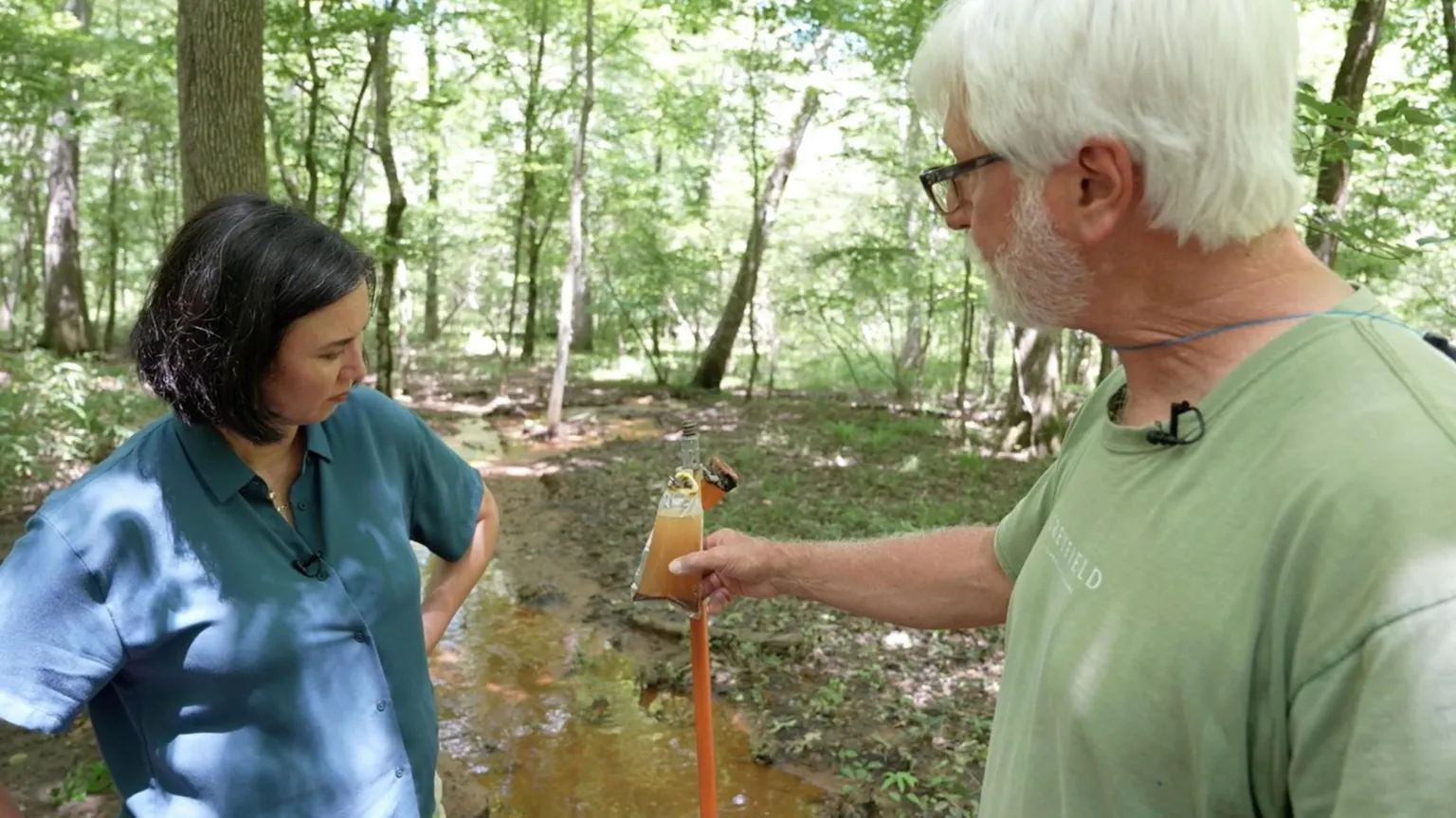
Gordon Rogers is the executive director of Flint Riverkeeper, a non-profit advocacy group that monitors the health of Georgia's Flint River. He takes us to a creek downhill from a new construction site for a data centre being built by US firm Quality Technology Services (QTS).
George Diets, a local volunteer, scoops up a sample of the water into a clear plastic bag. It's cloudy and brown.
"It shouldn't be that colour," he says. To him, this suggests sediment runoff - and possibly flocculants. These are chemicals used in construction to bind soil and prevent erosion, but if they escape into the water system, they can create sludge.
QTS says its data centres meet high environmental standards and bring millions in local tax revenue.
While construction is often carried out by third-party contractors, local residents are the ones left to deal with the consequences.
…A single AI query - for example, a request to ChatGPT - can use about as much water as a small bottle you'd buy from the corner shop. Multiply that by billions of queries a day, and the scale becomes clear.
https://ichef.bbci.co.uk/news/1536/cpsprodpb/1cc8/live/9dd2a020-5c9e-11f0-b8c6-458cd8075fd5.jpg.webp
Gordon Rogers takes regular water samples to monitor the health of Georgia's Flint River
Prof Rajiv Garg teaches cloud computing at Emory University in Atlanta. He says these data centres aren't going away - if anything, they're becoming the backbone of modern life.
"There's no turning back," Prof Garg says.
…Data centres have become more than just an industry trend - they're now part of national policy. President Donald Trump recently vowed to build the largest AI infrastructure project in history, calling it "a future powered by American data".
…As AI grows, the challenge is clear: how to power tomorrow's digital world without draining the most basic resource of all - water.