Saturday, February 28, 2026
Ca Sĩ Đức Tuấn và Nhạc Phạm Duy
Album Tình Khúc Phạm Duy Ca sĩ: Đức Tuấn Đức Tuấn Channel - Kênh Youtube chính thức của ca sĩ Đức Tuấn.
Đức Tuấn (sinh 1980) là một ca sĩ Việt Nam đoạt giải nhất Tiếng hát Truyền hình thành phố Hồ Chí Minh năm 2000 và Thí sinh biểu diễn xuất sắc nhất và Thí sinh được yêu thích nhất của Liên hoan giọng ca truyền hình ASEAN 2012.
https://www.youtube.com/watch?v=arCztKW1Uao&list=RDWewp0ptdNWw&index=5
ĐỨC TUẤN - THUYỀN VIỄN XỨ (PHẠM DUY)
https://www.youtube.com/watch?v=QjUMWAiTwxA&list=RDWewp0ptdNWw&index=3
ĐỨC TUẤN - XANH BẠC MÁI ĐẦU (ÁO LỤA HÀ ĐÔNG OST)
https://www.youtube.com/watch?v=7sKXjfI4FGs&list=RD7sKXjfI4FGs&start_radio=1
TÌNH CA (PHẠM DUY) - ĐỨC TUẤN
https://www.youtube.com/watch?v=Ql3wvbhUlUs&list=RD7sKXjfI4FGs&index=3
NƯƠNG CHIỀU (PHẠM DUY) - ĐỨC TUẤN
https://www.youtube.com/watch?v=uAe7R3wlux0&list=RD7sKXjfI4FGs&index=4
Thiên Thai - Đức Tuấn
https://www.youtube.com/watch?v=Wlx9zFIDQNg&list=RD7sKXjfI4FGs&index=5
BÀ MẸ GIO LINH (PHẠM DUY) - DUY QUANG
https://www.youtube.com/watch?v=Wewp0ptdNWw&list=RDWewp0ptdNWw&start_radio=1
Album Tình Khúc Phạm Duy Ca sĩ: Đức Tuấn Đức Tuấn Channel - Kênh Youtube chính thức của ca sĩ Đức Tuấn.
Đức Tuấn (sinh 1980) là một ca sĩ Việt Nam đoạt giải nhất Tiếng hát Truyền hình thành phố Hồ Chí Minh năm 2000 và Thí sinh biểu diễn xuất sắc nhất và Thí sinh được yêu thích nhất của Liên hoan giọng ca truyền hình ASEAN 2012.


Friday, February 27, 2026
This community festival embraces the joys of a frozen lake — while it still has one
https://www.npr.org/sections/the-picture-show/2026/02/27/g-s1-111346/madison-wisconsin-frozen-assets-festival
This community festival embraces the joys of a frozen lake — while it still has one
February 27, 20263:00 AM ET
Berly McCoy
https://npr.brightspotcdn.com/dims3/default/strip/false/crop/8640x5760+0+0/resize/2000/quality/85/format/webp/?url=http%3A%2F%2Fnpr-brightspot.s3.amazonaws.com%2F38%2F97%2F1993047d431f8d22af1131a2da8b%2Fice-festival-59.jpg
 People gather on Lake Mendota near an inflatable Statue of Liberty crown and torch at the 2026 Winter Carnival on Feb. 7 in Madison, Wis.
MADISON, Wis. — Earlier this month, Madison, Wis., was host to the city's 14th annual Frozen Assets Festival. "When our lakes are frozen, they are truly our greatest asset," says James Tye, executive director and founder of Clean Lakes Alliance, the nonprofit that hosts the festival.
This time of year, frozen lakes are a part of life here. The city was built on an isthmus — a thin strip of land between two bodies of water. Lake Mendota and Lake Monona border the city's historic downtown on either side, with the strip of land running about a mile wide at its thinnest. The lakes are visible from many places in town. In wintertime, ice fishing, skating, ice sailing and snowshoeing are all common sights.
Historically, people valued the ice for other reasons. "There's a long history of ice harvesting in this region," says Hilary Dugan, a limnologist — someone who studies inland waters — at the University of Wisconsin, Madison. "So [there was] just a lot of commercial activity on these lakes, cutting blocks of ice out of the lakes all winter."
Frozen lakes were so important to the city that records of when the ice froze each year go back more than 100 years. Today, there's even a contest where people guess the day Lake Mendota will freeze. On average, that date is getting later.
https://npr.brightspotcdn.com/dims3/default/strip/false/crop/5044x3363+0+0/resize/2000/quality/85/format/webp/?url=http%3A%2F%2Fnpr-brightspot.s3.amazonaws.com%2F56%2F5d%2F7218af9f411ea3f6319ae0decb6d%2Fice-festival-38.jpg
People gather on Lake Mendota near an inflatable Statue of Liberty crown and torch at the 2026 Winter Carnival on Feb. 7 in Madison, Wis.
MADISON, Wis. — Earlier this month, Madison, Wis., was host to the city's 14th annual Frozen Assets Festival. "When our lakes are frozen, they are truly our greatest asset," says James Tye, executive director and founder of Clean Lakes Alliance, the nonprofit that hosts the festival.
This time of year, frozen lakes are a part of life here. The city was built on an isthmus — a thin strip of land between two bodies of water. Lake Mendota and Lake Monona border the city's historic downtown on either side, with the strip of land running about a mile wide at its thinnest. The lakes are visible from many places in town. In wintertime, ice fishing, skating, ice sailing and snowshoeing are all common sights.
Historically, people valued the ice for other reasons. "There's a long history of ice harvesting in this region," says Hilary Dugan, a limnologist — someone who studies inland waters — at the University of Wisconsin, Madison. "So [there was] just a lot of commercial activity on these lakes, cutting blocks of ice out of the lakes all winter."
Frozen lakes were so important to the city that records of when the ice froze each year go back more than 100 years. Today, there's even a contest where people guess the day Lake Mendota will freeze. On average, that date is getting later.
https://npr.brightspotcdn.com/dims3/default/strip/false/crop/5044x3363+0+0/resize/2000/quality/85/format/webp/?url=http%3A%2F%2Fnpr-brightspot.s3.amazonaws.com%2F56%2F5d%2F7218af9f411ea3f6319ae0decb6d%2Fice-festival-38.jpg
 Hilary Dugan, a limnologist at the University of Wisconsin, Madison, poses for a portrait behind a hole she drilled on Lake Mendota during the city's annual Frozen Assets Festival on Feb. 7.
"We've actually lost about a month of lake ice duration here in Madison," says Dugan. And the ice that does form isn't always safe. "Traditionally, these were lakes that froze really safely every winter. And that's becoming less — we're less confident in that, going into the future."
As climate change accelerates, fluctuations in winter temperatures increase, which leads to unpredictable ice conditions. That was the case two years ago, in 2024, when the on-ice portion of the Frozen Assets Festival was cancelled. "At that point, it was just too warm. There were weird little things going on [on the ice], and so we called it to be on land," says Tye.
This year, Lake Mendota had over a foot of ice in early February, which was more than enough to hold the festival's 1,000-plus attendees. The event featured kite flyers, sky divers, ice hockey and the only 5K that takes place solely on ice.
Here is a selection of images from this year's festival:
https://npr.brightspotcdn.com/dims3/default/strip/false/crop/4563x3042+0+0/resize/2000/quality/85/format/webp/?url=http%3A%2F%2Fnpr-brightspot.s3.amazonaws.com%2Ff7%2F9c%2F5f4a6cd34c929413cb0dbc28ec83%2Fice-festival-09.jpg
Hilary Dugan, a limnologist at the University of Wisconsin, Madison, poses for a portrait behind a hole she drilled on Lake Mendota during the city's annual Frozen Assets Festival on Feb. 7.
"We've actually lost about a month of lake ice duration here in Madison," says Dugan. And the ice that does form isn't always safe. "Traditionally, these were lakes that froze really safely every winter. And that's becoming less — we're less confident in that, going into the future."
As climate change accelerates, fluctuations in winter temperatures increase, which leads to unpredictable ice conditions. That was the case two years ago, in 2024, when the on-ice portion of the Frozen Assets Festival was cancelled. "At that point, it was just too warm. There were weird little things going on [on the ice], and so we called it to be on land," says Tye.
This year, Lake Mendota had over a foot of ice in early February, which was more than enough to hold the festival's 1,000-plus attendees. The event featured kite flyers, sky divers, ice hockey and the only 5K that takes place solely on ice.
Here is a selection of images from this year's festival:
https://npr.brightspotcdn.com/dims3/default/strip/false/crop/4563x3042+0+0/resize/2000/quality/85/format/webp/?url=http%3A%2F%2Fnpr-brightspot.s3.amazonaws.com%2Ff7%2F9c%2F5f4a6cd34c929413cb0dbc28ec83%2Fice-festival-09.jpg
 A competitor runs in ice skates during a 5K during the Frozen Assets Festival on Lake Mendota on Feb. 7 in Madison, Wis.
https://npr.brightspotcdn.com/dims3/default/strip/false/crop/4455x2970+0+0/resize/2000/quality/85/format/webp/?url=http%3A%2F%2Fnpr-brightspot.s3.amazonaws.com%2Fa8%2F88%2F8b36ff054735b4884005b1cae107%2Fice-festival-07.jpg
A competitor runs in ice skates during a 5K during the Frozen Assets Festival on Lake Mendota on Feb. 7 in Madison, Wis.
https://npr.brightspotcdn.com/dims3/default/strip/false/crop/4455x2970+0+0/resize/2000/quality/85/format/webp/?url=http%3A%2F%2Fnpr-brightspot.s3.amazonaws.com%2Fa8%2F88%2F8b36ff054735b4884005b1cae107%2Fice-festival-07.jpg
 Runners warm up before the annual Frozen Assets Festival's 5K.
https://npr.brightspotcdn.com/dims3/default/strip/false/crop/4875x3755+0+0/resize/2000/quality/85/format/webp/?url=http%3A%2F%2Fnpr-brightspot.s3.amazonaws.com%2F02%2F14%2F40b6a98f43538bd39b5558741036%2Fice-festival-16.jpg
Runners warm up before the annual Frozen Assets Festival's 5K.
https://npr.brightspotcdn.com/dims3/default/strip/false/crop/4875x3755+0+0/resize/2000/quality/85/format/webp/?url=http%3A%2F%2Fnpr-brightspot.s3.amazonaws.com%2F02%2F14%2F40b6a98f43538bd39b5558741036%2Fice-festival-16.jpg
 Competitors run on Lake Mendota in Madison, Wis., during the annual Frozen Assets Festival's 5K on Saturday, Feb. 7.
https://npr.brightspotcdn.com/dims3/default/strip/false/crop/4420x3336+0+0/resize/2000/quality/85/format/webp/?url=http%3A%2F%2Fnpr-brightspot.s3.amazonaws.com%2F5e%2Ffe%2F6c3dbbeb4d70a87b15847fe8a0d4%2Fice-festival-19.jpg
Competitors run on Lake Mendota in Madison, Wis., during the annual Frozen Assets Festival's 5K on Saturday, Feb. 7.
https://npr.brightspotcdn.com/dims3/default/strip/false/crop/4420x3336+0+0/resize/2000/quality/85/format/webp/?url=http%3A%2F%2Fnpr-brightspot.s3.amazonaws.com%2F5e%2Ffe%2F6c3dbbeb4d70a87b15847fe8a0d4%2Fice-festival-19.jpg
 Lincoln Haldeman (right) and his sister Piper (center) measure ice thickness with Helen Schlimm (left), a researcher at UW-Madison's Center for Limnology, during a science demonstration at the annual Frozen Assets Festival on Lake Mendota on Saturday, Feb. 7.
https://npr.brightspotcdn.com/dims3/default/strip/false/crop/4808x3205+0+0/resize/2000/quality/85/format/webp/?url=http%3A%2F%2Fnpr-brightspot.s3.amazonaws.com%2Ff7%2Fa7%2Fee281dbf45f7a3580c86fffaad38%2Fice-festival-32.jpg
Lincoln Haldeman (right) and his sister Piper (center) measure ice thickness with Helen Schlimm (left), a researcher at UW-Madison's Center for Limnology, during a science demonstration at the annual Frozen Assets Festival on Lake Mendota on Saturday, Feb. 7.
https://npr.brightspotcdn.com/dims3/default/strip/false/crop/4808x3205+0+0/resize/2000/quality/85/format/webp/?url=http%3A%2F%2Fnpr-brightspot.s3.amazonaws.com%2Ff7%2Fa7%2Fee281dbf45f7a3580c86fffaad38%2Fice-festival-32.jpg
 Bill Quackenbush, of Ho-Chunk Nation (right), teaches Praneeth Kolli (left) how to compete in the snow snake competition during the city's annual Frozen Assets Festival on Lake Mendota. Snow snake is a traditional Indigenous winter sport where players slide handcrafted wooden sticks down a trench made of snow for distance.
https://npr.brightspotcdn.com/dims3/default/strip/false/crop/4414x3000+0+0/resize/2000/quality/85/format/webp/?url=http%3A%2F%2Fnpr-brightspot.s3.amazonaws.com%2F16%2Fa4%2Fc60701c3437fafd70c19182b3a8c%2Fice-festival-28.jpg
Bill Quackenbush, of Ho-Chunk Nation (right), teaches Praneeth Kolli (left) how to compete in the snow snake competition during the city's annual Frozen Assets Festival on Lake Mendota. Snow snake is a traditional Indigenous winter sport where players slide handcrafted wooden sticks down a trench made of snow for distance.
https://npr.brightspotcdn.com/dims3/default/strip/false/crop/4414x3000+0+0/resize/2000/quality/85/format/webp/?url=http%3A%2F%2Fnpr-brightspot.s3.amazonaws.com%2F16%2Fa4%2Fc60701c3437fafd70c19182b3a8c%2Fice-festival-28.jpg
 People skate during the Frozen Assets Festival at the Edgewater Hotel's ice rink on Saturday, Feb. 7, in Madison, Wis.
https://npr.brightspotcdn.com/dims3/default/strip/false/crop/3710x2473+0+0/resize/2000/quality/85/format/webp/?url=http%3A%2F%2Fnpr-brightspot.s3.amazonaws.com%2Fca%2F00%2Fb767efaf42b7b1b5408695ad5ec6%2Fice-festival-40.jpg
People skate during the Frozen Assets Festival at the Edgewater Hotel's ice rink on Saturday, Feb. 7, in Madison, Wis.
https://npr.brightspotcdn.com/dims3/default/strip/false/crop/3710x2473+0+0/resize/2000/quality/85/format/webp/?url=http%3A%2F%2Fnpr-brightspot.s3.amazonaws.com%2Fca%2F00%2Fb767efaf42b7b1b5408695ad5ec6%2Fice-festival-40.jpg
 A child plays in a sea of fish kites at the Frozen Assets Festival on Lake Mendota.
https://npr.brightspotcdn.com/dims3/default/strip/false/crop/4583x3055+0+0/resize/2000/quality/85/format/webp/?url=http%3A%2F%2Fnpr-brightspot.s3.amazonaws.com%2F88%2F0a%2F238ea9a14ed9b9473950b081a09f%2Fice-festival-39.jpg
A child plays in a sea of fish kites at the Frozen Assets Festival on Lake Mendota.
https://npr.brightspotcdn.com/dims3/default/strip/false/crop/4583x3055+0+0/resize/2000/quality/85/format/webp/?url=http%3A%2F%2Fnpr-brightspot.s3.amazonaws.com%2F88%2F0a%2F238ea9a14ed9b9473950b081a09f%2Fice-festival-39.jpg
 Tannia Serna (left) and Madeline Sudnick pose for a portrait with an owl kite on Lake Mendota during the annual Frozen Assets Festival.
https://npr.brightspotcdn.com/dims3/default/strip/false/crop/5884x3923+0+0/resize/2000/quality/85/format/webp/?url=http%3A%2F%2Fnpr-brightspot.s3.amazonaws.com%2F34%2Fac%2Ff23b369e45ba93210a47c69d3889%2Fice-festival-43.jpg
Tannia Serna (left) and Madeline Sudnick pose for a portrait with an owl kite on Lake Mendota during the annual Frozen Assets Festival.
https://npr.brightspotcdn.com/dims3/default/strip/false/crop/5884x3923+0+0/resize/2000/quality/85/format/webp/?url=http%3A%2F%2Fnpr-brightspot.s3.amazonaws.com%2F34%2Fac%2Ff23b369e45ba93210a47c69d3889%2Fice-festival-43.jpg
 A skydiver glides through the air during the Frozen Assets Festival above Lake Mendota and Madison, Wis., on Saturday, Feb. 7.
https://npr.brightspotcdn.com/dims3/default/strip/false/crop/7001x4667+0+0/resize/2000/quality/85/format/webp/?url=http%3A%2F%2Fnpr-brightspot.s3.amazonaws.com%2F03%2F00%2F7926276248f0a8f5041b6947f281%2Fice-festival-72.jpg
A skydiver glides through the air during the Frozen Assets Festival above Lake Mendota and Madison, Wis., on Saturday, Feb. 7.
https://npr.brightspotcdn.com/dims3/default/strip/false/crop/7001x4667+0+0/resize/2000/quality/85/format/webp/?url=http%3A%2F%2Fnpr-brightspot.s3.amazonaws.com%2F03%2F00%2F7926276248f0a8f5041b6947f281%2Fice-festival-72.jpg
 Tony Pavlak scoops slush off the water's surface in a hole drilled on Monona Bay while ice fishing.
https://npr.brightspotcdn.com/dims3/default/strip/false/crop/6569x4379+0+0/resize/2000/quality/85/format/webp/?url=http%3A%2F%2Fnpr-brightspot.s3.amazonaws.com%2F18%2F19%2F6c0473344c0d93cb3edbe2c76839%2Fice-festival-70.jpg
Tony Pavlak scoops slush off the water's surface in a hole drilled on Monona Bay while ice fishing.
https://npr.brightspotcdn.com/dims3/default/strip/false/crop/6569x4379+0+0/resize/2000/quality/85/format/webp/?url=http%3A%2F%2Fnpr-brightspot.s3.amazonaws.com%2F18%2F19%2F6c0473344c0d93cb3edbe2c76839%2Fice-festival-70.jpg
 A blue gill and ice skimmer rest on the ice as Tony Pavlak ice fishes on Monona Bay.
https://npr.brightspotcdn.com/dims3/default/strip/false/crop/5719x3813+0+0/resize/2000/quality/85/format/webp/?url=http%3A%2F%2Fnpr-brightspot.s3.amazonaws.com%2Fc5%2F50%2F81b68f9846998eb26ba0741fcc8f%2Fice-festival-29.jpg
A blue gill and ice skimmer rest on the ice as Tony Pavlak ice fishes on Monona Bay.
https://npr.brightspotcdn.com/dims3/default/strip/false/crop/5719x3813+0+0/resize/2000/quality/85/format/webp/?url=http%3A%2F%2Fnpr-brightspot.s3.amazonaws.com%2Fc5%2F50%2F81b68f9846998eb26ba0741fcc8f%2Fice-festival-29.jpg
 People gather on Lake Mendota for the 2026 Frozen Assets Festival on Saturday, Feb. 7, in Madison, Wis.
Kayla Wolf for NPR
https://www.npr.org/sections/the-picture-show/2026/02/27/g-s1-111346/madison-wisconsin-frozen-assets-festival
People gather on Lake Mendota for the 2026 Frozen Assets Festival on Saturday, Feb. 7, in Madison, Wis.
Kayla Wolf for NPR
https://www.npr.org/sections/the-picture-show/2026/02/27/g-s1-111346/madison-wisconsin-frozen-assets-festival
Tuesday, February 24, 2026
RẠN NỨT TRONG PHONG TRÀO MAGA
https://www.diendan.org/the-gioi/ran-nut-trong-phong-trao-maga
RẠN NỨT TRONG PHONG TRÀO MAGA
Trần Đán
Trước khi nói đến rạn nứt trong phong trào MAGA (Make America Great Again), tôi muốn nhắc sơ qua nguồn gốc của MAGA.
Các nhà xã hội học và chính trị học tại đại học Cambridge, Anh quốc, dựa trên các cuộc khảo sát lâu dài các thành viên MAGA, và dựa trên lời tuyên bố và hành vi của các lãnh tụ MAGA – trong đó nổi bật nhất là Tổng thống Donald Trump – đã đưa ra kết luận : Trong bối cảnh những thay đổi sâu sắc về kinh tế, văn hóa, chính trị ở Mỹ, MAGA là sự nổi dậy của một tầng lớp xã hội nhận thức họ bị mất dần “địa vị xã hội” (social status) và muốn giành lại thời kỳ vàng son. Tôi gọi đó là triệu chứng “Hi vọng Da trắng Cuối cùng” (The Last White Hope).
Từ địa vị nam giới nắm giữ kinh tế gia đình đến sự “mất quyền” vào tay phụ nữ ngày càng leo thang trong xã hội, từ địa vị tầng lớp da trắng làm chủ tầng lớp nhân viên lao động da màu nay phải tùng phục xếp người da màu, từ địa vị một chỉ huy trưởng quyền uy trong quân đội đến việc tuân lệnh các chỉ huy phụ nữ hay da màu, từ phổ biến một tôn giáo độc tôn đến phải “sống chung” với nhiều
tôn giáo xa lạ – và được xem là “thấp kém” hơn – từ hưởng thụ địa vị nam giới độc tôn đến sự thách thức của các giới tính khác, MAGA là một phản ứng muốn “xóa bỏ” những “tiến bộ” không ngừng trong xã hội Mỹ – tôi không thích dùng từ “một phong trào phản động” được một số học giả dùng.
Nhìn chung, MAGA hô hào quay về với mô hình xã hội Mỹ nơi đó các giá trị cốt lõi của người da trắng – đi kèm với quyền lực – phải được tái lập. Không lạ gì mà nhóm cử tri ủng hộ Trump đông nhất là đàn ông da trắng.
Cái gọi là “tầng lớp xã hội” đó không đơn giản được phân chia theo giàu nghèo, chủng tộc, tôn giáo, giới tính mà pha trộn lẫn nhau nên các lý thuyết chính trị học cổ điển không giải thích được một cách tinh gọn.
Một thành viên MAGA có thể là một công nhân mất việc trong cuộc toàn cầu hóa kinh tế, nhưng cũng có thể là một nhà đại tư bản như Elon Musk (Tesla), Peter Thiel (Palantir), Jeff Bezos (Amazon), Mark Zuckerber (Facebook), là một thành viên của nhóm da trắng thượng đẳng (white suppremasist) Proud Boys nhưng cũng có thể thuộc nhóm Blacks for Trump, Latinos for Trumps hay …”Vietnamese for Trump”, là một giám mục Công giáo chống lại phá thai nhưng cũng có thể là một mục sư Tin lành muốn một nước Mỹ tuyệt đối tuân thủ đạo lý trong KinhThánh Thiên Chúa Giáo, là một nhà lập pháp muốn bảo vệ quyền mưu cầu hạnh phúc trừ quyền mưu cầu hạnh phúc của các cặp đồng tính. Ta nên nhớ MAGA là một phong trào quy tụ những người cùng tư tưởng, chứ không phải một đảng phái với thành viên chính thức.
Nhưng các nhà đại tư bản da trắng như Trump hay Musk đã mất địa vị, mất quyền đâu? Đây là điểm tạo nên huyền thoại. Theo MAGA một vị cứu tinh xuất thân từ chính “giới tinh hoa” do nhận thức được nguy cơ về sự “trượt dốc quyền lực” của chủng tộc da trắng, sẽ đứng lên dẫn dắt MAGA đến vùng “đất hứa”. Người nắm được thời cơ đó chính là nhà tỉ phú Donald Trump.
Bầu cử 2024: đảng Dân Chủ dưới sự lãnh đạo của Joe Biden, và Kamala Harris kế thừa, bị đại bại. Tại các “tiểu bang chiến trường” (battleground states), những nhóm cử tri từng ủng hộ đảng Dân Chủ đã quay lưng với họ hàng loạt. Một bộ phận không nhỏ của giới công nhân thuộc các công đoàn, giới trẻ, phụ nữ, thậm chí dân da màu từng là trụ cột của đảng Dân Chủ, quay sang bỏ phiếu cho Trump, hay từ chối không đi bầu.
Bốn điều họ thất vọng về Biden là:
1) giá cả cao,
2) tình trạng nhập cư hỗn loạn,
3) để xảy ra vụ diệt chủng dân Palestine,
4) để cuộc chiến Ukraine-Nga kéo dài.
Họ tin vào lời hứa của vị “cứu tinh” rằng ông ta sẽ nhanh chóng giải quyết cả 4 vấn đề, có vụ ”chỉ trong vòng 24 tiếng đồng hồ, ” rằng ông ta mang sứ mệnh từ đấng Tối Cao, rằng ông sẽ đáp ứng lòng tin của những người “thật sự yêu nước” để vực dậy nước Mỹ và Làm cho Nó Vĩ đại Trở lại. Make America Great Again.
Thế thì sau một năm cầm quyền, vị cứu tinh đã làm được gì? Dân MAGA đã đến đất hứa chưa? Theo tôi, những thay đổi cực đoan của ông đã tạo ra sự rạn nứt sâu sắc trong hàng ngũ MAGA.
Dù lòng tin có mù quáng đến đâu nhưng khi việc làm của lãnh tụ không đi đôi với lời hứa, thì có ngày sự tỉnh ngộ cùng sẽ đến. Và như đã nói trên, sau một nămcầm quyền, dân MAGA vẫn không thấy được tôn trọng hơn, không thấy địa vị của họ được củng cố, không thấy đời sống của họ sung túc hơn. Và họ bắt đầu đặt nghi vấn.
Sự nổi loạn đau đớn nhất đến từ Marjorie Taylor Green, nữ dân biểu bang Georgia. Một đệ tử trung thành của Trump từ những ngày đầu, cô đã quay lưng với Trump, chỉ trích ông ta đã phản bội lý tưởng MAGA, đã không tập trung giải quyết các vấn đề dân sinh, giá cả trong nước mà lún sâu vào các rối ren quốc tế như Ukraine, Venezuala, Greenland and Iran – trái với lời hứa bỏ mặc thế giới để
tập trung vào xây dựng nước Mỹ. Cô đã từ chức dân biểu trước cuộc bầu cử giữa kỳ, tạo cơ hội cho đảng Dân Chủ giành ghế.
Điều ghê tởm nhất làm cô ấy tỉnh ngộ là hồ sơ Epstein. Trước đây, trong thời gian Trump tranh cử lần đầu, cô là người truyền bá thuyết âm mưu QAnon, tố cáo giới “tinh hoa”, ám chỉ đảng Dân Chủ, phạm tội ấu dâm và buôn người. Giờ đây, với hàng chục chứng nhân nữ tố cáo Trump dính đến, hay ít nhất dung dưỡng, tội ác của Epstein, Green cảm thấy bức xúc. Không rõ cô bức xúc vì lương tâm hay vì lý do chính trị. Nhưng với sự đốc thúc của Green, toàn bộ đảng viên đảng Cộng Hoà trong Hạ Viện đã bỏ phiếu buộc Bộ Tư Pháp dưới quyền của tay chân thân tín của Trump, Pam Bondi, phải công bố toàn bộ hồ sơ Epstein. Lúc đầu Trump tuyên bố hùng hồn rằng hồ sơ Epstein là một sự “bày đặt” (hoax) của phe Dân Chủ, nhưng trước sức ép của các thế lực truyền thông (influencer) MAGA ông đã phải nhượng bộ. Dù vậy, cho đến nay bộ Tư Pháp vẫn viện đủ cớ để công bố chỉ 3 triệu trên gần 6 triệu trang tài liệu, với chằng chịt dấu bôi xóa. Có thành viên đảng Dân Chủ nào
nằm trong tập tài liệu? Có. Nhưng oái ăm nhất là sự có mặt của “trùm” cố vấn MAGA, Steve Bannon, và biết bao nhiêu nhà tài phiệt ủng hộ Trump.
Rạn nứt thứ hai nằm trong vấn đề thực thi chính sách di trú. Theo các cuộc thăm dò, mặc dù đa số dân Mỹ ủng hộ các biện pháp chống tình trạng nhập cư hỗn loạn, họ nhận thấy việc thực thi đã “đi quá đà.” Hàng ngày cảnh đặc vụ Cơ quan Thực thi Luật Di trú và Hải quan (ICE) và Tuần tra Biên giới (Border Patrol) trùm kín mặt, không mang thẻ nhận diện, trang bị vũ khí đầy mình, và bắt người không trát toà – phạm pháp hay không thì hạ hồi phân giải sau khi đã bị đưa về những trại tập trung, hoặc bị trục xuất sang những nước không phải là quê hương – đãkhiến dân chúng bất bình. Sau vụ ICE và BP bắn chết hai công dân Mỹ da trắng tại Minneapolis, nhà truyền thông MAGA có thế lực Joe Rogan đã phải thốt lên, “không lẽ ta lại hành xử như Gestapo (mật vụ Đức Quốc Xã)?”. Làn sóng phản đối đã khiến Trump phải vội vã ra lệnh triệt thoái khỏi Minneapolis, nhưng ông không chịu đuổi việc người chịu trách nhiệm, bộ trưởng bộ Nội an Khristi Noem.
Rạn nứt thứ ba xảy ra khá bất ngờ khi một bộ phận MAGA, mà Hiệp hội Vũ khí Quốc gia (National Rifle Association) là đại diện lên tiếng phản đối lời tố cáo của chính quyền rằng họ có quyền giết Alex Pretti, một công dân Mỹ da trắng, vì anh ta mang súng trong người. Video do dân chúng quay cho thấy, trái với lời tố cáo của bộ trưởng Bộ Nội an Kristi Noem, không lúc nào Pretti đã đe dọa tính mạng của đặc vụ ICE. Với MAGA quyền thứ 2 trong Tuyên ngôn Nhân quyền Mỹ, tức quyền công dân được sở hữu súng, là một quyền bất khả xâm phạm đã từng khiến họ bỏ phiếu cho Trump.
Rạn nứt thứ tư nằm trong phạm vi kinh tế. Những chính sách kinh tế, tài chính nằm trong Bộ Luật Khổng lồ và Tuyệt đẹp (Big Beautiful Bill) do đảng Cộng Hoà thông qua, lợi nhiều cho người giàu nhưng chẳng lợi gì cho người nghèo. Nó giảm thuế cá nhân cho những gia đình có thu nhập hơn $127.000 hàng năm. Nó giảm thuế cho các công ty từ cao nhất 35% xuống thành 21%, mặc dù đã qua nạn dịch Covid. Để bù cho thâm thụt ngân sách, bộ luật BBB đã cắt khoản chi tiêu dành cho giáo dục, ý tế, hỗ trợ thực phẩm cho dân nghèo. Bao nhiêu trong đó là dân MAGA? Cộng vào đó chiến dịch DOGE do Elon Musk chủ trì đã viện lý do “làm guồng máy hành chính hiệu quả hơn” để sa thải hơn 300.000 nhân viên liên bang. Bao nhiêu trong số họ là dân MAGA?
Đồng thời hàng rào thuế quan mà Trump dựng lên với luận điểm bảo vệ việc làm cho công nhân, nông dân Mỹ đã gây ra tác dụng ngược. Trái với lời giải thích cực kỳ phản kinh tế của Trump, báo cáo của Cục Dự trữ Liên bang New York đã chỉ ra thuế nhập khẩu không do các nhà sản xuất nước ngoài đóng mà do các công ty nhập khẩu nhỏ và vừa của Mỹ đóng. Các công ty nhập khẩu này chuyển thuế sang người tiêu dùng bằng cách tăng giá thành phẩm, khiến vật giá tăng. Nhiều nông dân Mỹ cũng bị phá sản khi khách hàng đậu nành và bắp lớn nhất của họ, Trung Quốc, trả đũa bằng cách mua của nước khác.
Rạn nứt thứ năm thuộc phạm vi y tế. Đảng Cộng Hoà tại Quốc Hội đã bãi bỏ trợ cấp chính phủ trong chương trình Obamacare khiến 3-4 triệu người có thu nhập thấp không mua nổi bảo hiểm y tế. Cả đảng Cộng Hoà lẫn Trump đều bất lực không đưa ra một chương trình hỗ trợ nào khác tốt hơn sau nhiều hứa hẹn. Trong đó bao nhiêu là dân MAGA bị ảnh hưởng? Đồng thời, phong trào MAHA (Make Americans Healthy Again) vừa chỉ trích dữ dội Trump thông qua bộ trưởng Bộ Y tế Robert Kennedy Jr vì họ đốc thúc việc sản xuất chất glyphosate, một chất diệt cỏ đã được chứng minh gây ung thư. Trump cũng ngừng hỗ trợ xe điện, điện gió, chủ trương tăng cường đào dầu, và chấm dứt lệnh bắt buộc ngành điện than giới hạn thải chất mercury gây ung thư vào môi trường. Bao nhiêu dân MAGA sẽ bị đầu độc vì thực phẩm, chết vì ô nhiễm?
Rạn nứt thứ sáu thuộc ngành tư pháp. Tôi không muốn gán cho các thẩm phán được Trump hay các tổng thống Cộng hoà trước đó bổ nhiệm vào Tối cao Pháp viện (TCPV) là thân thiện với chủ thuyết MAGA, nhưng từ trước đến nay họ đã đưa ra những phán quyết đồng loạt thiên vị tổng thống. Nghiêm trọng nhất cho nền dân chủ là phán quyết cho rằng một vị tổng thống không thể bị buộc tội vì bất cứ lý do gì khi còn tại vị. Phán quyết đó đã bắt dừng tất cả các cuộc điều tra về tội phạm của Trump khi ông ta tìm đủ mọi cách để ngăn chặn việc Joe Biden thắng cử, kể cả khuyến khích cuộc bạo loạn 6/1/2021. Thế nhưng, ngày 20/2/2026 vừa qua, TCPV đã làm một điều gây chấn kinh ngạc. Với tỉ số 6-3, họ bác bỏ toàn bộ chính sách thuế quan của Trump, cho đó là đặc quyền của Quốc hội. Báo chí Mỹ đồng loạt ca ngợi sự “dũng cảm” của Tối cao Pháp viện đã cuối cùng dám đứng lên bênh vực hiến pháp.
Lo ngại đảng Cộng Hoà sẽ trở thành thiểu số tại Quốc hội trong kỳ bầu cử sắp đến, Trump không từ bỏ bất cứ thủ đoạn nào để lũng đoạn quy trình bầu cử. Một trong những cách đó là gây áp lực, nếu không muốn gọi là răn đe, lãnh đạo các bang do đảng Cộng hoà nắm phải “tái phân định địa hạt bầu cử” (redistricting). Texas là bang lớn đầu tiên đã thực thi lệnh của Trump, dành cho đảng Cộng Hoà 5 ghế. Lập tức bang California đối phó lại, dành 5 ghế cho đảng Dân Chủ. Không từ bỏ tham vọng, Trump tạo sức ép lên các bang Cộng Hoà Missouri, Ohio, North Carolina, kéo theo những đòn phản pháo từ các bang Dân Chủ. Nhưng rạn nứt trong đảng Cộng Hoà lần đầu xuất hiện khi tại bang Indiana, Thượng viện Tiểu bang với đa số Cộng Hoà đã bỏ phiếu 31-19 từ chối phục tùng. Thượng nghị sĩ 76 tuổi Jean Leising, sau 3 lần bầu cho Trump, kể lại: “Khi nghe cháu nội tôi thuật lại rằng tổng thống bêu xấu chúng tôi trên truyền thông, tôi đã rất tức giận…Muốn người ta thay đổi chính kiến, hành vi dọa dẫm không bao giờ có hiệu quả.”
Các cuộc thăm dò tuy chưa phản ảnh đầy đủ sự rạn nứt trong phong trào MAGA, nhưng cũng đủ làm các chiến lược gia đảng Cộng Hoà hốt hoảng. Họ yêu cầu Trump thay đổi thông điệp, nói nhiều hơn về các chủ đề dân sinh, nhưng vô vọng. Ông vẫn một mực cho rằng vật giá cao và người dân mất khả năng mua nhu yếu phẩm (affordability) là lời đồn thổi của phe Dân Chủ chứ không có thật. Thế nhưng, người dân, trong đó có nhiều dân MAGA, biết rõ giá thực phẩm, điện nước, tiền nhà không ngừng dâng cao. Họ không dễ bị phỉnh gạt. Các cố vấn của Trump lo ngại ông đang lập lại lầm lỗi tai hại của Joe Biden, không tỏ vẻ cảm thông với mối qua tâm hằng ngày của đại đa số cử tri. Tệ hại nhất cuộc thăm dò mới nhất của tổ chức bảo thủ Rasmussen tiết lộ lần đầu tiên 48% dân Mỹ đánh giá Biden là một tổng thống khá hơn Trump (40%).
Trong toàn bộ các nhóm cử tri trong liên minh (coalition) bầu cho Trump đều có sự thoái trào: dân thôn quê, công nhân thuộc công đoàn, người lớn tuổi, người có học vị thấp, thanh niên, kể cả nhóm gốc La-tin. Trong các cuộc bầu cử bất thường giữa năm 2025 tại New York, New Jersey, Virginia, Texas, Florida, ở những địa hạt mà Trump từng thắng đối thủ hơn 10%, lần này cử tri đã bầu cho ứng viên đảng Dân Chủ với tỉ số vượt trội hơn 10%. Nhưng nguy nhất là ngay cả trong nhóm cử tri từng kiên định ủng hộ các chính sách của Trump, nhóm Truyền Giáo Da Trắng (White Evangelicals), nhóm muốn đưa nước Mỹ quay về những giá trị trong Kinh Thánh Thiên Chúa Giáo, đang có sự xói mòn: theo cuộc thăm dò của Trung Tâm Nghiên Cứu Pew, tỉ số ủng hộ sau một năm cầm quyền của Trump tuột từ 69% còn 58%.
Đến cuộc bầu cử nửa kỳ (midterms) vào tháng 11 năm nay, toàn thể 435 ghế dân biểu sẽ được bầu lại. Với tỉ số hiện nay 218 Cộng Hoà và 214 Dân Chủ, với 3 ghế trống, đảng Dân Chủ chỉ cần giành thêm 3 ghế để nắm đa số. Thêm nữa 2/3 ghế thượng nghị sĩ , tức 35 trong số 50, sẽ được bầu lại. Đảng Dân Chủ cần giành thêm 4 ghế để thành đa số. Ngại thua, đã có 30 dân biểu Cộng Hoà không ra tái ứng cử, khiến đảng mất đi các ứng viên thâm niên dễ thắng hơn những ứng viên non.
Dân MAGA sẽ thức tỉnh hay vẫn chìm đắm trong ảo tưởng? Rạn nứt trong phong trào MAGA có biến thành cơn động đất?
Tôi tin rằng lịch sử sẽ một lần nữa chứng minh nước Mỹ mạnh do họ thiết lập được một cơ chế phân quyền bền vững và do sự đóng góp của bao nhiêu nhân tài thế giới đến từ các làn sóng nhập cư. Chưa phải đây là lần đầu các thiết chế của nền dân chủ Mỹ bị lung lay. Nhưng một lần nữa họ sẽ khắc phục được các yếu kém. Từ lúc Hiến pháp Mỹ ra đời năm 1789 đến nay, đã có đến 27 tu chính án (amendmends) tìm cách cải tiến nó. Như nhà chính trị học Pháp Alexis de Tocqueville nhận xét về nước Mỹ trong sách “Nền Dân chủ Mỹ” năm 1851, đấy là một cuộc thử nghiệm đầy hứa hẹn vì tiềm năng “tự chữa lành” của nó.
Feb 22, 2026
Trần Đán
NGUỒN : Diễn Đàn nhận được ngày 23.2.2016
Getting hitched? Protect your finances with a prenup
https://www.npr.org/2023/08/30/1196872794/prenups-arent-just-for-the-rich-and-famous-heres-when-to-consider-one
Getting hitched? Protect your finances with a prenup
Updated August 20, 20249:53 AM ET
Marielle Segarra
This story was originally published on August 30, 2023, and has been updated to include audio from a rerun episode.
When you get married, there are so many details to figure out. The wedding, whether you're changing your last name, how to decorate your new abode.
Amid these decisions, Theresa Viera, a family law attorney based in North Carolina, would like you to spare a moment to consider a prenuptial agreement. It's a legal contract between soon-to-be spouses that lays out how couples will deal with money during a marriage and, if it happens, after a divorce. That includes assets, debts and spousal support.
And they're not just for celebrities and wealthy people with loads of property and investment accounts, says Viera. They're for everybody. In 2023, Axios and the market research firm Harris Poll found that over 50% of U.S. adults polled said they were open to signing a prenup.
Here's what to know about these contracts — and how to decide whether to get one.
Talk about a prenup at least 6 months before the wedding
"It should be one of the first discussions after the engagement ring is exchanged," says Viera. "You don't want the duress of a wedding to influence your decision to enter into a prenup."
While few people want to bring up divorce on the verge of getting married, couples should think of prenups like insurance, says Viera. They're a financial safety net. "We're not preconceiving that a divorce is going to occur. We're discussing important financial issues that come up in every marriage."
Ask yourselves: What are your big financial goals for the future? Do you want a shared bank account? Do you want to own a business someday? Do you want to pay off your student loans separately or together? At what age do you want to retire? In case of divorce, who will get what?
Your answers may determine what to include in your prenup — and whether it's right for you.
Know what happens if you don't get a prenup
"If you get married and you don't have an agreement stating how your finances, your property and your debts are organized during the marriage, then the state laws would apply," says Viera. Every state law is a little different — but prenups basically allow couples to decide how to manage their financial affairs during and after a marriage.
If you decide that a prenuptial agreement isn't for you, Viera tells soon-t0-be spouses to have a tough conversation about their finances anyway. Otherwise, she adds, couples miss out on creating a strong foundation for their marriage. "I've had clients say, 'Hey Theresa, we're OK with how the state laws apply to our situation should we get divorced. We don't need a prenup.' And my response is, 'Good. I'm glad you had the discussion.' "
Get a lawyer
Each spouse should have a lawyer when negotiating a prenup, says Viera. Your legal rights change when you marry, including your tax and estate rights.
Prenups are legally binding contracts, she says. "So you want to know what your legal rights are first and have a clear understanding of that."
Remember: When it comes to kids, prenups can't include details about child support. But they can protect a stay-at-home parent from suffering financially in the event of divorce.
Be ready to pay for your prenup
Yes, prenups cost money — and the cost depends on how much attorneys in your area charge on an hourly basis, says Viera. Where she lives in North Carolina, rates are "anywhere from $175 to $500 an hour."
Attorneys may also quote a flat fee, she adds, which "could be $1,000 or more, depending on their hourly rate and how many hours they think [a case] will take."
Prenups are about taking care of each other
Viera and her fiancé considered a prenup before getting married. Her fiancé has notable retirement accounts and property — and she has three businesses.
Prenups are about taking care of each other, says Viera. They say, "I love you today. I don't know who I'm going to be 10 years from now. And I want you to know that no matter what, I'm going to take care of you, even if our relationship ends in divorce."
The audio portion of this episode was produced by Clare Marie Schneider and edited by Sylvie Douglis. The digital story was edited by Malaka Gharib.
Sunday, February 22, 2026
ĐẠO ĐỨC PHẬT GIÁO
https://thuvienhoasen.org/a43533/cac-tieu-chi-phan-doan-dao-duc-theo-quan-diem-phat-giao-tac-gia-rev-amritananda-viet-dich-quang-co
CÁC TIÊU CHÍ PHÁN ĐOÁN ĐẠO ĐỨC
THEO QUAN ĐIỂM PHẬT GIÁO
Criteria for Moral Judgment, from a Buddhist perspective
Tác giả: Rev. Amritananda
Việt dịch: Quảng Cơ
Biên tập: Tuệ Uyển
Điều mang tính hiển nhiên là mọi tôn giáo đều thừa nhận sự tồn tại của đạo đức và vô đạo đức.
Tuy nhiên, khi đi đến việc xác định và phán đoán một hành động là đạo đức hay phi đạo đức, mỗi tôn giáo và mỗi triết gia lại đưa ra những học thuyết khác nhau. Và mỗi học thuyết lại khác biệt đáng kể so với những học thuyết còn lại, đến mức gần như khiến chúng ta không thể đạt được một sự đồng thuận chung cho câu hỏi: “Thế nào là một hành động đạo đức?”
Một tôn giáo hữu thần, chẳng hạn như Hồi giáo, Kitô giáo hay Ấn Độ giáo, thường sẽ viện dẫn những điều răn của Thượng đế hay các vị thần được ghi trong các kinh điển thiêng liêng của họ — như Kinh Qur’an, Kinh Thánh, hay các bộ Veda và Bhagavad Gita — làm tiêu chí để phán xét một hành động. Vì vậy, đôi khi những hành vi tàn khốc như giết chóc hay tra tấn lại được biện minh là có đạo đức, nếu chúng được xem là nhằm làm vừa lòng hay phụng sự Thượng đế hoặc các vị thần linh của họ.
Các nhà xã hội học hiện đại cho rằng những hành động đạo đức là những hành động góp phần vào sự tồn tại và phát triển của nhân loại.
Đối với người theo thuyết đạo đức tuyệt đối, đạo đức và vô đạo đức được xác định dựa trên những chuẩn mực cố định trong tư tưởng con người. Trong khi đó, người theo thuyết tương đối cho rằng khái niệm đạo đức và phi đạo đức mang tính chủ quan và thay đổi tùy theo từng xã hội. Chính những quan điểm khác biệt này về đạo đức học đã thúc đẩy chúng ta xem xét các tiêu chí đạo đức từ một góc nhìn Phật giáo.
Phật giáo là một tôn giáo lấy con người làm trung tâm, với mối quan tâm cốt lõi là hòa bình, sự chung sống hài hòa của con người trên trái đất và sự phát triển tâm linh của họ. Tuy nhiên, điều này không có nghĩa là Phật giáo hoàn toàn phủ nhận sự tồn tại của các vị thần. Trong kinh điển Phật giáo vẫn có những đề cập đến chư thiên — thậm chí có thể nhiều hơn bất kỳ truyền thống tôn giáo nào khác còn tồn tại trên thế giới.
Tuy nhiên, những đề cập đến chư thiên trong kinh điển Phật giáo hoàn toàn khác với các bản văn tôn giáo khác. Trong Phật giáo, các vị thần được đặt vào một chiều kích mới. Ở chiều kích này, họ đã đánh mất phần lớn những đặc quyền vốn có, như địa vị đấng sáng tạo và điều khiển vũ trụ cùng muôn loài, hay tính bất tử tuyệt đối, v.v. Họ không còn được tôn thờ, dâng tế lễ, ca tụng hay cầu khẩn như trong nhiều truyền thống khác — nơi mỗi vị thần thường gắn với một hệ chuẩn đạo đức riêng. Và điều đáng chú ý nhất là trong kinh điển Phật giáo, các vị thần lại được mô tả là bày tỏ sự kính trọng đối với những con người trên trái đất sống đời đạo đức và gìn giữ phẩm hạnh.
Đạo đức giữ vai trò trung tâm trong Phật giáo. Sự tu tập trong Phật giáo bắt đầu từ nền tảng đạo đức và dần dần được hoàn thiện trong suốt tiến trình hành trì. Đến giai đoạn cuối của con đường Phật giáo, đạo đức không còn chỉ là sự tuân thủ các giới luật bên ngoài, mà trở thành một phẩm hạnh tự nhiên, viên mãn — được thể hiện trọn vẹn nơi các vị Phật, Bồ Tát và A-la-hán.
Theo quan điểm Phật giáo, các giáo huấn đạo đức không phải là những mệnh lệnh, điều răn hay những luật lệ hà khắc, mà là những nguyên tắc định hướng cho hành vi đúng đắn. Chúng mang tính mô tả nhiều hơn là áp đặt. Mục đích duy nhất của đạo đức Phật giáo là chỉ ra con đường, chứ không phải cưỡng ép con người phải tuân theo. Từ góc nhìn Phật giáo, hành động thiện hay bất thiện không phải là điều được thưởng hay bị phạt bởi một quyền lực siêu nhiên nào, mà đơn giản là tự mang lấy những hệ quả tương ứng của chính nó.
Bây giờ, chúng ta hãy quay lại điểm chính: tiêu chí để phán đoán một hành động là đạo đức hay phi đạo đức. Theo Phật giáo, việc định nghĩa hành động thiện và bất thiện chủ yếu gắn liền với tâm lý con người. Không phải mọi hành động thường nhật chúng ta thực hiện đều được xem là đạo đức hay vô đạo đức; chỉ những hành động được thực hiện với ý định rõ ràng mới được đánh giá là thiện hoặc bất thiện.
Trong các bài kinh Phật giáo thời kỳ đầu, có nhiều cặp thuật ngữ mang tính đánh giá như puñña và pāpa (có công đức và không có công đức), kusala và akusala (thiện xảo và bất thiện), dhamma và adhamma (chánh pháp và phi pháp), sevitabba và asevitabba (điều nên tu tập và điều không nên tu tập), kalyāṇa và pāpaka (tốt và xấu), cùng sukkha và kaṇha (sáng và tối). Trong số đó, kusala và akusala (thiện xảo và bất thiện) được sử dụng rộng rãi hơn trong các kinh điển Phật giáo thời kỳ đầu.
Phật giáo đánh giá một hành động là đạo đức hay phi đạo đức không dựa trên sự quy chiếu đến Đức Phật hay bất kỳ đấng tối cao nào khác, mà dựa trên một tiêu chuẩn thực tiễn — tức là hệ quả của hành động đó ảnh hưởng đến người thực hiện hoặc người khác như thế nào. Nếu một hành động mang lại lợi ích cho bản thân và cho người khác thì chắc chắn đó là điều tốt, bất kể người ấy có niềm tin gì.
Trong Kinh Giáo Giới La-hầu-la ở Rừng Xoài thuộc Trung Bộ Kinh, Đức Phật đã phân loại tất cả các hành động thành bốn loại:
i. Những hành động mà hậu quả của chúng gây hại cho chính người thực hiện.
ii. Những hành động mà hậu quả của chúng có lợi cho người thực hiện, nhưng gây hại cho người khác.
iii. Những hành động mà hậu quả của chúng không mang lại lợi ích cho cả người thực hiện lẫn người khác.
iv. Những hành động mà hậu quả của chúng mang lại lợi ích cho cả người thực hiện và người khác.
Loại hành động cuối cùng được khuyến khích là hành động có đạo đức và phù hợp với luân lý.
Thứ hai, người thực hiện một hành động cần phải tự so sánh và quán xét trước khi hành động; người ấy nên suy nghĩ xem hậu quả của hành động mình sắp làm có mang lại điều dễ chịu cho chính mình hay không.
Đức Phật đã nói rõ điều này trong Dhammapada (kinh Pháp Cú):
“Tất cả chúng sinh đều run sợ trước hình phạt, tất cả đều sợ hãi cái chết. Lấy mình làm ví dụ để so sánh, chớ giết hại, chớ làm tổn hại người khác.”
Điều này còn được giải thích rõ hơn trong Samyutta Nikaya (Tương Ưng Bộ Kinh) như sau:
“Ở đây, một vị Thánh đệ tử suy nghĩ như sau: ‘Ta không muốn chết. Ta mong cầu hạnh phúc và không thích khổ đau. Nếu có người giết ta — trong khi ta muốn sống và không muốn chết — điều đó sẽ không làm ta vui thích hay hoan hỷ. Cũng vậy, nếu ta giết một người khác — người không muốn chết, mong cầu hạnh phúc và không muốn khổ đau — thì điều đó cũng sẽ không làm người ấy vui thích hay hoan hỷ. Làm sao ta có thể gây cho người khác điều mà chính ta không ưa thích?’
Sau khi suy nghĩ như vậy, vị ấy từ bỏ việc sát sinh và tán thán hạnh không sát sinh.”
Hai ví dụ này rõ ràng loại trừ mọi khả năng xem việc hiến tế động vật — vốn được thực hành rộng rãi trong một số tôn giáo trên thế giới như Hồi giáo và Ấn Độ giáo — là có đạo đức theo bất kỳ nghĩa nào của thuật ngữ này.
Điều đó cũng minh nhiên bác bỏ khả năng coi các hành vi khủng bố, tẩy não, cuồng tín và những cái gọi là “thánh chiến” hay “chiến tranh chính nghĩa” vì bất kỳ mục đích nào là hành vi đạo đức.
Ngoài những điều đã nêu trên, Adhipateyya Sutta (Kinh Tự Chủ / Kinh Quyền Lực Nội Tâm) thuộc Anguttara Nikaya (Tăng Chi Bộ Kinh) còn khuyên chúng ta xem xét thêm hai yếu tố nữa, đó là:
i. Dư luận xã hội (lokādhipateyya – “lấy thế gian làm chủ”):
Khuyên mỗi cá nhân nên tự xét xem việc mình sắp làm có bị người khác quở trách hay không, đặc biệt là bởi những bậc hiền trí trong xã hội.
ii. Lý luận đạo đức đúng đắn (dhammādhipateyya – “lấy pháp làm chủ”):
Khuyên cá nhân xem xét liệu hành động mình sắp làm có phù hợp với chuẩn mực đạo đức (pháp) hay không, và nên tránh mọi hành vi đi ngược lại chuẩn mực ấy.
(Trong kinh này còn nêu thêm yếu tố thứ ba là attādhipateyya – “lấy mình làm chủ”, tức tự mình làm tiêu chuẩn để quán xét hành động.)
Trong Kalamasutta (kinh Kalama) thuộc Anguttara Nikaya (Tăng Chi Bộ Kinh), Đức Phật đã dạy những tiêu chuẩn thực tiễn nhất để phán đoán một hành động là đạo đức hay phi đạo đức.
Tại đây, Đức Phật khuyên một nhóm người đang hoang mang trong việc xác định điều gì là đạo đức và điều gì không phải đạo đức, vì họ đang tiếp xúc với nhiều hệ thống tôn giáo khác nhau; mỗi hệ thống đều cho rằng con đường của mình là tốt đẹp và đạo đức nhất, đồng thời chê bai giáo lý của người khác.
Đáp lại câu hỏi của họ, Đức Phật dạy rằng không nên vội vàng chấp nhận hay bác bỏ bất cứ điều gì chỉ vì mặc khải, truyền thống, kinh điển, suy luận thuần túy, suy đoán, vì kính trọng thầy mình, hay vì tin đồn.
Sau đó, Ngài chỉ rõ cách tự mình quyết định một hành động là thiện hay bất thiện. Ngài dạy:
“Này các Kālāma, khi các ông tự mình biết rõ rằng những điều này là bất thiện (akusala), sai trái, đưa đến khổ đau — thì hãy từ bỏ chúng.
Và khi các ông tự mình biết rõ rằng những điều này là thiện (kusala), tốt đẹp, đưa đến lợi ích và an lạc — thì hãy chấp nhận và thực hành theo chúng.”
Ngài không dừng lại ở đó; Ngài tiếp tục chỉ rõ phương pháp một cách cụ thể. Ngài hỏi thính chúng rằng khi tham lam, sân hận, si mê… khởi lên nơi một người, thì chúng có mang lại hạnh phúc cho bản thân người ấy và cho người khác hay không. Thính chúng đồng thanh trả lời là không. Khi đó, Đức Phật khuyên họ nên từ bỏ những hành vi như vậy.
Tiếp theo, Ngài hỏi: khi một người có tâm không tham, có lòng thương yêu, lòng từ bi và không si mê, thì những tâm niệm ấy có tốt cho bản thân và cho người khác hay không? Thính chúng dĩ nhiên trả lời là có. Đức Phật tuyên bố những điều ấy là đạo đức và khuyên nên duy trì, thực hành và phát triển chúng.
Không đi xa hơn nữa, tôi xin rút ra kết luận rằng tiêu chuẩn Phật giáo trong việc phán đoán một hành động không có sự can thiệp của bất kỳ đấng tối cao nào, kể cả chính Đức Phật; cũng không liên quan đến việc cầu nguyện hay các nghi thức tôn giáo khác.
Những tiêu chuẩn ấy được xây dựng trên một lập trường thực tiễn, chú trọng thích đáng đến hạnh phúc và an lạc của người thực hiện cũng như của tất cả mọi người.
Vì vậy, tiêu chuẩn đạo đức của Phật giáo có tính phổ quát và có thể được chấp nhận rộng rãi./.
***
Phụ thích:
Các tiêu chí phán đoán đạo đức theo quan điểm Phật giáo
Từ góc nhìn Phật giáo, đạo đức không dựa trên mệnh lệnh của một đấng tối cao, mà dựa trên tâm ý (động cơ), hành động và hệ quả của hành động đối với bản thân và người khác. Một số tiêu chí cốt lõi gồm:
1. Ý định (Cetanā)
Trong Phật giáo, ý định là yếu tố quyết định giá trị đạo đức của hành động. Một hành động được xem là thiện hay bất thiện chủ yếu dựa vào động cơ phía sau nó — xuất phát từ tham, sân, si hay từ từ bi và trí tuệ.
2. Nghiệp (Karma) và hệ quả
Theo giáo lý về nghiệp, mọi hành động thân–khẩu–ý đều tạo ra hệ quả tương ứng. Một hành động đạo đức là hành động dẫn đến giảm khổ đau và tăng trưởng an lạc cho mình và người.
3. Giảm thiểu khổ đau (Dukkha)
Tiêu chí quan trọng là: hành động đó có làm giảm khổ đau hay không? Phật giáo nhấn mạnh việc chuyển hóa nguyên nhân của khổ đau thay vì chỉ xử lý bề mặt.
4. Tâm từ bi (Karunā) và bất hại (Ahimsa)
Hành động được xem là đạo đức khi dựa trên lòng từ bi và nguyên tắc không gây hại. Điều này thể hiện rõ trong Năm giới căn bản của người cư sĩ.
5. Chánh niệm và trí tuệ (Paññā)
Đạo đức không tách rời trí tuệ. Một hành động được thực hiện trong chánh niệm và hiểu biết sâu sắc về tính vô thường, vô ngã sẽ có xu hướng ít gây hại và nhiều lợi ích hơn.
6. Sự chuyển hóa nội tâm
Đạo đức không chỉ là tuân thủ quy tắc bên ngoài, mà là quá trình chuyển hóa nội tâm, làm suy yếu các tâm bất thiện và nuôi dưỡng các phẩm chất như từ bi, hỷ xả.
Tóm lại, theo quan điểm Phật giáo, một hành động là đạo đức khi nó xuất phát từ ý định trong sáng, được thực hiện với chánh niệm và trí tuệ, và dẫn đến sự giảm khổ đau cho bản thân và tất cả chúng sinh.
Source:
https://www.buddhistdoor.net/features/criteria-for-moral-judgment-from-a-buddhist-perspective/
Saturday, February 21, 2026
AI enters the exam room
https://www.scientificamerican.com/article/ai-is-entering-health-care-and-nurses-are-being-asked-to-trust-it/
February 17, 2026
AI enters the exam room
When alerts misfire or can’t explain themselves, nurses still carry the risk
By Hilke Schellmann edited by Eric Sullivan
Adam Hart has been a nurse at St. Rose Dominican Hospital in Henderson, Nev., for 14 years. A few years ago, while assigned to help out in the emergency department, he was listening to the ambulance report on a patient who’d just arrived—an elderly woman with dangerously low blood pressure—when a sepsis flag flashed in the hospital’s electronic system.
Sepsis, a life-threatening response to infection, is a major cause of death in U.S. hospitals, and early treatment is critical. The flag prompted the charge nurse to instruct Hart to room the patient immediately, take her vitals and begin intravenous (IV) fluids. It was protocol; in an emergency room, that often means speed.
But when Hart examined the woman, he saw that she had a dialysis catheter below her collarbone. Her kidneys weren’t keeping up. A routine flood of IV fluids, he warned, could overwhelm her system and end up in her lungs. The charge nurse told him to do it anyway because of the sepsis alert generated by the hospital’s artificial-intelligence system. Hart refused.
A physician overheard the escalating conversation and stepped in. Instead of fluids, the doctor ordered dopamine to raise the patient’s blood pressure without adding volume—averting what Hart believed could have led to a life-threatening complication.
What stayed with Hart was the choreography that the AI-generated alert produced. A screen prompted urgency, which a protocol turned into an order; a bedside objection grounded in clinical reasoning landed, at least in the moment, as defiance. No one was acting in bad faith. Still, the tool pushed them to comply when the evidence right in front of them—the patient and her compromised kidneys—demanded the exact opposite. (A hospital spokesperson said that they could not comment on a specific case but that the hospital views AI as “one of the many tools that supports, not supersedes, the expertise and judgment of our care teams.”)
That dynamic is becoming familiar in U.S. health care. Over the past several years hospitals have woven algorithmic models into routine practice. Clinical care often relies on matching a patient’s symptoms against rigid protocols—an environment ideal for automation. For an exhausted workforce, the appeal of handing off routine tasks such as documentation to AI is undeniable.
The technologies already implemented span a spectrum from predictive models that calculate simple risk scores to agentic AI that promises autonomous decision-making—enabling systems to titrate a patient’s oxygen flow or reprioritize an ER triage queue with little human input. A pilot project launched in Utah a few months ago uses chatbot technology with agentic capabilities to renew prescriptions, a move proponents say gives providers more time, although physician associations have opposed the removal of human oversight. Across the country, health systems are using similar tools to flag risks, ambiently listen to visits with patients, generate clinical notes, monitor patients via wearable devices, match participants to clinical trials, and even manage the logistics of operating rooms and intensive care unit transfers.
Nurses saw how an imperfect product could become policy—and then become their problem.
The industry is chasing a vision of truly continuous care: a decision-making infrastructure that keeps tabs on patients between appointments by combining what’s in the medical record—laboratory test results, imaging, notes, meds—with population data and with the data people generate on their own by using, for instance, wearables and food logs. It watches for meaningful changes, sends guidance or prompts, and flags cases that need human input. Proponents argue this kind of data-intensive, always-on monitoring is beyond the cognitive scope of any human provider.
Others say clinicians must stay in the loop, using AI not as autopilot but as a tool to help them make sense of vast troves of data. Last year Stanford Medicine rolled out ChatEHR, a tool that allows clinicians to “chat” with a patient’s medical records. One physician shared that the tool found critical information buried in the records of a cancer patient, which helped a team including six pathologists to give a definitive diagnosis. “If that doesn’t prove the value of EHR, I don’t know what does,” they reported.
At the same time, on many hospital floors these digital promises often fracture, according to Anaeze Offodile, chief strategy officer at Memorial Sloan Kettering Cancer Center in New York City. He notes that faulty algorithms, poor implementation and low return on investment have caused some projects to stall. On the ground, nurses, who are tasked with caring for patients, are increasingly wary of unvalidated tools. This friction has moved from the ward into the streets. In the past two years nurses in California and New York City have staged demonstrations to draw attention to unregulated algorithmic tools entering the health-care system, arguing that while hospitals invest in AI the bedside remains dangerously short-staffed.
Sepsis prediction has become a cautionary case. Hospitals across the U.S. widely adopted information health technology company Epic’s sepsis-prediction algorithm. Later evaluations found it substantially less accurate than marketed. Epic says that studies in clinical settings have found its sepsis model improved outcomes and that it has since released a second version it claims performs better. Still, nurses saw how an imperfect product could become policy—and then become their problem.
Burnout, staffing shortages and rising workplace violence are already thinning the nursing workforce, according to a 2024 nursing survey. Those pressures spilled onto the steps of New York City Hall last November, when members of the New York State Nurses Association rallied and then testified before the City Council’s hospitals committee. They argued that some of the city’s biggest private systems are pouring money into executives and AI projects while hospital units remain understaffed and nurses face escalating safety risks. As this story was going to press in mid-January, 15,000 nurses at hospital systems in New York City were on strike, demanding safer staffing levels and workplace protections.
New AI-enabled monitoring models often arrive in hospitals with the same kind of hype that has accompanied AI in other industries. In 2023 UC Davis Health rolled out BioButton in its oncology bone marrow transplant unit, calling it “transformational.” The device, a small, hexagonal silicone sensor worn on a patient’s chest, continuously tracked vital signs such as heart rate, temperature and breathing patterns.
On the floor it frequently generated alerts that were difficult for nurses to interpret. For Melissa Beebe, a registered nurse who has worked at UC Davis Health for 17 years, the pings offered little actionable data. “This is where it became really problematic,” she says. “It was vague.” The notifications flagged changes in vital signs without specifics."
Beebe says she often followed alarms that led nowhere. “I have my own internal alerts—‘something’s wrong with this patient, I want to keep an eye on them’—and then the BioButton would have its own thing going on. It was overdoing it but not really giving great information.”
As a union representative for the California Nurses Association at UC Davis Health, Beebe requested a formal discussion with hospital leadership before the devices were rolled out, as allowed by the union’s contract. “It’s just really hyped: ‘Oh, my gosh, this is going to be so transformative, and aren’t you so lucky to be able to do it?’” she says. She felt that when she and other nurses raised questions, they were seen as resistant to technology. “I’m a WHY nurse. To understand something, I have to know why. Why am I doing it?”
Among the nurses’ concerns were how the device would work on different body types and how quickly they were expected to respond to alerts. Beebe says leadership had few clear answers. Instead nurses were told the device could help with early detection of hemorrhagic strokes, which patients were particularly at risk for on her floor. “But the problem is that heart rate, temperature and respiratory rate, for a stroke, would be some pretty late signs of an issue,” she says. “You’d be kind of dying at that point.” Earlier signs of a hemorrhagic stroke may be difficulty rousing the patient, slurred speech or balance problems. “None of those things are BioButton parameters.”
In the end, UC Davis Health stopped using the BioButtons after piloting the technology for about a year, Beebe says. “What they were finding was that in the patients who were really sick and would benefit from that kind of alert, the nurses were catching it much faster,” she explains. (UC Davis Health said in a statement that it piloted BioButton alongside existing monitors and ultimately chose not to adopt it because its alerts did not offer a clear advantage over current monitoring.)
Beebe argues that clinical judgment, shaped by years of training and experience and informed by subtle sensory cues and signals from technical equipment, cannot be automated. “I can’t tell you how many times I have that feeling, I don’t feel right about this patient. It could be just the way their skin looks or feels to me.” Elven Mitchell, an intensive care nurse of 13 years now at Kaiser Permanente Hospital in Modesto, Calif., echoes that view. “Sometimes you can see a patient and, just looking at them, [know they’re] not doing well. It doesn’t show in the labs, and it doesn’t show on the monitor,” he says. “We have five senses, and computers only get input.”
Clinical care often relies on matching a patient’s symptoms against rigid protocols—an environment ideal for automation.
Algorithms can augment clinical judgment, experts say, but they cannot replace it. “The models will never have access to all of the data that the provider has,” says Ziad Obermeyer, Blue Cross of California Distinguished Associate Professor of Health Policy and Management at the University of California, Berkeley, School of Public Health. The models are mostly analyzing electronic medical records, but not everything is in the digital file. “And that turns out to be a bunch of really important stuff like, How are they answering questions? How are they walking? All these subtle things that physicians and nurses see and understand about patients.”
Mitchell, who also serves on his hospital’s rapid-response team, says his colleagues have trouble trusting the alerts. He estimates that roughly half of the alerts generated by a centralized monitoring team are false positives, yet hospital policy requires bedside staff to evaluate each one, pulling nurses away from patients already flagged as high risk. (Kaiser Permanente said in a statement that its AI monitoring tools are meant to support clinicians, with decisions remaining with care teams, and that the systems are rigorously tested and continuously monitored.)
“Maybe in 50 years it will be more beneficial, but as it stands, it is a trying-to-make-it-work system,” Mitchell says. He wishes there were more regulation in the space because health-care decisions can, in extreme cases, be about life or death.
Across interviews for this article, nurses consistently emphasized that they are not opposed to technology in the hospital. Many said they welcome tools that are carefully validated and demonstrably improve care. What has made them wary, they argue, is the rapid rollout of heavily marketed AI models whose performance in real-world settings falls short of promises. Rolling out unvalidated tools can have lasting consequences. “You are creating mistrust in a generation of clinicians and providers,” warns one expert, who requested anonymity out of concern about professional repercussions.
Concerns extend beyond private vendors. Hospitals themselves are sometimes bypassing safeguards that once governed the introduction of new medical technologies, says Nancy Hagans, nurse and president of the New York State Nurses Association.
The risks are not merely theoretical. Obermeyer, the professor at Berkeley’s School of Public Health, found that some algorithms used in patient care turned out to be racist. “They’re being used to screen about 100 million to 150 million people every year for these kinds of decisions, so it’s very widespread,” he says. “It does bring up the question of why we don’t have a system for catching those things before they are deployed and start affecting all these important decisions,” he adds, comparing the introduction of AI tools in health care to medical drug development. Unlike with drugs, there is no single gatekeeper for AI; hospitals are often left to validate tools on their own.
At the bedside, opacity has consequences: If the alert is hard to explain, the aftermath still belongs to the clinician. If a device performs differently across patients—missing some, overflagging others—the clinician inherits that, too.
Hype surrounding AI has further complicated matters. Over the past couple of years AI-based listening tools that record doctor-patient interactions and generate a clinical note to document the visit spread quickly through health care. Many institutions bought them hoping they’d save clinicians time. Many providers appreciate being freed from taking notes while talking to patients, but emerging evidence suggests the efficiency gains may be modest. Studies have reported time savings ranging from negligible to up to 22 minutes per day. “Everybody rushed in saying these things are magical; they’re gonna save us hours. Those savings did not materialize,” says Nigam Shah, a professor of medicine at Stanford University and chief data scientist for Stanford Health Care. “What’s the return on investment of saving six minutes per day?”
Similar experiences have made some elite institutions wary of relying only on outside companies for algorithmic tools. A few years back Stanford Health Care, Mount Sinai Health System in New York City, and others brought AI development in-house so they could develop their own tools, test tools from vendors, tune them and defend them to clinicians. “It’s a strategic redefinition of health-care AI as an institutional capability rather than a commodity technology we purchase,” Shah says. At Mount Sinai, that shift has meant focusing less on algorithms themselves and more on adoption and trust—trying to create trust with health-care workers and fitting new tools into the workflow.
AI tools also need to say why they’re recommending something and identify the specific signals that triggered the alert, not just present a score. Hospitals need to pay attention to human-machine interactions, says Suchi Saria, John C. Malone Associate Professor of Computer Science at Johns Hopkins University and director of the school’s Machine Learning and Healthcare Lab. AI models, she argues, should function more like well-trained team members. “It’s not gonna work if this new team member is disruptive. People aren’t gonna use it,” Saria says. “If this new member is unintelligible, people aren’t gonna use it.”
Yet many institutions do not consult or co-create with their nurses and other frontline staff when considering or building new AI tools that will be used in patient care. “Happens all the time,” says Stanford’s Shah. He recalls initially staffing his data-science team with doctors, not nurses, until his institution’s chief nursing officer pushed back. He now believes nurses’ perspectives are indispensable. “Ask nurses first, doctors second, and if the doctor and nurse disagree, believe the nurse, because they know what’s really happening,” he says.
To include more staff members in the process of developing AI tools, some institutions have implemented a bottom-up approach in addition to a top-down approach. “Many of the best ideas come from people closest to the work, so we created a process where anyone in the company can submit an idea,” says Robbie Freeman, a former bedside nurse and now chief digital transformation officer at Mount Sinai. A wound-care nurse had the great idea to build an AI tool to predict which patients are likely to develop bedsores. The program has a high adoption rate, Freeman says, partly because that nurse is enthusiastically training her peers.
Freeman says the goal is not to replace clinical judgment but to build tools clinicians will use—tools that can explain themselves. In the version nurses want, the alert is an invitation to look closer, not an untrustworthy digital manager.
The next frontier arrived at Mount Sinai’s cardiac-catheterization lab last year with a new agentic AI system called Sofiya. Instead of nurses calling patients ahead of a stenting procedure to provide instructions and answer questions, Sofiya now gives them a ring. The AI agent, designed with a “soft-spoken, calming” voice and depicted as a female model in scrubs on life-size promotional cutouts, saved Mount Sinai more than 200 nursing hours in five months, according to Annapoorna Kini, director of the cath lab. But some nurses aren’t onboard with Sofiya. Last November, at a New York City Council meeting, Denash Forbes, a nurse at Mount Sinai for 37 years, testified that Sofiya’s work must still be checked by nurses to ensure accuracy.
Even Freeman admits there is a “ways to go” until this agentic AI will provide an integrated and seamless experience. Or maybe it will join the ranks of failed AI pilots. As the industry chases the efficiency of autonomous agents, we need an algorithm-testing infrastructure. For now the safety of the patient remains anchored in the very thing AI cannot replicate: the intuition of the human clinician. Like in the case of Adam Hart, who rejected a digital verdict in order to protect a patient’s lungs, the ultimate value of the nurse in the age of AI may be not their ability to follow the prompt but their willingness to override it.
Hilke Schellmann is an Emmy Award-winning reporter and as associate professor of journalism at New York University.
Friday, February 20, 2026
Michael Pollan says AI may 'think' — but it will never be conscious
https://www.npr.org/2026/02/19/nx-s1-5713514/michael-pollan-ai-consciousness-a-world-appears
February 19, 202612:22 PM ET
Terry Gross
 https://npr.brightspotcdn.com/dims3/default/strip/false/crop/3911x2933+0+104/resize/400/quality/85/format/webp/?url=http%3A%2F%2Fnpr-brightspot.s3.amazonaws.com%2F48%2F1e%2F489978cf45bfb233c55af4db9100%2Fmichael-pollan-author-photo-credit-christopher-michel.jpg
Michael Pollan is the author of A World Appears: A Journey into Consciousness.
Christopher Michel/Penguin Random House
What is consciousness?
After writing a book about how using psychedelics in a therapeutic setting can change your consciousness, that's the question journalist Michael Pollan found himself struggling to answer.
"There's nothing any of us know with more certainty than the fact that we are conscious. It's immediately available to us. It's the voice in our head," he says. And yet, Pollan adds: "How does three pounds of this tofu-like substance between your ears generate subjective experience? Nobody knows the answer to that question."
His new book, A World Appears: A Journey into Consciousness, explores consciousness on both a personal and technological level. Pollan, who lives close to Silicon Valley, says some believe that Artificial Intelligence is capable of consciousness.
"They base this on a premise ... that basically the brain is a computer, and that consciousness is software," he says. "And if you can run it on the brain, which is essentially, in their view, a 'meat-based computer,' you should be able to run it on other kinds of machines."
Pollan disagrees with this assessment. He acknowledges that computers can simulate thought — but he adds that "real thought" is based on feeling.
"If you think about it, your feelings are very tied to your vulnerability, to your having a body that can be hurt, to the ability to suffer and perhaps your mortality," he says. "So I think that any feelings that a chatbot reports will be weightless, meaningless, because they don't have bodies. They can't suffer."
Interview highlights
I find this whole tender care for the possible consciousness of chatbots really odd, because we have not extended moral consideration to billions of people, not to mention the animals that we eat that we know are conscious.
Michael Pollan
On the notion that people have moral obligations to chatbots
That's a very active conversation here, which is if they are conscious, we then have moral obligations to them, and have to think about granting them personhood, for example, the way we've granted corporations personhood. I think that would be insane. We would lose control of them completely by giving them rights. But I find this whole tender care for the possible consciousness of chatbots really odd, because we have not extended moral consideration to billions of people, not to mention the animals that we eat that we know are conscious. So we're gonna start worrying about the computers? That seems like our priorities are screwed up.
On the sentience of plants
Plants can see, which is a weird idea. There's a certain vine that can actually change its leaf form to mimic the plant it's twining around. How does it know what that leaf form is? Plants can hear. If you play the sound of chomping caterpillars on a leaf, they will produce chemicals to repel those caterpillars and to convey, to alert other plants in the vicinity. Plants have memory. You can teach them something and they'll remember it for 28 days.
Plants can communicate and respond to touch. Does that mean they're intelligent?
And plants can be anesthetized. I thought this was particularly mind blowing. So I'm thinking of a plant like the sensitive plant, Mimosa pudica, that if you touch it, it collapses its leaves, or a carnivorous plant that eats bugs that cross its threshold. You can anesthetize them and they won't do anything. So the fact that they have two states of being is very suggestive of something like consciousness.
On losing time to let our mind wander
I worry, too, that with media, with our technologies, we are shrinking the space in which spontaneous thought can occur. And that this space of ... spontaneous thought is something precious that we're giving away to these corporations that essentially want to monetize our attention, and in the case of chatbots, want to monetize our attachments, our deep human attachments. So consciousness is, I think — and this is what to me is the urgency of the issue — consciousness is under siege. I think that it's the last frontier for some of these companies that want to sell our time.
On our paradoxical ideas about the self
What's interesting and paradoxical about the self is that we preach the values of self-assurance and self-confidence and having a strong sense of self. We want our kids to have that. On the other hand, we spend a lot of time trying to escape the self, to transcend it, whether it's through sports or experiences of art, going to the movies or psychedelics or meditation. So we have very mixed feelings about the self. I think because the self separates us. The ego is a defensive structure. It builds walls. And when those walls come down or even just [are] lowered, we can connect to other people, to art, to nature, to the divine in some cases.
There were many moments of despair in the process of reporting and writing this book. It took me five years, and there were many times where [I told my wife] "I've dug a hole here, and I don't know how I'm ever going to get out of it." And some of it had to do with mounting frustration with the science, and some of it had to do with the fact that I had this classic male problem/solution Western frame — that there was a problem and I was going to find the solution.
It took my wife, in part, and [Zen Buddhist teacher] Joan Halifax and some other people, who got me to question that and [they] said, "Yeah, there is the problem of consciousness, but there's also the fact of it, and the fact is wondrous. The fact is miraculous. And you've put all this energy into this narrow beam of attention. Why don't you open that beam up further and just explore the phenomenon that is going on in your head, which is so precious and so beautiful." And that's kind of where I came out — and it's certainly not where I expected to come out.
Anna Bauman and Susan Nyakundi produced and edited this interview for broadcast. Bridget Bentz, Molly Seavy-Nesper and Beth Novey adapted it for the web.
https://npr.brightspotcdn.com/dims3/default/strip/false/crop/3911x2933+0+104/resize/400/quality/85/format/webp/?url=http%3A%2F%2Fnpr-brightspot.s3.amazonaws.com%2F48%2F1e%2F489978cf45bfb233c55af4db9100%2Fmichael-pollan-author-photo-credit-christopher-michel.jpg
Michael Pollan is the author of A World Appears: A Journey into Consciousness.
Christopher Michel/Penguin Random House
What is consciousness?
After writing a book about how using psychedelics in a therapeutic setting can change your consciousness, that's the question journalist Michael Pollan found himself struggling to answer.
"There's nothing any of us know with more certainty than the fact that we are conscious. It's immediately available to us. It's the voice in our head," he says. And yet, Pollan adds: "How does three pounds of this tofu-like substance between your ears generate subjective experience? Nobody knows the answer to that question."
His new book, A World Appears: A Journey into Consciousness, explores consciousness on both a personal and technological level. Pollan, who lives close to Silicon Valley, says some believe that Artificial Intelligence is capable of consciousness.
"They base this on a premise ... that basically the brain is a computer, and that consciousness is software," he says. "And if you can run it on the brain, which is essentially, in their view, a 'meat-based computer,' you should be able to run it on other kinds of machines."
Pollan disagrees with this assessment. He acknowledges that computers can simulate thought — but he adds that "real thought" is based on feeling.
"If you think about it, your feelings are very tied to your vulnerability, to your having a body that can be hurt, to the ability to suffer and perhaps your mortality," he says. "So I think that any feelings that a chatbot reports will be weightless, meaningless, because they don't have bodies. They can't suffer."
Interview highlights
I find this whole tender care for the possible consciousness of chatbots really odd, because we have not extended moral consideration to billions of people, not to mention the animals that we eat that we know are conscious.
Michael Pollan
On the notion that people have moral obligations to chatbots
That's a very active conversation here, which is if they are conscious, we then have moral obligations to them, and have to think about granting them personhood, for example, the way we've granted corporations personhood. I think that would be insane. We would lose control of them completely by giving them rights. But I find this whole tender care for the possible consciousness of chatbots really odd, because we have not extended moral consideration to billions of people, not to mention the animals that we eat that we know are conscious. So we're gonna start worrying about the computers? That seems like our priorities are screwed up.
On the sentience of plants
Plants can see, which is a weird idea. There's a certain vine that can actually change its leaf form to mimic the plant it's twining around. How does it know what that leaf form is? Plants can hear. If you play the sound of chomping caterpillars on a leaf, they will produce chemicals to repel those caterpillars and to convey, to alert other plants in the vicinity. Plants have memory. You can teach them something and they'll remember it for 28 days.
Plants can communicate and respond to touch. Does that mean they're intelligent?
And plants can be anesthetized. I thought this was particularly mind blowing. So I'm thinking of a plant like the sensitive plant, Mimosa pudica, that if you touch it, it collapses its leaves, or a carnivorous plant that eats bugs that cross its threshold. You can anesthetize them and they won't do anything. So the fact that they have two states of being is very suggestive of something like consciousness.
On losing time to let our mind wander
I worry, too, that with media, with our technologies, we are shrinking the space in which spontaneous thought can occur. And that this space of ... spontaneous thought is something precious that we're giving away to these corporations that essentially want to monetize our attention, and in the case of chatbots, want to monetize our attachments, our deep human attachments. So consciousness is, I think — and this is what to me is the urgency of the issue — consciousness is under siege. I think that it's the last frontier for some of these companies that want to sell our time.
On our paradoxical ideas about the self
What's interesting and paradoxical about the self is that we preach the values of self-assurance and self-confidence and having a strong sense of self. We want our kids to have that. On the other hand, we spend a lot of time trying to escape the self, to transcend it, whether it's through sports or experiences of art, going to the movies or psychedelics or meditation. So we have very mixed feelings about the self. I think because the self separates us. The ego is a defensive structure. It builds walls. And when those walls come down or even just [are] lowered, we can connect to other people, to art, to nature, to the divine in some cases.
There were many moments of despair in the process of reporting and writing this book. It took me five years, and there were many times where [I told my wife] "I've dug a hole here, and I don't know how I'm ever going to get out of it." And some of it had to do with mounting frustration with the science, and some of it had to do with the fact that I had this classic male problem/solution Western frame — that there was a problem and I was going to find the solution.
It took my wife, in part, and [Zen Buddhist teacher] Joan Halifax and some other people, who got me to question that and [they] said, "Yeah, there is the problem of consciousness, but there's also the fact of it, and the fact is wondrous. The fact is miraculous. And you've put all this energy into this narrow beam of attention. Why don't you open that beam up further and just explore the phenomenon that is going on in your head, which is so precious and so beautiful." And that's kind of where I came out — and it's certainly not where I expected to come out.
Anna Bauman and Susan Nyakundi produced and edited this interview for broadcast. Bridget Bentz, Molly Seavy-Nesper and Beth Novey adapted it for the web.
Wednesday, February 18, 2026
President Day
https://www.nguoi-viet.com/nvtv-tin-tuc/nvtv-diem-tin-trong-ngay/trump-bi-dan-duc-tut-quan-nhan-ngay-tong-thong-my/
Sunday, February 15, 2026
Bài thơ XUÂN VÃN của Điều Ngự Giác Hoàng - Trần Nhân Tông
Bài thơ XUÂN VÃN của Điều Ngự Giác Hoàng - Trần Nhân Tông
Thích Thông Huệ
Vua Trần Nhân Tông là một minh quân đời thứ 3 triều Trần. Từ lúc còn là Thái Tử, Ngài đã được vua cha cho học Thiền cùng Tuệ Trung Thượng Sĩ, biết rõ đường lối tu hành theo tông chỉ “Phản quan tự kỷ bổn phận sự, bất tùng tha đắc” (Xoay lại soi sáng chính mình là phận sự gốc, không cầu bên ngoài mà được). Khi lên ngôi, dù bộn bề trăm việc đối nội và đối ngoại, Ngài vẫn có chỗ sống riêng của mình, tuy ở trong trần mà vẫn vui với Đạo. Năm 41 tuổi, Ngài nhường ngôi cho con, sau đó xuất gia về núi Yên Tử, lấy hiệu Hương Vân Đại đầu đà, được tôn xưng là Điều Ngự Giác Hoàng. Ngài sáng lập dòng Thiền Trúc Lâm Yên Tử mang đậm bản sắc dân tộc, trở thành vị Sơ Tổ của dòng Thiền đặc thù Việt Nam . Bài thơ “Xuân vãn” là một trong những bài mượn cảnh mùa xuân, diễn đạt một cách sâu sắc trình độ tâm linh vút cao của Ngài:
XUÂN VÃN
Niên thiếu hà tằng liễu sắc không,
Nhất xuân tâm sự bách hoa trung.
Như kim khám phá Đông hoàng diện,
Thiền bản, bồ đoàn khán trụy hồng
Hòa thượng Trúc Lâm dịch:
CUỐI XUÂN
Thuở bé chưa từng rõ sắc không,
Xuân về hoa nở rộn trong lòng.
Chúa Xuân nay bị ta khám phá,
Thiền bản, bồ đoàn, ngắm cánh hồng.
Bài thơ tứ tuyệt ngắn ngủi nhưng bao hàm cả hai giai đoạn đời Ngài: lúc còn bé chưa biết đường tu và khi đã là vị Thiền Sư đạt đạo.
“Thuở bé chưa từng rõ sắc không / Xuân về hoa nở rộn trong lòng”: Thuở bé là lúc còn non tuổi đời, cũng là khi còn ấu thơ về đạo lý. Nhân một ngày xuân đi dạo trong vườn thượng uyển, Thái Tử thấy trăm hoa đua nở tỏa hương ngào ngạt. Chưa thấu hiểu lý Bát Nhã, chưa rõ thể tánh không của các pháp, Thái Tử ngỡ thân tâm cảnh đều thật có. Ý thức chấp ngã chấp pháp mạnh mẽ, nhất là trong điều kiện thuận lợi về vật chất, Ngài làm sao tránh khỏi rộn ràng xao xuyến khi thấy cảnh xuân về? Và đây hầu như là tâm trạng chung của con người, nhất là những ai có tâm hồn nghệ sĩ. Nhà thơ Đinh Hùng nhìn xuân sang mà nhớ hương người xưa:
Xuân nào như xuân mới?
Hương nào như hương xưa?
Lòng chàng không có tuổi
Duyên chàng se tình cờ.
hay J. Leiba nói thay cô gái tuổi trăng tròn:
Em nhớ năm em lên mười lăm,
Cũng ngày đông cuối sắp sang xuân.
Mừng xuân, em thấy tim hồi hộp,
Nhìn cái xuân sang khác mọi lần.
Tập khí của chúng ta là dính mắc với trần cảnh, loạn động theo các duyên bên ngoài. Từ đó tạo nghiệp, quẩn quanh trong sáu nẻo luân hồi. Đức Phật dạy, chính sáu căn là đầu mối của phiền não sinnh tử, do tiếp xúc với sáu trần mà khởi tâm phân biệt. Nhưng sáu căn cũng là nguồn gốc của Niết bàn, khi thấy nghe hay biết tất cả các pháp mà vẫn an nhiên tự tại. Thời điểm chợt nhận ra tánh giác thường hằng của chính mình là khoảnh khắc diệu thường, ngàn năm không dễ có. Những bậc đạt đạo dùng rất nhiều mỹ từ tạm đặt tên cho tánh giác sẵn đủ ấy, vì thật sự nó không có tên, cũng không thể dùng ngôn từ diễn tả. Ở đây, Sơ Tổ Điều Ngự gọi là Chúa Xuân. “Chúa Xuân nay bị ta khám phá”. Thật ra, Chúa Xuân không lẫn tránh, không giấu mặt, cũng không phải ở đâu xa. Chỉ vì vọng thức che lấp nên không nhận ra tánh giác lúc nào cũng sáng ngời.
Mai Hoa Ni đời Tống viết bài thơ Ngộ đạo như sau:
Tìm Xuân, chẳng thấy bóng xuân sang,
Giày rơm giẫm nát đỉnh mây ngàn.
Trở về chợt ngửi hương mai ngát,
Xuân ở đầu cành đã chứa chan.
(Đỗ Tùng Bách dịch)
Một đời lặn lội, mòn mỏi những bước chân giẫm nát cỏ cây trên đỉnh núi mây phủ, thế mà vẫn chưa tìm thấy mùa xuân. Chính vì ý tưởng “tìm xuân” nên xuân không thể hiện. Chúa Xuân không ở bên ngoài, không phải là đối tượng của sự tìm cầu, mà chính là mình - con người bất sanh bất diệt xưa nay. Sực tỉnh xoay trở về chính mình, ta mới nhận ra, quả thật xuân đang trùm khắp vạn hữu, mai đang tỏa ngát mùi hương.!
Sơ Tổ của chúng ta không những đã trở về, đã khám phá Chúa Xuân, Ngài còn trọn vẹn sống cùng mùa Xuân miên viễn:
“Thiền bản, bồ đoàn, ngắm cánh hồng”.
Thiền bản là chiếc chõng hay giường nhỏ, bồ đoàn là chiếc gối tròn để ngồi. Đây là hai dụng cụ sử dụng khi tọa thiền. Giường hay chõng thiền còn ám chỉ chân tánh hay bản tâm của mỗi người. Ngồi trên giường Thiền nghĩa là hằng sống cùng bản tâm sẵn đủ. Bản tâm thường tịch nhưng thường tri, luôn lặng lẽ mà luôn chiếu sáng. Định của bản tâm không trụ không xả, không nhập không xuất nên là thường định, đại định. Tinh thần Bồ tát Đại thừa không bỏ huyễn cầu chơn, không bỏ mê về ngộ, không bỏ trần gian thủ chứng Niết bàn. Trong các cảnh vô thường sinh diệt, các bậc đạt đạo nhận ra và sống bằng thể tánh chân thường bất sinh, nên có cái nhìn thẩm thấu vào bản chất của các pháp. Do vậy, các Ngài tự tại anh nhiên trước sự biến đổi của vũ trụ vạn hữu, nên nói “ngồi trên giường Thiền ngắm từng cánh hoa rụng trong một chiều xuân vãn”.
Cùng một cảnh xuân nhưng lúc mê thì tâm loạn động, dính mắc theo cảnh, khi ngộ thì an nhiên nhìn mọi sự đổi dời. Xuân đời đến rồi đi, hoa theo xuân nở rồi tàn, nhưng Chúa Xuân mãi hiện hữu, siêu vượt thời - không. Mùa Xuân miên viễn ấy không ở đâu xa, không từ bên ngoài đến, mà ở ngay đương xứ - tại đây và bây giờ. Cầu chúc tất cả chúng ta, nhân mùa xuân đến, nhận ra Chúa - Xuân - tự - tâm của chính mình, đồng thời chan rải hương xuân đến khắp mọi người.
Mùa Xuân Kỷ Sửu - 2009
Thiền thất Viên Giác
Người gửi bài: Anh Huy
Nguồn: Thuvienhoasen.org
Phụ lục
Ngày bé nào đâu hiểu sắc không
Nên chi xuân đến rộn trong lòng
Nay khi biết rõ chân Xuân diện
Tĩnh lự nhìn hoa bông tuyết rơi
Nguyên Thuần tạm dịch
Saturday, February 14, 2026
The dark origins of Valentine's Day
https://www.npr.org/2011/02/14/133693152/the-dark-origins-of-valentines-day
The dark origins of Valentine's Day
Updated February 14, 20227:49 AM ET
By Arnie Seipel
Valentine's Day is a time to celebrate romance and love and kissy-face fealty. But the origins of this festival of candy and cupids are actually dark, bloody — and a bit muddled.
Though no one has pinpointed the exact origin of the holiday, one place to start is ancient Rome.
The Romans' celebrations were violent
https://media.npr.org/assets/img/2011/02/13/valentine_custom-824b9bb9861c966077c98c55b95e9bac4247e856.jpg?s=400&c=85&f=webp
 A drawing depicts the death of St. Valentine — one of them, anyway. The Romans executed two men by that name on Feb. 14 of different years in the third century.
Hulton Archive/Getty Images
From Feb. 13 to 15, the Romans celebrated the feast of Lupercalia. The men sacrificed a goat and a dog, then whipped women with the hides of the animals they had just slain.
The Roman romantics "were drunk. They were naked," Noel Lenski, now a religious studies professor at Yale University, told NPR in 2011. Young women would line up for the men to hit them, Lenski said. They believed this would make them fertile.
The brutal fete included a matchmaking lottery in which young men drew the names of women from a jar. The couple would then be, um, coupled up for the duration of the festival — or longer, if the match was right.
The ancient Romans may also be responsible for the name of our modern day of love. Emperor Claudius II executed two men — both named Valentine — on Feb. 14 of different years in the third century. Their martyrdom was honored by the Catholic Church with the celebration of St. Valentine's Day.
As the holiday spread, it evolved
https://media.npr.org/assets/img/2011/02/11/shakespeare_vert-a37282e82e342b9a1c6bdc32a91cf7498bfca286.jpg?s=400&c=85&f=webp
A drawing depicts the death of St. Valentine — one of them, anyway. The Romans executed two men by that name on Feb. 14 of different years in the third century.
Hulton Archive/Getty Images
From Feb. 13 to 15, the Romans celebrated the feast of Lupercalia. The men sacrificed a goat and a dog, then whipped women with the hides of the animals they had just slain.
The Roman romantics "were drunk. They were naked," Noel Lenski, now a religious studies professor at Yale University, told NPR in 2011. Young women would line up for the men to hit them, Lenski said. They believed this would make them fertile.
The brutal fete included a matchmaking lottery in which young men drew the names of women from a jar. The couple would then be, um, coupled up for the duration of the festival — or longer, if the match was right.
The ancient Romans may also be responsible for the name of our modern day of love. Emperor Claudius II executed two men — both named Valentine — on Feb. 14 of different years in the third century. Their martyrdom was honored by the Catholic Church with the celebration of St. Valentine's Day.
As the holiday spread, it evolved
https://media.npr.org/assets/img/2011/02/11/shakespeare_vert-a37282e82e342b9a1c6bdc32a91cf7498bfca286.jpg?s=400&c=85&f=webp
 William Shakespeare helped romanticize Valentine's Day in his work, and it gained popularity throughout Britain and the rest of Europe.
Perry-Castañeda Library, University of Texas
Later, Pope Gelasius I muddled things in the fifth century by combining St. Valentine's Day with Lupercalia to expel the pagan rituals. But the festival was more of a theatrical interpretation of what it had once been. Lenski added, "It was a little more of a drunken revel, but the Christians put clothes back on it. That didn't stop it from being a day of fertility and love."
Around the same time, the Normans celebrated Galatin's Day. Galatin meant "lover of women." That was likely confused with St. Valentine's Day at some point, in part because they sound alike.
As the years went on, the holiday grew sweeter. Chaucer and Shakespeare romanticized it in their work, and it gained popularity throughout Britain and the rest of Europe. Handmade paper cards became the tokens du jour in the Middle Ages.
Eventually, the tradition made its way to the New World. The Industrial Revolution ushered in factory-made cards in the 19th century. And in 1913, Hallmark Cards of Kansas City, Mo., began mass-producing valentines. February has not been the same since.
How we celebrate now
Today, the holiday is big business. But that commercialization has spoiled the day for many. Helen Fisher, a sociologist at Rutgers University, said we have only ourselves to blame.
"This isn't a command performance," she said. "If people didn't want to buy Hallmark cards, they would not be bought, and Hallmark would go out of business."
And so the celebration of Valentine's Day goes on, in varied ways. Many will break the bank buying jewelry and flowers for their beloveds. Some will celebrate in a SAD (that's Singles Awareness Day) way, dining alone and bingeing on self-gifted chocolates — while others will find a way to make peace with singlehood in a society that wants everyone to partner up.
William Shakespeare helped romanticize Valentine's Day in his work, and it gained popularity throughout Britain and the rest of Europe.
Perry-Castañeda Library, University of Texas
Later, Pope Gelasius I muddled things in the fifth century by combining St. Valentine's Day with Lupercalia to expel the pagan rituals. But the festival was more of a theatrical interpretation of what it had once been. Lenski added, "It was a little more of a drunken revel, but the Christians put clothes back on it. That didn't stop it from being a day of fertility and love."
Around the same time, the Normans celebrated Galatin's Day. Galatin meant "lover of women." That was likely confused with St. Valentine's Day at some point, in part because they sound alike.
As the years went on, the holiday grew sweeter. Chaucer and Shakespeare romanticized it in their work, and it gained popularity throughout Britain and the rest of Europe. Handmade paper cards became the tokens du jour in the Middle Ages.
Eventually, the tradition made its way to the New World. The Industrial Revolution ushered in factory-made cards in the 19th century. And in 1913, Hallmark Cards of Kansas City, Mo., began mass-producing valentines. February has not been the same since.
How we celebrate now
Today, the holiday is big business. But that commercialization has spoiled the day for many. Helen Fisher, a sociologist at Rutgers University, said we have only ourselves to blame.
"This isn't a command performance," she said. "If people didn't want to buy Hallmark cards, they would not be bought, and Hallmark would go out of business."
And so the celebration of Valentine's Day goes on, in varied ways. Many will break the bank buying jewelry and flowers for their beloveds. Some will celebrate in a SAD (that's Singles Awareness Day) way, dining alone and bingeing on self-gifted chocolates — while others will find a way to make peace with singlehood in a society that wants everyone to partner up.
Thursday, February 12, 2026
Hình ảnh ĐI BỘ VÌ HÒA BÌNH
Các hình ảnh của đoàn du tăng đi bộ từ Fort Worth, TX đến thủ đô Washington DC :
https://thuvienhoasen.org/p122a43437/di-bo-vi-hoa-binh
https://thuvienhoasen.org/p122a43481/walk-for-peace-thu-100-ngay-bbt-tvhs
https://www.youtube.com/watch?v=AAciRWyTCEI
3 DAYS LEFT: Buddhist Monks Global Meditation Invitation | Walk for Peace 2,300 Miles | Feb 11
https://www.youtube.com/watch?v=XHcJls0wqiQ
COMPLETE VIDEO: Buddhist monks' Walk for Peace arrives at Washington National Cathedral
https://thuvienhoasen.org/p122a43475/19-monks-walk-2-300-miles-across-america-without-saying-a-word
https://thuvienhoasen.org/images/file/M3W4GiBa3ggBAJBj/w800/wfp-12.jpg
https://thuvienhoasen.org/images/file/PBROIhta3ggBABEk/walk-for-peace.jpg
https://thuvienhoasen.org/images/file/2oeCIhta3ggBAJoN/walk-for-peace1.jpg
https://thuvienhoasen.org/images/file/6F25Ihta3ggBAAFn/walk-for-peace2.jpg
https://thuvienhoasen.org/images/file/o9HtIhta3ggBAAhP/walk-for-peace3.jpg
https://thuvienhoasen.org/images/file/CuMfIxta3ggBAJNn/walk-for-peace4.jpg
https://thuvienhoasen.org/images/file/ty9NIxta3ggBAOJv/walk-for-peace5.jpg
https://thuvienhoasen.org/images/file/DRp4Ixta3ggBADZP/walk-for-peace6.jpg
https://thuvienhoasen.org/images/file/7tu6Ixta3ggBAApO/walk-for-peace7.jpg
thuvienhoasen.org/images/file/7tu6Ixta3ggBAApO/walk-for-peace7.jpg"/>
https://thuvienhoasen.org/images/file/NHrsihVa3ggBAt0x/wfp-01.png
https://thuvienhoasen.org/images/file/sK9jixVa3ggBAupq/w800/wfp-02.png
https://thuvienhoasen.org/images/file/azPpixVa3ggBAt9N/w800/wfp-03.png
https://thuvienhoasen.org/images/file/nC1ljBVa3ggBAmZP/w800/wfp-04.png
https://thuvienhoasen.org/images/file/GGPcjBVa3ggBAs1c/w800/wfp-05.png
https://thuvienhoasen.org/images/file/X11YjRVa3ggBApwD/w800/wfp-06.png
https://thuvienhoasen.org/images/file/2kTBjRVa3ggBAgVF/w800/wfp-07.png
https://thuvienhoasen.org/images/file/p44sjhVa3ggBAs0X/wfp-08.png
Tuesday, February 10, 2026
The Ten Ox-Herding Pictures Revisited
In the Ten Ox-herding Pictures a little child and an ox are depicted. The ox is the essential self which we are seeking. The little child represents the self of the phenomenal world which wants very much to grasp the essential self - not through concepts and thoughts, but as it really is. This little child (the self of the phenomenal world) is, in fact, always seeking something. It wants money, status, and fame. But life is more than just money, more than just status, and more than just fame. So, the self goes on seeking, now through this philosophy, now through that religion, and endeavors to grow and to make as much progress as possible. There are some who are defeated by the struggle, become neurotic, and even go so far as suicide. For them the spirit of seeking something has operated only as a minus factor; the fact that they are still expending energy and continuing to seek something has not changed.
But why is it that men and women always seek something in this way? According to the teaching of Zen, men and women are essentially perfect and complete, in reality limitless and absolute (this is called "buddha" [hotoke] or "essential buddha-being" [honrai-jôbutsu]). Nevertheless, though being such, they appear phenomenally as imperfect, limited, relative, passing sinful beings (sometimes this is called "ordinary people" [bompu], and sometimes "living beings" [shujô]). Besides, although human being are born this way, they cannot know the essence (Buddha nature) of their own perfection and limitless absoluteness.
The Ten Ox-herding Pictures have concretely depicted the process in which the imperfect, limited, and relative self (the little child) awakens to the perfect, unlimited, and absolute essential self (the ox), grasps it, tames it, forgets it, and completely incorporates it into the personality.
Stage 1
SEEKING THE OX
 https://terebess.hu/english/img/cow01.jpg
The desire has arisen to seek the essential self, the original self (the ox). It is known as the "first stirring of the heart" [sho-hosshin] and is indeed a precious and beautiful movement. Although there are billions of people living on this earth, there are only very few who know that the essential self is completely perfect and absolutely limitless.
Stage 2
FINDING THE TRACKS
https://terebess.hu/english/img/cow01.jpg
The desire has arisen to seek the essential self, the original self (the ox). It is known as the "first stirring of the heart" [sho-hosshin] and is indeed a precious and beautiful movement. Although there are billions of people living on this earth, there are only very few who know that the essential self is completely perfect and absolutely limitless.
Stage 2
FINDING THE TRACKS
 https://terebess.hu/english/img/cow02.jpg
You read and understand the sutras, or study the various teachings of Shakyamuni and of the patriarchs, and come to a conceptual understanding of the content of their experience. That is to say, it is the stage in which you have understood "cerebrally" the existence of the ox.
Stage 3
CATCHING SIGHT OF THE OX
https://terebess.hu/english/img/cow02.jpg
You read and understand the sutras, or study the various teachings of Shakyamuni and of the patriarchs, and come to a conceptual understanding of the content of their experience. That is to say, it is the stage in which you have understood "cerebrally" the existence of the ox.
Stage 3
CATCHING SIGHT OF THE OX
 https://terebess.hu/english/img/cow03.jpg
You for the first time escape from the fetters of the ego and see reality just as it is.
Stage 4
SEIZING THE OX
https://terebess.hu/english/img/cow03.jpg
You for the first time escape from the fetters of the ego and see reality just as it is.
Stage 4
SEIZING THE OX
 https://terebess.hu/english/img/cow04.jpg
See clearly, without the mediation of concepts, that the essence of your self is completely empty, and that because the essential self is empty it has the unlimited ability to become anything. The expression in the Prajna-Paramita Sutra, "Form is emptiness," refers to this reality; it is neither a thought nor a concept.
Stage 5
TAMING THE OX
https://terebess.hu/english/img/cow04.jpg
See clearly, without the mediation of concepts, that the essence of your self is completely empty, and that because the essential self is empty it has the unlimited ability to become anything. The expression in the Prajna-Paramita Sutra, "Form is emptiness," refers to this reality; it is neither a thought nor a concept.
Stage 5
TAMING THE OX
 https://terebess.hu/english/img/cow05.jpg
Grasping clearly the fact that the essence of your self is completely empty [ninku] and at the same time all beings in the universe are also completely empty [hokku].
Stage 6
RIDING THE OX HOME
https://terebess.hu/english/img/cow05.jpg
Grasping clearly the fact that the essence of your self is completely empty [ninku] and at the same time all beings in the universe are also completely empty [hokku].
Stage 6
RIDING THE OX HOME
 https://terebess.hu/english/img/cow06.jpg
You were able to grasp your true self.
Stage 7
OX FORGOTTEN,
PERSON REMAINING
https://terebess.hu/english/img/cow06.jpg
You were able to grasp your true self.
Stage 7
OX FORGOTTEN,
PERSON REMAINING
 https://terebess.hu/english/img/cow07.jpg
Forgetting the ox. Both the ox to be sought (the true self) and the seeker also are totally void and empty of content. Once this is understood, the ox and the seeker are totally one.
Stage 8
PERSON AND OX
BOTH FORGOTTEN
https://terebess.hu/english/img/cow07.jpg
Forgetting the ox. Both the ox to be sought (the true self) and the seeker also are totally void and empty of content. Once this is understood, the ox and the seeker are totally one.
Stage 8
PERSON AND OX
BOTH FORGOTTEN
 https://terebess.hu/english/img/cow08.jpg
Experience the nothingness. The basis of Zen is to grasp this world of nothingness through experience. Zen without this experience is merely a conceptual Zen and amounts to nothing more than playing around with plastic models of Zen.
Stage 9
RETURNING
TO THE SOURCE
https://terebess.hu/english/img/cow08.jpg
Experience the nothingness. The basis of Zen is to grasp this world of nothingness through experience. Zen without this experience is merely a conceptual Zen and amounts to nothing more than playing around with plastic models of Zen.
Stage 9
RETURNING
TO THE SOURCE
 https://terebess.hu/english/img/cow09.jpg
The fact that there is no distinction between self and others simply continues without end
Stage 10
ENTERING THE MARKETPLACE
WITH ARMS HANGING LOOSE
https://terebess.hu/english/img/cow09.jpg
The fact that there is no distinction between self and others simply continues without end
Stage 10
ENTERING THE MARKETPLACE
WITH ARMS HANGING LOOSE
 https://terebess.hu/english/img/cow10.jpg
All is peaceful under the sun. Compassion arising out of the body even without Dharma-bonds.
https://terebess.hu/english/img/cow10.jpg
All is peaceful under the sun. Compassion arising out of the body even without Dharma-bonds.
Monday, February 9, 2026
CUỘC ĐI BỘ VÌ HÒA BÌNH CỦA CÁC NHÀ SƯ Ở FORT WORTH
The Walk for Peace is not a parade, protest or ceremony of faith, Pannakara said before the group left Fort Worth. It is “a journey to bring blessings to countless lives in a world filled with uncertainty and restlessness.”
Early into the journey, a traffic collision outside Houston in November injured some of the walkers and resulted in a leg amputation for one monk.
The weather was often unkind. They recently braved snow and ice in the Carolinas and Virginia, following a massive winter storm in late January that hit Texas and many states on the eastern side of the country.
Aloka, 4, underwent surgery for an injury to one of his legs in January. Today, the tan and white pooch is seen in social media videos walking, resting in a vehicle or sharing a moment with one of the monks.
The Huong Dao Vipassana Bhavana Center has been in Fort Worth for more than 26 years. The temple serves a predominantly Vietnamese-American community that follows the Buddhist faith.
The center is the future site of the $200 million Dhammacetiya Project, which is 14-acres that will feature 840 stupas, or shrines, each engraved with sacred scriptures representing the Buddha’s wisdom and compassion. The project was announced in 2022, and the temple kicked off the expansion in May.
Buddhist monks dedicate their lives to practicing and sharing Buddha’s teachings through meditation, study and service. Following Buddha’s example, monks often undertake walking pilgrimages that can last for months.
https://www.keranews.org/news/2026-02-14/walk-for-peace-buddhist-monks-arrived-in-fort-worth-for-homecoming-celebration
Monks back to Forth Worth, TX on Feb 14, 2026.
https://apnews.com/video/a-15-week-walk-for-peace-concludes-with-buddhist-monks-arrival-in-washington-795b9c90260040bd831265e8ae5109c4
https://apnews.com/video/people-travel-to-washington-to-see-buddhist-monks-finish-peace-walk-5cb2107d096245158f090892c4d402ee
https://www.bbc.com/news/articles/c4g75wer084o
Buddhist monks' 108-day Walk for Peace set to end in Washington DC
3 hours ago Feb 10, 2026 Brandon Drenon
A band of Buddhist monks who have spent four months walking - sometimes barefoot or through the snow - on a 2,000-mile march from Texas to Washington DC is expected to complete their journey on Tuesday.
The group's arduous so-called Walk of Peace has gone viral, capturing the attention of millions of Americans at a time of heightened political division in the US.
Along the way, the troupe has shared a message of mindfulness, with its leader, the Venerable Bhikkhu Pannakara, saying: "My hope is, when this walk ends, the people we met will continue practicing mindfulness and find peace."
Their journey began on 26 October 2025 at the Huong Dao Vipassana Bhavana Center in Fort Worth.
After arriving in Washington, the monks will visit the Washington National Cathedral and the Lincoln Memorial.
The group also reportedly plans to appeal to lawmakers to declare Buddha's birthday - called Vesak - a national holiday - but their expedition has gained traction beyond this policy request.
"Their long journey and gentle witness invite us all to deepen our commitment to compassion," said Washington Episcopal Bishop Mariann Budde, who will help host the monks at an interfaith reception, according to the Associated Press.
The 19 travelling monks are from Theravada Buddhist monasteries around the globe.
The final day of their single-file trek across the country began on Tuesday morning in Arlington, Virginia, roughly five miles (9.1km) outside the US capitol.
A livestream on the group's Facebook account shows them walking past piles of snow, as the first days of above-freezing tem
is in our world now," one user wrote.
For the last 108 days - a sacred number in Buddhism representing spiritual completion - the group has walked this same single-file line step by step. But the trip has not been without incident.
In November, an escort vehicle that accompanied the monks as they walked alongside a highway in Houston, Texas was hit by a truck, injuring two of the monks. One of them had his leg amputated.
Their return to Texas is likely to be quicker - and easier - as they are expected to commute back via bus, arriving in Fort Worth on Saturday.
https://ichef.bbci.co.uk/news/1536/cpsprodpb/f9c1/live/78443290-067d-11f1-9794-9f23a318f722.jpg.webp
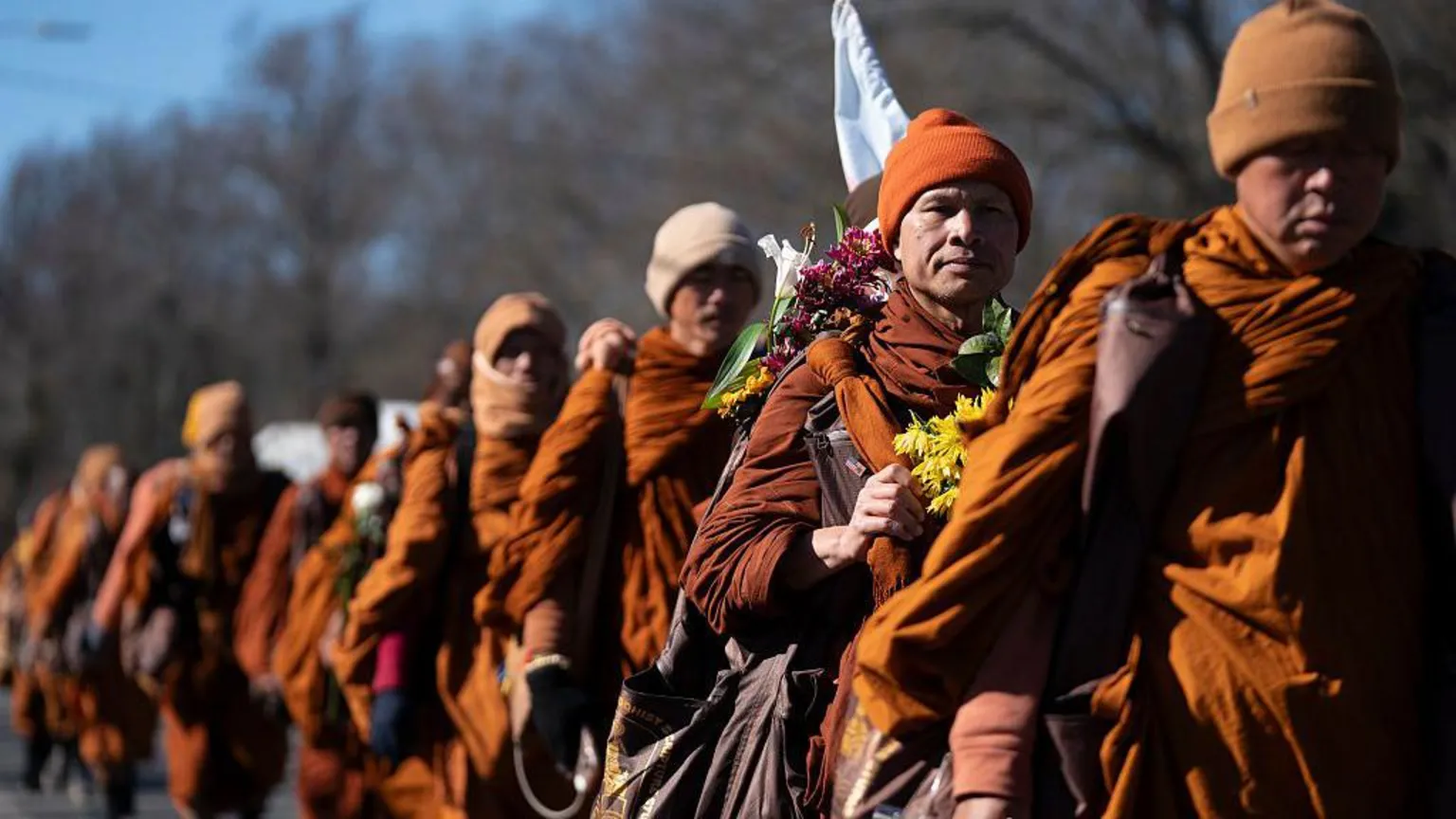 https://thuvienhoasen.org/a43498/cac-phat-tu-nghi-gi-ve-cuoc-di-bo-vi-hoa-binh-cua-cac-nha-su-o-fort-worth-
CÁC PHẬT TỬ NGHĨ GÌ VỀ “CUỘC ĐI BỘ VÌ HÒA BÌNH” CỦA CÁC NHÀ SƯ Ở FORT WORTH?
Ba tháng sau hành trình lịch sử,
Tricycle trò chuyện với các vị thầy và tác giả về ý nghĩa của Walk for Peace 2026.
Viết bởi Tricycle Ngày 06 tháng 02 năm 2026
Link to the Live Map: https://walkforpeace.short.gy/live-map
https://thuvienhoasen.org/images/file/B6XZL3Zn3ggBAFdd/w317/wfp-0123.jpg
https://thuvienhoasen.org/a43498/cac-phat-tu-nghi-gi-ve-cuoc-di-bo-vi-hoa-binh-cua-cac-nha-su-o-fort-worth-
CÁC PHẬT TỬ NGHĨ GÌ VỀ “CUỘC ĐI BỘ VÌ HÒA BÌNH” CỦA CÁC NHÀ SƯ Ở FORT WORTH?
Ba tháng sau hành trình lịch sử,
Tricycle trò chuyện với các vị thầy và tác giả về ý nghĩa của Walk for Peace 2026.
Viết bởi Tricycle Ngày 06 tháng 02 năm 2026
Link to the Live Map: https://walkforpeace.short.gy/live-map
https://thuvienhoasen.org/images/file/B6XZL3Zn3ggBAFdd/w317/wfp-0123.jpg
 Ảnh Internet
Vào ngày 26 tháng 10 năm 2025, một nhóm mười chín nhà sư thuộc truyền thống Phật giáo Theravada Việt Nam, liên kết với Trung tâm Thiền Quán Hương Đạo Vipassana Bhavana, đã bắt đầu một cuộc hành hương lịch sử từ trung tâm chùa ở Fort Worth, Texas, đến Washington, D.C., nhằm thúc đẩy hòa bình, lòng từ bi và bất bạo động. Từ những khởi đầu khiêm tốn và bất chấp một số chấn thương nghiêm trọng gặp phải dọc đường, câu chuyện này đã lan tỏa trong trái tim và trí tưởng tượng của công chúng, biến những nhà sư này—cùng với người bạn đồng hành là chú chó cứu hộ tên Aloka—thành những nhân vật nổi tiếng trên mạng, với hàng ngàn người hâm mộ và ủng hộ tụ tập để gặp họ tại các điểm dừng chân dọc hành trình.
Ba tháng trôi qua, đoàn hành hương gần như đã chạm đến đích. Trong bối cảnh bạo lực, chia rẽ, kỳ thị chủng tộc và tàn ác đang bao trùm Hoa Kỳ cũng như thế giới nói chung, việc công chúng muốn tập trung vào những nỗ lực cao quý của những người thúc đẩy hòa bình và khôi phục sự hài hòa trong một thế giới đang rất cần điều đó là điều dễ hiểu. Nhưng chính xác thì điều gì ở những nhà sư cụ thể này vào lúc này khiến họ trở thành tâm điểm của thời đại?
Để đặt những nhà sư cao quý và hành trình lịch sử của họ vào bối cảnh, Tạp chí Tricycle đã hỏi một số vị thầy và tác giả Phật giáo: Điều gì ở các nhà sư “Walk for Peace” của Fort Worth lại thu hút trí tưởng tượng của công chúng đến vậy?
Khi cảm thấy mọi thứ đang trượt dốc vào chủ nghĩa độc tài và chẳng có gì chúng ta làm có tác dụng chút nào, phần tồi tệ nhất không phải là nỗi sợ—mà là cảm giác hoàn toàn bất lực. Đó là lúc hành động bất bạo động, biểu tình, diễu hành và xuất hiện công khai thay đổi mọi thứ đối với chúng ta. Nó biến việc lướt tin tiêu cực và xoáy vòng thành việc thực sự làm điều gì đó thực tế; nó mang lại cảm giác rằng chúng ta có thể chống lại. Thay vì ám ảnh về những thế lực khổng lồ mà chúng ta không chạm tới được, chúng ta tập trung vào việc kết nối. Chúng ta đang lên tiếng cho câu nói “không trên thời gian của tôi!”. Khi thấy tấm gương đó, những người khác—ít chú ý hơn đến thế giới đang điên loạn—nhận ra có điều gì đó đang xảy ra đòi hỏi sự chú ý và tham gia. Vì vậy, bất kỳ hình thức biểu tình nào cũng không phải là ý tưởng viển vông.
Vì vậy tôi ủng hộ nhóm các nhà sư Phật giáo đi bộ 2.300 dặm đến Washington, D.C., trong Walk for Peace. Đó không phải là điều ngây thơ cảm thấy tốt hoặc biểu tượng trống rỗng. Cũng không chỉ là lòng từ bi. Đó là nói “không” bằng đôi chân—ngay cả khi mọi thứ lệch hướng, như tai nạn làm bị thương một số nhà sư dọc đường. Toàn bộ ý nghĩa là lấy tất cả sự dễ tổn thương, nỗi sợ hãi và đau buồn về tình trạng thế giới và biến nó thành từng bước chân trước bước chân sau, cùng nhau, cứ tiếp tục đi.
–JOSH KORDA, thầy dạy Phật giáo và cố vấn, Dharma Punx NYC
Họ đang đi bộ vì tất cả chúng ta.
–JACK KORNFIELD, thầy dạy Vipassana Mỹ, nhà tâm lý học và tác giả
Với mỗi bước chân, an trú hoàn toàn trong khoảnh khắc hiện tại này, con đường thanh tịnh của sự giác ngộ trải ra dưới chân tôi. Với mỗi bước chân, sự tĩnh lặng và bình an nở hoa trong thân và tâm tôi, trái tim tôi mở ra như một bông hoa dưới ánh mặt trời buổi sáng. Với mỗi bước chân, tôi trở thành một với Đức Phật, một với Tăng đoàn, một với Pháp, và tìm thấy nơi nương tựa trong vòng ôm ấm áp này. Với mỗi bước chân, tôi phát nguyện nuôi dưỡng một trái tim tràn đầy tình yêu, sự bình an và hành động từ bi phục vụ tất cả chúng sinh.
Là một thầy dạy Pháp trong cộng đồng Làng Mai của Phật giáo dấn thân xã hội do Hòa thượng Thích Nhất Hạnh sáng lập, tôi được nhắc nhở về thực hành và sức mạnh của việc đi bộ như một hành động chữa lành cá nhân và tập thể, đi bộ như chứng nhân xã hội, một tuyên ngôn về hòa bình và đoàn kết với thế giới con người và hơn cả con người. Thầy dạy thực hành thiền hành như một kỷ luật tâm linh, một thực hành chữa lành và chuyển hóa. Đi bộ một cách thư giãn, làm dịu và buông bỏ căng thẳng trong cơ thể, tạo ra tâm trạng hạnh phúc và biết ơn trong khoảnh khắc này, giống như lời cầu nguyện. Mọi con đường, dù là phố xá thành phố hay lối mòn rừng, đều là con đường giác ngộ.
Thầy và Mục sư Tiến sĩ Martin Luther King, Jr. chia sẻ một tình bạn đặc biệt mà Thầy đã nhắc lại trong một khoảnh khắc xúc động. “Martin, anh biết không?” Thầy nói, “Ở Việt Nam, họ gọi anh là Bồ-tát, một chúng sinh giác ngộ đang cố gắng đánh thức các chúng sinh khác và giúp họ đi theo hướng từ bi và hiểu biết.” Thầy nói những lời này với King trong một trong những cuộc gặp cuối cùng của họ. Vài năm trước đó, trong thư đề cử Thầy cho Giải Nobel Hòa bình, King viết: “Tôi biết Thích Nhất Hạnh, và vinh dự được gọi ông ấy là bạn của tôi.”
Cả King và Thầy đều tham gia đi bộ như một hình thức chứng nhân xã hội bất bạo động và thực hành công khai việc làm hòa bình. Họ chia sẻ tầm nhìn về hòa bình, từ bi và tình yêu được khơi dậy bởi sự dấn thân xã hội bất bạo động, bao gồm thiền hành như một hình thức hành động xã hội. Điều này đặc biệt quan trọng trong Chiến dịch Birmingham lịch sử năm 1963, một sự kiện then chốt trong cuộc đấu tranh cho công lý chủng tộc và xã hội tại Hoa Kỳ. Được tổ chức bởi Hội nghị Lãnh đạo Cơ đốc giáo Miền Nam và những người khác, hành động này dẫn đến việc thông qua Đạo luật Dân quyền 1964 và Đạo luật Quyền Bầu cử 1965. Chiến dịch Birmingham được thúc đẩy bởi quyết tâm và cam kết của các tình nguyện viên, những người bình thường cam kết với sự kháng cự bất bạo động. Mỗi tình nguyện viên phải ký cam kết, một tuyên ngôn bằng văn bản về bất bạo động bao gồm lời thề thiền định hàng ngày, đi bộ và nói chuyện theo cách “Thượng đế là tình yêu”, cầu nguyện hàng ngày và thực hiện các hành động phục vụ người khác. Chiến dịch lịch sử này nhấn mạnh tầm quan trọng của quyết tâm tâm linh và hành động bất bạo động có nguyên tắc trong việc thúc đẩy công lý xã hội qua thực hành hòa bình.
Ngày nay, khi xã hội chúng ta đối mặt với cơn bão lửa của bất công chủng tộc và xã hội, áp bức hệ thống và cấu trúc, sự phá bỏ cơ chế thực thi dân quyền của chính phủ liên bang, mối đe dọa đối với pháp quyền và bạo lực liên tục, cuộc hành hương vì hòa bình và từ bi này đưa vào nhận thức của chúng ta sự giao thoa giữa công lý xã hội và sự dấn thân tâm linh. Cuộc hành hương đi bộ vì hòa bình của hai mươi bốn nhà sư từ Phật giáo Theravada Việt Nam chỉ cho chúng ta một trật tự công lý mới dựa trên hành động từ bi, hòa bình và tình yêu, thách thức chúng ta chuyển hóa khổ đau thành từ bi, hiểu biết và tình yêu.
Cuộc hành hương hòa bình này là một hành động tình yêu và giải phóng nhắc nhở chúng ta, như năm 1964, hãy tái khám phá những gì chúng ta yêu thương, điều gì quan trọng, và dâng hiến tình yêu này vì lợi ích của thế giới.
–VALERIE BROWN, thầy dạy Pháp, Làng Mai
Người sáng lập Tào Động Thiền tông, Đạo Nguyên Thiền sư, từng nói: “Đừng hỏi tôi đi đâu, vì tôi du hành trong thế giới vô hạn này, nơi mỗi bước chân tôi đi là nhà của tôi.”
Tôi vô cùng biết ơn mười chín nhà sư dũng cảm của Trung tâm Hương Đạo Vipassana Bhavana, và tất nhiên là Aloka chú chó Hòa bình, vì thực hành anh hùng của họ, chắc chắn đang chạm đến trái tim mọi người trên toàn thế giới. Ở một khía cạnh, họ đã thực hiện một hành trình khổng lồ, gặp gỡ những người mới và lan tỏa Pháp bằng lời nói và hành động. Và ở khía cạnh sâu sắc hơn, họ chưa bao giờ rời khỏi ngôi nhà thực sự của mình—ngôi nhà trải dài từ mỗi mảnh đất họ bước qua đến tận cùng vũ trụ.
Phép màu của thực hành chúng ta là những cử chỉ nhỏ nhất, được dâng hiến bằng tất cả trái tim, có sức mạnh ngang với những nỗ lực anh hùng.
Đi bộ như một biểu hiện của hy vọng sâu sắc về sự chuyển hóa chính trị và xã hội có lịch sử lâu dài trong Phật giáo, từ thời Đức Phật Thích Ca. Tôi thường nghĩ về cuộc diễu hành phụ nữ đầu tiên, do những nữ tổ tiên sớm nhất của chúng ta thực hiện. Khi Đức Phật ban đầu từ chối truyền giới cho phụ nữ, mẹ kế của Ngài là Mahaprajapati và những người theo bà cạo đầu, mặc y áo tu sĩ và bắt đầu hành trình 200 dặm chân trần đến Vesali. Thách thức bất bạo động và sự dâng hiến thực hành cam kết của họ đã dẫn đến việc thành lập các nữ tu sĩ đầu tiên được biết đến trong lịch sử bất kỳ truyền thống tôn giáo nào. Qua việc đi bộ của chúng ta, qua thực hành của chúng ta, chúng ta có thể mang lại những phép màu.
Chúng ta có thể được truyền cảm hứng từ Walk for Peace, đặc biệt giữa bối cảnh bạo lực gia tăng, nhưng thấy mình không thể gạt bỏ cuộc sống để thực hiện những hành động cam kết hào phóng lớn lao. Nhưng phép màu của thực hành chúng ta là những cử chỉ nhỏ nhất, được dâng hiến bằng tất cả trái tim, có sức mạnh ngang với những nỗ lực anh hùng đó. Một cuộc đi bộ hòa bình có thể đưa chúng ta qua cả lục địa, nhưng cũng có thể đưa chúng ta đến nhà hàng xóm để nói với họ rằng họ được yêu thương, được chào đón và không cô đơn. Hãy noi gương mười chín nhà sư và Aloka, và mong mỗi bước chân của chúng ta trong thế giới vô hạn này, ngôi nhà thực sự của chúng ta, là biểu hiện của hòa bình với và vì tất cả chúng sinh.
–RIVER SHANNON, luật sư lợi ích công chúng, nhà giáo dục và linh mục Thiền tại Cộng đồng Thiền Mountain Rain
Điều thế giới cần bây giờ là một dòng chảy hòa bình để ngăn chặn ba độc mà MLK từng gọi là chủ nghĩa quân phiệt, nghèo đói và phân biệt chủng tộc. Những nhà sư này, chỉ bằng sự hiện diện của họ, đáp lại lời kêu gọi của Bồ-tát để giải thoát tất cả chúng sinh khỏi khổ đau.
–VIMALASARA, tác giả và thầy cao cấp trong Cộng đồng Phật giáo Triratna
Tôi đã theo dõi các nhà sư Hương Đạo trong Walk for Peace với sự quan tâm và truyền cảm hứng. Những bức ảnh mở lòng tôi. Thật hiếm thấy loại hành hương này ở phương Tây. Ở Thái Lan, nơi tôi lớn lên, các nhà sư đi khất thực hàng ngày. Họ rời chùa lúc bình minh và đi ra ngoài với bát khất thực đen cầm trước ngực. Những gì họ làm không chỉ là bức ảnh đẹp. Đó là sự tin tưởng rơi: rằng việc khất thực của họ sẽ khơi dậy dana, sự hào phóng của chúng ta, và do đó họ sẽ ăn được. Ý tưởng không ăn trong một ngày chạm đến sự an toàn nguyên thủy nhất của chúng ta. Tôi nói nhiều về cuộc đi khất thực này vì nó khiến tôi xúc động, mỗi lần, suy ngẫm về một sự tận tụy với Pháp sâu rộng đến mức tôi sẵn sàng đặt mình vào vị trí có nguy cơ không được ăn.
Chúng ta có thể thừa nhận rằng Phật giáo, khi thực hành chân thành và siêng năng, là một cam kết không thoải mái. Nó khá khó chịu. Nó yêu cầu chúng ta tin rằng công việc nội tâm chúng ta đang làm sẽ giúp chúng ta trưởng thành thành những chúng sinh của tình yêu và trí tuệ, Bồ-tát. Điều này nghe cao cả, và đôi khi cảm thấy cao cả, nhưng công việc trên con đường cũng lộn xộn và khó khăn. Theo thời gian có những khoảnh khắc nản lòng, nếu không phải đau đớn. Chúng ta chán thiền; mệt mỏi với việc nghe cùng những câu chuyện Pháp; và tin rằng phiền não, những ô nhiễm nội tâm, là những vết đen cứng đầu nhất trong hội trường Pháp. Một điều mà các nhà sư có thể đang cho chúng ta thấy là chúng ta cần rất nhiều quyết tâm để tiếp tục trên con đường Pháp. Họ đặt tấm gương.
Có 2,6 triệu người theo dõi trang Facebook của Walk for Peace. Hai nhà sư bị thương trong tai nạn đường bộ. Một người bị cắt cụt chân và đã quay lại một phần hành hương bằng xe lăn. Các nhà sư được đi cùng bởi chú chó Aloka, nghĩa là ánh sáng, có lượng người theo dõi riêng. Những con đường mà các nhà sư sẽ đi qua được người dân xếp hàng chờ đợi. Trông giống như Ngày Quốc khánh 4 tháng 7, ngoại trừ mọi người đội mũ len và áo phao, và cuộc diễu hành im lặng. Có quá nhiều lễ vật ở một số đoạn đường mà các nhà sư không thể nhận hết những gì mọi người đưa ra.
Khi tôi thấy những nhà sư khiêm tốn trong y áo màu cam cháy đi bộ vì hòa bình, được người Mỹ bình thường chào đón bên đường đưa nước uống, hoa, quỳ xuống cầu nguyện, tôi khóc.
Walk for Peace đang diễn ra ngay bây giờ. Vào mùa đông. Khi chính phủ bắt cóc và giết hại công dân của chính mình. Những nhà sư giản dị này đang đi một chặng đường dài để yêu cầu tổng thống chúng ta chỉ định một ngày lễ quốc gia cho hòa bình.
Tôi hy vọng điều này thu hút sự chú ý của chúng ta. Tôi hy vọng nó xuyên qua tiếng ồn. Dân chủ Mỹ không ở trong khủng hoảng; nó đang tan vỡ theo thời gian thực. Chính phủ chúng ta đang bắt cóc trẻ em trên đường phố và giết những người quay phim họ bằng điện thoại. Chúng ta nên làm gì? Diễu hành—chiến đấu—bảo vệ—chạy trốn—trốn—cầu nguyện—khóc. Tôi nghe thấy tất cả.
Cuộc đi bộ này chỉ là biểu tượng, nhưng chúng ta đang học được sức mạnh lớn lao của một biểu tượng. Mỹ chưa bao giờ là một nền dân chủ hoàn hảo. Ánh sáng (aloka) tỏa ra từ việc chúng ta cố gắng, từ cách chúng ta làm mới cam kết không hoàn hảo của mình để che chở cho những người mệt mỏi và đón nhận những người yếu đuối (còn gọi là người tị nạn), đã truyền cảm hứng cho một tấm gương trên toàn thế giới về những gì chúng ta có thể trở thành. “Chúng ta” ở đây tôi muốn nói là nhân loại; mọi người sống trong thân thể con người tuyệt vời này có cơ hội chọn hành động mỗi ngày. Một số động vật không thể chọn. Chỉ con người suy nghĩ và có cái tôi quan sát có thể quyết định ý định khác nhau và hành động theo cách mới mẻ, ý thức hơn. Quyết định của chúng ta quan trọng. Chúng có thể xuất phát từ một biểu tượng và lý tưởng. Con người chúng ta đã quyết định sau chiến tranh khủng khiếp rằng chúng ta nên lập các hiệp ước hòa bình, và nỗ lực đàm phán các hiệp ước không phổ biến vũ khí; rằng chúng ta nên hứa giúp đỡ hàng xóm, và qua đó ngăn chặn xung đột vũ trang. Tất cả đang có nguy cơ bị phá hủy bây giờ.
Có ai đọc lại “The New Colossus” gần đây không? Bài thơ được Emma Lazarus viết vào thế kỷ 19, không phải năm tốt đẹp cho quyền phụ nữ. Lazarus giúp định cư người tị nạn chạy trốn pogrom ở Mỹ. Lời của bà được khắc ở chân Tượng Nữ thần Tự do:
Không giống như gã khổng lồ đồng của danh tiếng Hy Lạp, Với đôi chân chinh phục dang rộng từ đất này sang đất khác; Tại đây, ở cổng hoàng hôn rửa bởi biển của chúng ta sẽ đứng Một người phụ nữ vĩ đại cầm đuốc, ngọn lửa của bà là tia chớp bị giam cầm, và tên bà Mẹ của Những Người Lưu Vong. Từ bàn tay ngọn hải đăng của bà tỏa ra lời chào đón toàn cầu; đôi mắt dịu dàng của bà chỉ huy cảng nối cầu không khí mà hai thành phố khung cảnh. “Hãy giữ lại, các vùng đất cổ xưa, sự huy hoàng truyền thuyết của các ngươi!” bà kêu lên Với đôi môi im lặng. “Hãy đưa cho ta những người mệt mỏi, nghèo khổ của ngươi, Những đám đông chật chội khao khát thở tự do, Những kẻ khốn cùng bị vứt bỏ từ bờ biển đông đúc của ngươi. Hãy gửi những người vô gia cư, bị bão tố giạt đến cho ta, Ta giơ ngọn đèn của ta bên cạnh cánh cửa vàng!”
Phần lớn bài thơ vẫn còn cộng hưởng bây giờ. Mặc dù mở đầu bằng phủ định, Mỹ dường như đã quay về với Colossus của Rhodes, gã khổng lồ đồng mạ vàng (“danh tiếng Hy Lạp”) với đôi chân đến để thống trị. Thật sốc khi thấy “twin cities” được nhắc đến trong bài thơ viết từ lâu. Lazarus ám chỉ những cặp thành phố khác, nhưng trái tim chúng ta hướng về Minneapolis–St. Paul. Tia chớp bị giam trong ngọn lửa gợi nhớ đến vajra, tia sét kim cương là biểu tượng của Kim Cương thừa, Pháp được làm cho thời đại này. Tôi nhận thấy Nữ thần Tự do nhăn mặt. Bà không cười khi chào đón “những người vô gia cư”, “đám đông chật chội khao khát thở tự do”. Công việc này không dễ dàng. Nó sâu sắc không thoải mái.
Nhiều phần của bài thơ nghe giống như lời nguyện Bồ-tát, nơi chúng ta hứa sẽ là cầu, thuyền, ngọn hải đăng (aloka) trong đêm. Tôi tin rằng đó là lựa chọn trước mặt chúng ta: liệu chúng ta sẽ lấy ví dụ về chinh phục và thống trị, hay chúng ta sẽ thấy phẩm chất trang nghiêm thầm lặng; quyết tâm sâu sắc; sức bền của nhóm nhà sư này, những người thực hành giống như chúng ta—và để nó khơi dậy ngọn lửa trong chúng ta hướng về trí tuệ và từ bi.
Sẽ cần rất nhiều quyết tâm để chúng ta quyết định đặt cam kết với Pháp lên trên TV, mạng xã hội, kỳ nghỉ, mua sắm. Chúng ta sống lâu hơn và chủ yếu khỏe mạnh hơn bao giờ hết, nhưng điệu nhảy của luân hồi ngày nay dường như là nghiện tâm trí quyến rũ nhất mà chúng ta từng thấy. Chúng ta đang cầm một sòng bạc trong túi, một máy kẹo cao su trong điện thoại.
Nếu bạn đang theo dõi những gì đang xảy ra ở đất nước yêu dấu này và tự hỏi mình có thể làm gì—xin hãy. Hãy để các nhà sư truyền cảm hứng cho bạn. Hãy để cuộc đi bộ của họ đưa bạn vào kshanti, sự nhẫn nhục với luân hồi, và virya, nỗ lực vui vẻ, để đi trên con đường như bạn chưa từng đi trước đây.
–SUNISA MANNING, thầy dạy Pháp, Heart Sangha
Mặc dù tôi chỉ có thể theo dõi hành trình của họ từ xa, tôi biết rằng sự thể hiện những phẩm chất đẹp đẽ như từ bi, chánh niệm và hòa bình của họ đã chạm sâu đến những người có cơ hội gặp họ. Dưới đây là hai câu chuyện nhỏ.
Một học viên tham gia nhóm học kinh của tôi đã xúc động đến rơi nước mắt bởi lòng tốt toát ra từ các nhà sư này. Cô ấy lưu ý rằng mọi người trong sự hiện diện của họ đều tự nhiên chắp tay anjali, kể cả các sĩ quan cảnh sát trang bị súng và áo chống đạn. Cô ấy lưu ý sự tương phản rõ rệt giữa ảnh hưởng của họ đối với mọi người và ảnh hưởng của các đặc vụ ICE gần đây.
Kinh chúng tôi học ngày hôm đó nói về một người thiền học cách “bỏ các chướng ngại”—buông bỏ một số trạng thái tâm làm suy yếu trí tuệ. Bài kinh nói về những phẩm chất tự nhiên được lộ ra khi một trạng thái tâm hại rơi đi. Ví dụ, khi sân hận được buông bỏ, người thiền “an trú từ bi vì lợi ích của tất cả chúng sinh”. Có lẽ khi ICE không hiện diện, các nhà sư từ bi trở nên hữu hình.
Một câu chuyện thứ hai là đoạn clip tin tức từ một thầy dạy Pháp đồng nghiệp. Câu chuyện được phát trên đài truyền hình địa phương, nơi một phóng viên cùng vợ và con nhỏ đã đến gặp các nhà sư. Anh ấy kể cho đồng nghiệp về trải nghiệm của mình. Do đám đông, họ phải đi bộ một dặm để đến chỗ các nhà sư. Một vị đang thuyết Pháp, và mặc dù phóng viên không thấy được, anh ấy đã hấp thụ thông điệp chính: Chúng ta có thể an trú hoàn toàn trong khoảnh khắc hiện tại, không để tâm bị phân tâm hay lang thang trên những chuỗi suy nghĩ dài. Chỉ đơn giản hiện diện như vậy là một cách dẫn đến cuộc sống bình an hơn.
Khi xem người bình thường này mô tả trải nghiệm (đầu tiên?) của anh ấy với một bài thuyết Pháp, tôi ấn tượng bởi cách nó mang lại sự rõ ràng cho tâm anh ấy. Cuộc sống với công việc toàn thời gian, vợ và con nhỏ chắc chắn bận rộn, vậy mà anh ấy ngay lập tức thấy lợi ích của chánh niệm và nói rất hùng hồn khi truyền đạt thông điệp của nhà sư cho đồng nghiệp đài truyền hình.
Những lợi ích nào có thể đến khi mọi người tạm thời đồng điệu với những gì đẹp đẽ, từ bi, trí tuệ và bình an?
Trong cả hai trường hợp, chúng ta thấy cách thái độ và lời nói thẳng thắn từ các nhà sư có thể chạm đến trái tim bất kỳ ai mở lòng, dù là Phật tử hay không, người thực hành hay không. Tôi tưởng tượng cuộc đi bộ của họ như một nam châm được kéo từ Texas đến Washington, D.C., sắp xếp những mảnh sắt ngẫu nhiên của cuộc sống mọi người dọc đường. Mặc dù sự sắp xếp đó cuối cùng sẽ thư giãn sau khi nam châm đi qua, nhưng nó sẽ không xảy ra ngay lập tức. Những lợi ích nào có thể đến khi mọi người tạm thời đồng điệu với những gì đẹp đẽ, từ bi, trí tuệ và bình an?
Thật truyền cảm hứng khi biết rằng chúng ta có một thực hành qua đó những phẩm chất này được củng cố trong trái tim mình và cũng có thể ảnh hưởng đến người khác.
–KIM ALLEN, thầy dạy Nội quán phương Tây
Đó là một trải nghiệm tuyệt vời khi chứng kiến phản ứng của công chúng đối với các nhà sư Phật giáo đi bộ vì hòa bình qua miền nam Hoa Kỳ. Vào thời điểm chúng ta bị buộc phải chứng kiến sự tàn sát phát trực tiếp đầu tiên ở nước ngoài và giờ là trong nước, cuộc hành hương hòa bình này đang cộng hưởng với công chúng Mỹ, dù họ có phải Phật tử hay không, mang dân tộc lại gần nhau vượt qua rào cản chính trị, tôn giáo và sắc tộc trong niềm vui và sự nhẹ nhàng mà đã rất cần thiết. Lặp đi lặp lại trong các bản tin về các nhà sư, cả người xem tụ tập và phóng viên đều nói rằng cảm giác hy vọng vào tương lai của họ được làm mới, rằng chỉ nhìn thấy các nhà sư đã khiến một số người rơi nước mắt. Đối với Phật tử đặc biệt, đây là cơ hội tuyệt vời để chúng ta an trú trong hỷ lạc đồng cảm với những người bị xúc động bởi hành hương và hoan hỷ với công đức lớn lao do các nhà sư và các chùa tiếp đón họ dọc đường tạo ra, những nơi chia sẻ liều thuốc hạnh phúc của Phật Pháp tại mỗi địa điểm mà các vị tôn giả dừng nghỉ.
Giữa tất cả điều này, tôi muốn dành một khoảnh khắc suy ngẫm về lịch sử và dòng truyền thừa của cách truyền thống đi bộ vì hòa bình đến được Mỹ, để căn cứ mình vào sự phong phú của một truyền thống hiện đại đã đi một con đường xuyên quốc gia độc đáo.
Bhikkhu Pannakara và mười tám nhà sư khác đang truyền tải một truyền thống Theravada xuyên quốc gia bắt nguồn từ năm 1992 khi một vị sư được kính trọng trong truyền thống Khmer Theravada, Hòa thượng Maha Ghosananda, dẫn dắt dhammayietra đầu tiên, hay “hành hương vì hòa bình”. Hàng trăm nhà sư, ni cô và cư sĩ Phật tử tụ họp để hộ tống bằng chân một số người tị nạn từ các trại ở Thái Lan về làng quê ở Campuchia, đi qua 125 dặm đất vẫn còn đầy mìn vô hình từ chế độ Khmer Đỏ. Khi tin tức về hành hương lan truyền, số lượng hành hương—Phật tử và không phải—tham gia tăng theo cấp số nhân và thu hút sự chú ý của truyền thông quốc tế. Những năm sau, dhammayietra trở thành truyền thống hàng năm cho Phật tử Theravada ở Campuchia, đi một con đường mới bắt đầu lại từ Thái Lan và lần này đi qua toàn bộ Campuchia vào Việt Nam. Giống như Tăng đoàn ban đầu của các đệ tử trực tiếp của Đức Phật, các hành hương dừng lại tại các làng mạc và thành phố, chùa chiền và tu viện, để chia sẻ giáo pháp về bất bạo động, giải thoát khỏi khổ đau và sự quý giá của sinh mạng con người cho các cộng đồng họ đi qua.
Các chùa và tu viện ở Việt Nam tiếp nhận các hành hương này ở cuối hành trình dài, đặc biệt trong những năm đầu, chủ yếu là các chùa Theravada theo truyền thống Campuchia. Lãnh thổ Khmer đã bị sáp nhập dần vào miền nam Việt Nam hiện đại từ thế kỷ 15, với biên giới hiện đại phần lớn hình thành vào thế kỷ 18. Trong phần lớn thời gian này, văn hóa Phật giáo ở miền nam Việt Nam bị chia đôi: Người Kinh, dân tộc lớn nhất Việt Nam, tiếp tục thực hành truyền thống Đại thừa; trong khi Theravada chủ yếu giới hạn ở thiểu số Khmer.
Điều này thay đổi vào năm 1940 khi một nhà sư tên Hòa thượng Hồ Tông đến Sài Gòn từ Phnom Penh, mở chùa Bửu Quang ở quận Gò Dưa, một chùa Theravada dạy bằng tiếng Việt cho đối tượng người Việt. Hòa thượng Hồ Tông là người Kinh, sinh ở miền nam Việt Nam với tên Lê Văn Giang, và được đào tạo làm bác sĩ thú y. Ông đến Phnom Penh dưới sự phân công của chính quyền thực dân Pháp, nơi niềm đam mê gần như ám ảnh với Phật giáo nắm lấy ông. Ông đầu tiên khám phá truyền thống Đại thừa bằng tiếng Việt, nhưng điều này không thỏa mãn khát khao tâm linh của ông. Sự tò mò dẫn ông đến các sách tiếng Pháp về Phật giáo Theravada, khiến ông kinh ngạc bởi sự đơn giản và trực tiếp của giáo lý Đức Phật—một sự tương phản rõ rệt với triết lý Đại thừa phức tạp ông đọc bằng tiếng mẹ đẻ. Và thế là ông bắt đầu học và thực hành với các nhà sư Campuchia tại chùa Unalom, cuối cùng xuất gia với họ. Khi Hòa thượng Hồ Tông trở về Việt Nam, ông mang theo một nhóm nhỏ các nhà sư Việt Nam khác được đào tạo trong Theravada Campuchia, và họ bắt đầu dạy truyền thống Theravada bằng tiếng Việt, cũng như dịch kinh điển Pali sang tiếng Việt. Hòa thượng Hồ Tông sau này được công nhận là vị đầu tiên Sangharaja của Tăng đoàn Phật giáo Theravada Việt Nam, chịu trách nhiệm thành lập cộng đồng Theravada người Việt đầu tiên trong nước. Và vì vậy, khi các đoàn dhammayietra đến các chùa biên giới Việt Nam ở cuối cuộc hành trình, nhiều chùa Khmer này được dân cư và điều hành bởi các tu sĩ Việt Nam và thuộc mạng lưới các chùa và tu viện Theravada Việt Nam do Hòa thượng Hồ Tông và đệ tử thành lập. Bây giờ, hơn ba mươi năm sau dhammayietra đầu tiên, thậm chí các chùa Việt Nam liên kết với Đại thừa cũng tham gia truyền thống này.
Mười chín nhà sư từ chùa Hương Đạo đi bộ qua miền nam Hoa Kỳ thuộc trường phái Theravada Việt-Khmer do Hòa thượng Hồ Tông truyền lại—vị trụ trì chùa của họ, Hòa thượng Bhikkhu Ratanaguna, là đệ tử trực tiếp cuối cùng của Hòa thượng Hồ Tông. Khi trái tim chúng ta cộng hưởng trong hỷ lạc đồng cảm với tất cả những người bị xúc động bởi dhammayietra lịch sử đầu tiên ở Mỹ này, chúng ta nên giữ chánh niệm tôn kính đối với lịch sử cao quý mà chúng ta đang kế thừa. Tôi nghĩ lý do chính khiến điều này cộng hưởng mạnh mẽ với người Mỹ là có một sự biết sâu sắc không thể giải thích rằng câu chuyện của Walk for Peace phản ánh chính câu chuyện của nước Mỹ—đó là câu chuyện về di cư, sự kết hợp đa văn hóa, và các truyền thống đến vùng đất mới, được thích nghi và thực hành trong bản dịch. Và đây là câu chuyện về nước Mỹ mà tất cả chúng ta cần được nhắc nhở vào khoảnh khắc này.
–AN TRAN, tác giả
Thực hành hành hương, một hình thức thực hành Phật giáo quan trọng, vẫn chưa phát triển ở Mỹ, vì vậy tôi đã theo dõi Walk for Peace với sự quan tâm và biết ơn sâu sắc. Tôi lớn lên ở miền Nam. Khi nhớ về những con đường nông thôn miền Nam, tôi nghĩ đến những đoạn đường dài yên tĩnh, những tài xế nông thôn không quen với người đi bộ, và những chú chó ngoài lãnh thổ. Tôi tự hỏi các nhà sư gặp những chú chó đó như thế nào, họ đàm phán các tình huống suýt va chạm với xe bán tải ra sao, và họ ăn gì. Quan trọng nhất, tôi tò mò về những người chờ dọc đường để chào đón họ. Điều gì đưa họ ra ngoài trời lạnh? Họ đang tìm kiếm gì? Họ mong đợi tìm thấy ai?
Tôi hỏi một người bạn miền Nam tại sao cô ấy nghĩ người miền Nam lại bị cuốn hút bởi các nhà sư đến vậy. Cô ấy trả lời qua loạt tin nhắn:
Chúng ta cần nhiều năng lượng của họ hơn. Chúng ta cần chữa lành và tha thứ cho con cái chúng ta biết đến tình yêu. Chúng ta đang tìm kiếm Chúa Kitô và họ là ví dụ gần nhất.
Mọi thứ đang xảy ra quá nhanh đến mức khó biết bắt đầu từ đâu ngoài việc theo các nhà sư.
Đây là sức mạnh của hành hương. Bất kỳ ý định nào chúng ta có khi bắt đầu hành hương đều thay đổi và mở ra ý nghĩa sâu sắc hơn khi chúng ta đi. Hành hương là một phép thuật được rèn luyện bởi mỗi cuộc gặp gỡ dọc đường—mỗi khó khăn, mỗi hành động tử tế, mỗi cuộc gặp gỡ trái tim. Ý nghĩa của hành hương nằm ở việc thực hiện nó.
Mặc dù tôi đã thực hiện nhiều hành hương Phật giáo, nhưng hành hương gần gũi nhất với trái tim tôi diễn ra ở Nhật Bản năm 2012. Hành hương 88 ngôi chùa ở Shikoku, hay Henro, mất bốn mươi lăm ngày đi bộ liên tục, qua làng mạc, thành phố và rừng, qua núi dốc và dọc bờ biển. Khi nhìn lại bây giờ, tôi nhớ ít về việc chân đau thế nào, lo lắng về chỗ ngủ, và cơn bão tôi lội qua. Những gì tôi nhớ là con người.
Tại sao tôi đi? Trận động đất và sóng thần năm 2011 khiến khoảng 20.000 người chết ở khu vực gần chùa nhà tôi. Người phụ nữ hiến tặng tượng Quan Âm Bồ-tát lớn trong đại sảnh chính của chúng tôi đã bị sóng cuốn trôi. Ngay khi có thể, tôi đến bờ biển tỉnh Iwate để giúp đỡ. Tôi tưởng tượng mình mặc đồ bảo hộ dọn dẹp đống đổ nát, nhưng đó không phải là điều người dân cần từ tôi. Họ yêu cầu tôi dâng hương, lắng nghe câu chuyện của họ qua tách trà, và tụng kinh cho người thân đã mất. Họ cần nhân chứng cho nỗi đau của họ.
Năm sau, tôi đi hành hương Shikoku để tưởng nhớ những người chết trong sóng thần, cũng như những người chết ở khoa ung thư bệnh viện nơi tôi làm tuyên úy chuyên nghiệp. Tôi đi bộ vì nỗi đau vô lượng mà tôi đã chứng kiến và trải qua chỉ trong một năm ngắn ngủi.
Vào ngày đầu tiên, tôi gặp một người đàn ông đang chứng kiến gia đình tan vỡ. Sau đó, tôi gặp một cặp vợ chồng già có con trai không thể rời phòng. Tôi đi cùng một nhà sư trẻ chết vì ung thư não, một người phụ nữ sợ hãi kết hôn với chồng bạo hành, và một chàng trai trẻ Trung Quốc đang tìm kiếm lựa chọn thay thế cho tương lai vật chất. Cũng như trong Walk for Peace, mọi người dâng lễ vật dọc đường—thức ăn, trà, vật nhỏ, băng dán chân, một bát mì nóng, chỗ ở. Mọi người khóc. Mọi người cảm ơn tôi. Mọi người chụp ảnh. Một số dâng lễ vật nhanh chóng rồi vội vã đi về ngày bận rộn. Một người mẹ đi cùng tôi hàng giờ, kể chuyện trong khi chúng tôi đi qua cánh đồng lúa dưới mưa.
Đây là phép thuật tôi thấy đang xảy ra giữa các nhà sư Walk for Peace và những người theo dõi họ. Chúng ta thấy trẻ em thực hành hào phóng và chúng ta cảm thấy hào phóng hơn. Người lớn khóc và trái tim chúng ta mở ra. Thấy mọi người đi hàng giờ để gặp các nhà sư mang lại cho chúng ta mục đích mới. Hành hương chuyển hóa trái tim tan vỡ của chúng ta. Từ bi lớn lên và lan tỏa trong thế giới xung quanh. Theo cách này, tất cả chúng ta đã cùng các nhà sư biến mỗi ngày thành ngày hòa bình của mình.
–TENKU RUFF, Osho, Beacon Zen Temple
Khi tôi biết về Walk for Peace, suy nghĩ đầu tiên lướt qua tâm tôi là sadhu, sadhu, sadhu—Lành thay! Lành thay! Lành thay! Những tiêu đề thống trị tin tức hiếm khi vui vẻ, và những ngày này xung đột dường như không bao giờ kết thúc. Vì vậy thật sảng khoái và ấm lòng khi biết về nỗ lực của các nhà sư này trong việc lan tỏa thông điệp hòa bình.
Dự án Walk for Peace bắt nguồn từ loại đi bộ mà các tu sĩ Phật giáo đã làm từ khi tôn giáo bắt đầu. Trong các văn bản rất sớm, chúng ta nghe về các nhà khất thực Phật giáo đi đến và từ làng mạc bằng chân, tiếp xúc với hoàng gia và thường dân, để chia sẻ giáo lý và lối sống của họ. Walk for Peace nhằm nâng cao nhận thức về chánh niệm, và không nghi ngờ gì các nhà sư—với y áo vá màu nâu cam và bát kim loại—thể hiện nguyên mẫu cổ xưa của tu sĩ lang thang.
Tất nhiên, hành hương không hoàn toàn hào nhoáng. Bây giờ, như ngày xưa, những chuyến đi bộ gian nan và khó lường. Quần áo và vật dụng các vị mang theo nặng hàng chục pound, họ đi từ hai mươi đến tám mươi dặm mỗi ngày, phơi mình với thời tiết. Một số đã cần chăm sóc y tế dọc đường, và vào tháng 11, một nhà sư thậm chí bị xe tông, khiến bác sĩ phải cắt cụt một chân để cứu mạng. Dù vậy, nhóm vẫn kiên trì.
Phần nào nhờ sự tận tụy của họ, Walk for Peace đã chạm đến công chúng đang khao khát niềm vui. Một số người trực tuyến gọi sự kiện này là điều lớn nhất xảy ra với Phật giáo ở Bắc Mỹ trong một thời gian dài, và nó thậm chí đã đến được mọi người trên toàn cầu. Thực tế, khi tôi đang đi bộ cá nhân ở Rio de Janeiro, Brazil, hướng dẫn viên du lịch rất hào hứng hỏi bạn bè tôi và tôi ấn tượng về sứ mệnh của các tu sĩ.
Đôi khi, Phật tử—đặc biệt là Phật tử phương Tây—cảm thấy tội lỗi khi ủng hộ các vấn đề xã hội. Điều này dễ hiểu nếu chúng ta xem xét cả bầu không khí chính trị ngột ngạt của Mỹ và các nguyên tắc từ bỏ thế gian của Phật giáo. Tuy nhiên luôn có căng thẳng giữa mục tiêu siêu việt và nội tại của thực hành Phật giáo.
Đối với tôi, Walk for Peace phù hợp hoàn hảo trong bối cảnh xã hội-lịch sử rộng lớn hơn của Phật giáo Đông Nam Á và phong trào Phật giáo Dấn thân. Từ những năm 1950, các lãnh đạo nổi bật như cố Hòa thượng Thích Nhất Hạnh và B. R. Ambedkar đã áp dụng đạo đức và thực hành Phật giáo vào các nguyên nhân hiện đại—dù chỉ để lan tỏa thông điệp rằng thế giới cần hòa bình.
Quy mô của hoạt động như vậy là một sự tiến hóa của thực hành Phật giáo qua các thế kỷ nhưng không thiếu nền tảng trong truyền thống đa diện. Ngày nay, hầu hết mọi truyền thống Phật giáo đều đối mặt với thực tế xã hội đương thời theo cách này hay cách khác. Các tu sĩ như Bhikkhu Bodhi người Mỹ đã lâu nay kêu gọi tôn giáo đóng vai trò lớn hơn trong thay đổi tích cực, các nhà sư Sri Lanka đã biểu tình chống bạo lực toàn quốc, và các nhà sư Thái Lan đã phong tăng cho cây cối để bảo tồn hệ sinh thái mong manh. Mối quan hệ giữa tu hành và hoạt động không mới hay chưa từng nghe.
Nếu có gì, Walk for Peace nhắc tôi về lời khuyên của Đức Phật trong Tăng Chi Bộ Kinh: “Sau khi xem xét và kiểm tra kỹ, hãy tán thán những người đáng tán thán” (AN 5.236). Và điều gì đáng tán thán? Sự từ bỏ, tình yêu và từ bi—đặc biệt khi những giá trị đó dường như đang khan hiếm.
–BRADLEY DONALDSON, thầy dạy và cựu tu sĩ
Tôi đã khóc.
Tôi lần đầu biết về các nhà sư đi bộ khi đang tĩnh tâm tại Upaya ở Santa Fe. Có một hội thảo của các thầy về con đường Bồ-tát, nhưng lời của Roshi Joan Halifax ở lại với tôi. Bà nói về cách lịch sử, các nhà sư đi bộ là biểu tượng của thực tế đáng sợ nơi chúng ta đã đến điểm không còn xa xỉ để không làm gì. Tuy nhiên, khi đối mặt với quy mô của khủng hoảng, đôi khi điều duy nhất còn lại là đặt chân này trước chân kia.
Đôi khi, tôi thấy mình bác bỏ toàn bộ chuyện, rút lui vào trạng thái lạc quan giả tạo chỉ để tiếp tục và, chủ yếu, để làm cha mẹ mà không làm con cái sợ chết khiếp. Những khoảnh khắc khác, tôi cảm thấy giận dữ và căng thẳng dâng trào, khơi dậy mong muốn tuyệt vọng làm điều gì đó, chỉ để nhìn quanh phòng khách và nhận ra không có gì tôi có thể thay đổi cơ bản về những gì đang xảy ra từ đây. Và rồi, trong tĩnh lặng, tôi cảm thấy một sự không biết thực sự. Từ không gian đó, một hy vọng khôn ngoan nổi lên. Có sự chân thành trong khát khao của tôi rằng thế giới được tiếp cận hòa bình và ổn định. Chấp nhận rằng tôi không biết cách điều đó xảy ra cho phép tôi ngừng cố gắng thay đổi thế giới một mình. Thay vào đó, nó củng cố trí tuệ sâu sắc của tôi để giữ tập trung vào giới (sila) và nuôi dưỡng những gì thiện lành trong đời sống riêng.
Sự tập trung và hướng đi này quan trọng cho sức khỏe của tôi, là đóng góp đáng kể cho sức khỏe của con cái tôi, và cuối cùng có tác động tích cực đến những người tôi tiếp xúc trong ngày.
Steve Armstrong, người gần đây đã qua đời, đã nhấn mạnh với tôi và chồng tôi tầm quan trọng của việc hướng đến sự toàn vẹn. Cuộc đi bộ này là sự di chuyển thực sự hướng đến mong muốn toàn vẹn rằng chúng ta có hòa bình. Hòa bình này có nhiều hình thức, và không cần chờ giải quyết ở cấp độ toàn cầu để có hòa bình bên trong.
Tôi được nhắc nhở hết lần này đến lần khác, thực hành của chúng ta không phải để đánh bại sự khó chịu và bất toại nguyện bằng “vũ khí” của các thực hành Phật giáo. Đó là sử dụng những thực hành này để ở cùng với sự không chắc chắn, rối loạn, giận dữ, tổn thương và hy vọng khôn ngoan.
Nghe về các nhà sư khiến tôi khóc vì an ủi, một sự nhận ra rằng, vâng, điều này rối loạn. Xem clip của họ trên mạng xã hội, tôi cảm thấy sự đoàn kết và sức mạnh. Thấy trẻ em và hàng xóm gặp họ với hoa bên đường khôi phục niềm tin của tôi vào nhân loại. Ngay cả chấn thương của nhà sư bị xe tông cũng nhắc tôi rằng một số rủi ro đáng giá.
Tôi chúc các nhà sư an toàn trên hành trình. Mong mỗi bước chân gom góp ý định thiện lành của nhân loại chúng ta và đưa chúng ta tiến lên cùng nhau hướng đến hòa bình.
–SHANNON SMITH, thầy dạy, Secular Dharma Foundation
Nguồn: https://tricycle.org/article/what-do-buddhists-think-of-fort-worths-walk-for-peace-monks/
Ảnh Internet
Vào ngày 26 tháng 10 năm 2025, một nhóm mười chín nhà sư thuộc truyền thống Phật giáo Theravada Việt Nam, liên kết với Trung tâm Thiền Quán Hương Đạo Vipassana Bhavana, đã bắt đầu một cuộc hành hương lịch sử từ trung tâm chùa ở Fort Worth, Texas, đến Washington, D.C., nhằm thúc đẩy hòa bình, lòng từ bi và bất bạo động. Từ những khởi đầu khiêm tốn và bất chấp một số chấn thương nghiêm trọng gặp phải dọc đường, câu chuyện này đã lan tỏa trong trái tim và trí tưởng tượng của công chúng, biến những nhà sư này—cùng với người bạn đồng hành là chú chó cứu hộ tên Aloka—thành những nhân vật nổi tiếng trên mạng, với hàng ngàn người hâm mộ và ủng hộ tụ tập để gặp họ tại các điểm dừng chân dọc hành trình.
Ba tháng trôi qua, đoàn hành hương gần như đã chạm đến đích. Trong bối cảnh bạo lực, chia rẽ, kỳ thị chủng tộc và tàn ác đang bao trùm Hoa Kỳ cũng như thế giới nói chung, việc công chúng muốn tập trung vào những nỗ lực cao quý của những người thúc đẩy hòa bình và khôi phục sự hài hòa trong một thế giới đang rất cần điều đó là điều dễ hiểu. Nhưng chính xác thì điều gì ở những nhà sư cụ thể này vào lúc này khiến họ trở thành tâm điểm của thời đại?
Để đặt những nhà sư cao quý và hành trình lịch sử của họ vào bối cảnh, Tạp chí Tricycle đã hỏi một số vị thầy và tác giả Phật giáo: Điều gì ở các nhà sư “Walk for Peace” của Fort Worth lại thu hút trí tưởng tượng của công chúng đến vậy?
Khi cảm thấy mọi thứ đang trượt dốc vào chủ nghĩa độc tài và chẳng có gì chúng ta làm có tác dụng chút nào, phần tồi tệ nhất không phải là nỗi sợ—mà là cảm giác hoàn toàn bất lực. Đó là lúc hành động bất bạo động, biểu tình, diễu hành và xuất hiện công khai thay đổi mọi thứ đối với chúng ta. Nó biến việc lướt tin tiêu cực và xoáy vòng thành việc thực sự làm điều gì đó thực tế; nó mang lại cảm giác rằng chúng ta có thể chống lại. Thay vì ám ảnh về những thế lực khổng lồ mà chúng ta không chạm tới được, chúng ta tập trung vào việc kết nối. Chúng ta đang lên tiếng cho câu nói “không trên thời gian của tôi!”. Khi thấy tấm gương đó, những người khác—ít chú ý hơn đến thế giới đang điên loạn—nhận ra có điều gì đó đang xảy ra đòi hỏi sự chú ý và tham gia. Vì vậy, bất kỳ hình thức biểu tình nào cũng không phải là ý tưởng viển vông.
Vì vậy tôi ủng hộ nhóm các nhà sư Phật giáo đi bộ 2.300 dặm đến Washington, D.C., trong Walk for Peace. Đó không phải là điều ngây thơ cảm thấy tốt hoặc biểu tượng trống rỗng. Cũng không chỉ là lòng từ bi. Đó là nói “không” bằng đôi chân—ngay cả khi mọi thứ lệch hướng, như tai nạn làm bị thương một số nhà sư dọc đường. Toàn bộ ý nghĩa là lấy tất cả sự dễ tổn thương, nỗi sợ hãi và đau buồn về tình trạng thế giới và biến nó thành từng bước chân trước bước chân sau, cùng nhau, cứ tiếp tục đi.
–JOSH KORDA, thầy dạy Phật giáo và cố vấn, Dharma Punx NYC
Họ đang đi bộ vì tất cả chúng ta.
–JACK KORNFIELD, thầy dạy Vipassana Mỹ, nhà tâm lý học và tác giả
Với mỗi bước chân, an trú hoàn toàn trong khoảnh khắc hiện tại này, con đường thanh tịnh của sự giác ngộ trải ra dưới chân tôi. Với mỗi bước chân, sự tĩnh lặng và bình an nở hoa trong thân và tâm tôi, trái tim tôi mở ra như một bông hoa dưới ánh mặt trời buổi sáng. Với mỗi bước chân, tôi trở thành một với Đức Phật, một với Tăng đoàn, một với Pháp, và tìm thấy nơi nương tựa trong vòng ôm ấm áp này. Với mỗi bước chân, tôi phát nguyện nuôi dưỡng một trái tim tràn đầy tình yêu, sự bình an và hành động từ bi phục vụ tất cả chúng sinh.
Là một thầy dạy Pháp trong cộng đồng Làng Mai của Phật giáo dấn thân xã hội do Hòa thượng Thích Nhất Hạnh sáng lập, tôi được nhắc nhở về thực hành và sức mạnh của việc đi bộ như một hành động chữa lành cá nhân và tập thể, đi bộ như chứng nhân xã hội, một tuyên ngôn về hòa bình và đoàn kết với thế giới con người và hơn cả con người. Thầy dạy thực hành thiền hành như một kỷ luật tâm linh, một thực hành chữa lành và chuyển hóa. Đi bộ một cách thư giãn, làm dịu và buông bỏ căng thẳng trong cơ thể, tạo ra tâm trạng hạnh phúc và biết ơn trong khoảnh khắc này, giống như lời cầu nguyện. Mọi con đường, dù là phố xá thành phố hay lối mòn rừng, đều là con đường giác ngộ.
Thầy và Mục sư Tiến sĩ Martin Luther King, Jr. chia sẻ một tình bạn đặc biệt mà Thầy đã nhắc lại trong một khoảnh khắc xúc động. “Martin, anh biết không?” Thầy nói, “Ở Việt Nam, họ gọi anh là Bồ-tát, một chúng sinh giác ngộ đang cố gắng đánh thức các chúng sinh khác và giúp họ đi theo hướng từ bi và hiểu biết.” Thầy nói những lời này với King trong một trong những cuộc gặp cuối cùng của họ. Vài năm trước đó, trong thư đề cử Thầy cho Giải Nobel Hòa bình, King viết: “Tôi biết Thích Nhất Hạnh, và vinh dự được gọi ông ấy là bạn của tôi.”
Cả King và Thầy đều tham gia đi bộ như một hình thức chứng nhân xã hội bất bạo động và thực hành công khai việc làm hòa bình. Họ chia sẻ tầm nhìn về hòa bình, từ bi và tình yêu được khơi dậy bởi sự dấn thân xã hội bất bạo động, bao gồm thiền hành như một hình thức hành động xã hội. Điều này đặc biệt quan trọng trong Chiến dịch Birmingham lịch sử năm 1963, một sự kiện then chốt trong cuộc đấu tranh cho công lý chủng tộc và xã hội tại Hoa Kỳ. Được tổ chức bởi Hội nghị Lãnh đạo Cơ đốc giáo Miền Nam và những người khác, hành động này dẫn đến việc thông qua Đạo luật Dân quyền 1964 và Đạo luật Quyền Bầu cử 1965. Chiến dịch Birmingham được thúc đẩy bởi quyết tâm và cam kết của các tình nguyện viên, những người bình thường cam kết với sự kháng cự bất bạo động. Mỗi tình nguyện viên phải ký cam kết, một tuyên ngôn bằng văn bản về bất bạo động bao gồm lời thề thiền định hàng ngày, đi bộ và nói chuyện theo cách “Thượng đế là tình yêu”, cầu nguyện hàng ngày và thực hiện các hành động phục vụ người khác. Chiến dịch lịch sử này nhấn mạnh tầm quan trọng của quyết tâm tâm linh và hành động bất bạo động có nguyên tắc trong việc thúc đẩy công lý xã hội qua thực hành hòa bình.
Ngày nay, khi xã hội chúng ta đối mặt với cơn bão lửa của bất công chủng tộc và xã hội, áp bức hệ thống và cấu trúc, sự phá bỏ cơ chế thực thi dân quyền của chính phủ liên bang, mối đe dọa đối với pháp quyền và bạo lực liên tục, cuộc hành hương vì hòa bình và từ bi này đưa vào nhận thức của chúng ta sự giao thoa giữa công lý xã hội và sự dấn thân tâm linh. Cuộc hành hương đi bộ vì hòa bình của hai mươi bốn nhà sư từ Phật giáo Theravada Việt Nam chỉ cho chúng ta một trật tự công lý mới dựa trên hành động từ bi, hòa bình và tình yêu, thách thức chúng ta chuyển hóa khổ đau thành từ bi, hiểu biết và tình yêu.
Cuộc hành hương hòa bình này là một hành động tình yêu và giải phóng nhắc nhở chúng ta, như năm 1964, hãy tái khám phá những gì chúng ta yêu thương, điều gì quan trọng, và dâng hiến tình yêu này vì lợi ích của thế giới.
–VALERIE BROWN, thầy dạy Pháp, Làng Mai
Người sáng lập Tào Động Thiền tông, Đạo Nguyên Thiền sư, từng nói: “Đừng hỏi tôi đi đâu, vì tôi du hành trong thế giới vô hạn này, nơi mỗi bước chân tôi đi là nhà của tôi.”
Tôi vô cùng biết ơn mười chín nhà sư dũng cảm của Trung tâm Hương Đạo Vipassana Bhavana, và tất nhiên là Aloka chú chó Hòa bình, vì thực hành anh hùng của họ, chắc chắn đang chạm đến trái tim mọi người trên toàn thế giới. Ở một khía cạnh, họ đã thực hiện một hành trình khổng lồ, gặp gỡ những người mới và lan tỏa Pháp bằng lời nói và hành động. Và ở khía cạnh sâu sắc hơn, họ chưa bao giờ rời khỏi ngôi nhà thực sự của mình—ngôi nhà trải dài từ mỗi mảnh đất họ bước qua đến tận cùng vũ trụ.
Phép màu của thực hành chúng ta là những cử chỉ nhỏ nhất, được dâng hiến bằng tất cả trái tim, có sức mạnh ngang với những nỗ lực anh hùng.
Đi bộ như một biểu hiện của hy vọng sâu sắc về sự chuyển hóa chính trị và xã hội có lịch sử lâu dài trong Phật giáo, từ thời Đức Phật Thích Ca. Tôi thường nghĩ về cuộc diễu hành phụ nữ đầu tiên, do những nữ tổ tiên sớm nhất của chúng ta thực hiện. Khi Đức Phật ban đầu từ chối truyền giới cho phụ nữ, mẹ kế của Ngài là Mahaprajapati và những người theo bà cạo đầu, mặc y áo tu sĩ và bắt đầu hành trình 200 dặm chân trần đến Vesali. Thách thức bất bạo động và sự dâng hiến thực hành cam kết của họ đã dẫn đến việc thành lập các nữ tu sĩ đầu tiên được biết đến trong lịch sử bất kỳ truyền thống tôn giáo nào. Qua việc đi bộ của chúng ta, qua thực hành của chúng ta, chúng ta có thể mang lại những phép màu.
Chúng ta có thể được truyền cảm hứng từ Walk for Peace, đặc biệt giữa bối cảnh bạo lực gia tăng, nhưng thấy mình không thể gạt bỏ cuộc sống để thực hiện những hành động cam kết hào phóng lớn lao. Nhưng phép màu của thực hành chúng ta là những cử chỉ nhỏ nhất, được dâng hiến bằng tất cả trái tim, có sức mạnh ngang với những nỗ lực anh hùng đó. Một cuộc đi bộ hòa bình có thể đưa chúng ta qua cả lục địa, nhưng cũng có thể đưa chúng ta đến nhà hàng xóm để nói với họ rằng họ được yêu thương, được chào đón và không cô đơn. Hãy noi gương mười chín nhà sư và Aloka, và mong mỗi bước chân của chúng ta trong thế giới vô hạn này, ngôi nhà thực sự của chúng ta, là biểu hiện của hòa bình với và vì tất cả chúng sinh.
–RIVER SHANNON, luật sư lợi ích công chúng, nhà giáo dục và linh mục Thiền tại Cộng đồng Thiền Mountain Rain
Điều thế giới cần bây giờ là một dòng chảy hòa bình để ngăn chặn ba độc mà MLK từng gọi là chủ nghĩa quân phiệt, nghèo đói và phân biệt chủng tộc. Những nhà sư này, chỉ bằng sự hiện diện của họ, đáp lại lời kêu gọi của Bồ-tát để giải thoát tất cả chúng sinh khỏi khổ đau.
–VIMALASARA, tác giả và thầy cao cấp trong Cộng đồng Phật giáo Triratna
Tôi đã theo dõi các nhà sư Hương Đạo trong Walk for Peace với sự quan tâm và truyền cảm hứng. Những bức ảnh mở lòng tôi. Thật hiếm thấy loại hành hương này ở phương Tây. Ở Thái Lan, nơi tôi lớn lên, các nhà sư đi khất thực hàng ngày. Họ rời chùa lúc bình minh và đi ra ngoài với bát khất thực đen cầm trước ngực. Những gì họ làm không chỉ là bức ảnh đẹp. Đó là sự tin tưởng rơi: rằng việc khất thực của họ sẽ khơi dậy dana, sự hào phóng của chúng ta, và do đó họ sẽ ăn được. Ý tưởng không ăn trong một ngày chạm đến sự an toàn nguyên thủy nhất của chúng ta. Tôi nói nhiều về cuộc đi khất thực này vì nó khiến tôi xúc động, mỗi lần, suy ngẫm về một sự tận tụy với Pháp sâu rộng đến mức tôi sẵn sàng đặt mình vào vị trí có nguy cơ không được ăn.
Chúng ta có thể thừa nhận rằng Phật giáo, khi thực hành chân thành và siêng năng, là một cam kết không thoải mái. Nó khá khó chịu. Nó yêu cầu chúng ta tin rằng công việc nội tâm chúng ta đang làm sẽ giúp chúng ta trưởng thành thành những chúng sinh của tình yêu và trí tuệ, Bồ-tát. Điều này nghe cao cả, và đôi khi cảm thấy cao cả, nhưng công việc trên con đường cũng lộn xộn và khó khăn. Theo thời gian có những khoảnh khắc nản lòng, nếu không phải đau đớn. Chúng ta chán thiền; mệt mỏi với việc nghe cùng những câu chuyện Pháp; và tin rằng phiền não, những ô nhiễm nội tâm, là những vết đen cứng đầu nhất trong hội trường Pháp. Một điều mà các nhà sư có thể đang cho chúng ta thấy là chúng ta cần rất nhiều quyết tâm để tiếp tục trên con đường Pháp. Họ đặt tấm gương.
Có 2,6 triệu người theo dõi trang Facebook của Walk for Peace. Hai nhà sư bị thương trong tai nạn đường bộ. Một người bị cắt cụt chân và đã quay lại một phần hành hương bằng xe lăn. Các nhà sư được đi cùng bởi chú chó Aloka, nghĩa là ánh sáng, có lượng người theo dõi riêng. Những con đường mà các nhà sư sẽ đi qua được người dân xếp hàng chờ đợi. Trông giống như Ngày Quốc khánh 4 tháng 7, ngoại trừ mọi người đội mũ len và áo phao, và cuộc diễu hành im lặng. Có quá nhiều lễ vật ở một số đoạn đường mà các nhà sư không thể nhận hết những gì mọi người đưa ra.
Khi tôi thấy những nhà sư khiêm tốn trong y áo màu cam cháy đi bộ vì hòa bình, được người Mỹ bình thường chào đón bên đường đưa nước uống, hoa, quỳ xuống cầu nguyện, tôi khóc.
Walk for Peace đang diễn ra ngay bây giờ. Vào mùa đông. Khi chính phủ bắt cóc và giết hại công dân của chính mình. Những nhà sư giản dị này đang đi một chặng đường dài để yêu cầu tổng thống chúng ta chỉ định một ngày lễ quốc gia cho hòa bình.
Tôi hy vọng điều này thu hút sự chú ý của chúng ta. Tôi hy vọng nó xuyên qua tiếng ồn. Dân chủ Mỹ không ở trong khủng hoảng; nó đang tan vỡ theo thời gian thực. Chính phủ chúng ta đang bắt cóc trẻ em trên đường phố và giết những người quay phim họ bằng điện thoại. Chúng ta nên làm gì? Diễu hành—chiến đấu—bảo vệ—chạy trốn—trốn—cầu nguyện—khóc. Tôi nghe thấy tất cả.
Cuộc đi bộ này chỉ là biểu tượng, nhưng chúng ta đang học được sức mạnh lớn lao của một biểu tượng. Mỹ chưa bao giờ là một nền dân chủ hoàn hảo. Ánh sáng (aloka) tỏa ra từ việc chúng ta cố gắng, từ cách chúng ta làm mới cam kết không hoàn hảo của mình để che chở cho những người mệt mỏi và đón nhận những người yếu đuối (còn gọi là người tị nạn), đã truyền cảm hứng cho một tấm gương trên toàn thế giới về những gì chúng ta có thể trở thành. “Chúng ta” ở đây tôi muốn nói là nhân loại; mọi người sống trong thân thể con người tuyệt vời này có cơ hội chọn hành động mỗi ngày. Một số động vật không thể chọn. Chỉ con người suy nghĩ và có cái tôi quan sát có thể quyết định ý định khác nhau và hành động theo cách mới mẻ, ý thức hơn. Quyết định của chúng ta quan trọng. Chúng có thể xuất phát từ một biểu tượng và lý tưởng. Con người chúng ta đã quyết định sau chiến tranh khủng khiếp rằng chúng ta nên lập các hiệp ước hòa bình, và nỗ lực đàm phán các hiệp ước không phổ biến vũ khí; rằng chúng ta nên hứa giúp đỡ hàng xóm, và qua đó ngăn chặn xung đột vũ trang. Tất cả đang có nguy cơ bị phá hủy bây giờ.
Có ai đọc lại “The New Colossus” gần đây không? Bài thơ được Emma Lazarus viết vào thế kỷ 19, không phải năm tốt đẹp cho quyền phụ nữ. Lazarus giúp định cư người tị nạn chạy trốn pogrom ở Mỹ. Lời của bà được khắc ở chân Tượng Nữ thần Tự do:
Không giống như gã khổng lồ đồng của danh tiếng Hy Lạp, Với đôi chân chinh phục dang rộng từ đất này sang đất khác; Tại đây, ở cổng hoàng hôn rửa bởi biển của chúng ta sẽ đứng Một người phụ nữ vĩ đại cầm đuốc, ngọn lửa của bà là tia chớp bị giam cầm, và tên bà Mẹ của Những Người Lưu Vong. Từ bàn tay ngọn hải đăng của bà tỏa ra lời chào đón toàn cầu; đôi mắt dịu dàng của bà chỉ huy cảng nối cầu không khí mà hai thành phố khung cảnh. “Hãy giữ lại, các vùng đất cổ xưa, sự huy hoàng truyền thuyết của các ngươi!” bà kêu lên Với đôi môi im lặng. “Hãy đưa cho ta những người mệt mỏi, nghèo khổ của ngươi, Những đám đông chật chội khao khát thở tự do, Những kẻ khốn cùng bị vứt bỏ từ bờ biển đông đúc của ngươi. Hãy gửi những người vô gia cư, bị bão tố giạt đến cho ta, Ta giơ ngọn đèn của ta bên cạnh cánh cửa vàng!”
Phần lớn bài thơ vẫn còn cộng hưởng bây giờ. Mặc dù mở đầu bằng phủ định, Mỹ dường như đã quay về với Colossus của Rhodes, gã khổng lồ đồng mạ vàng (“danh tiếng Hy Lạp”) với đôi chân đến để thống trị. Thật sốc khi thấy “twin cities” được nhắc đến trong bài thơ viết từ lâu. Lazarus ám chỉ những cặp thành phố khác, nhưng trái tim chúng ta hướng về Minneapolis–St. Paul. Tia chớp bị giam trong ngọn lửa gợi nhớ đến vajra, tia sét kim cương là biểu tượng của Kim Cương thừa, Pháp được làm cho thời đại này. Tôi nhận thấy Nữ thần Tự do nhăn mặt. Bà không cười khi chào đón “những người vô gia cư”, “đám đông chật chội khao khát thở tự do”. Công việc này không dễ dàng. Nó sâu sắc không thoải mái.
Nhiều phần của bài thơ nghe giống như lời nguyện Bồ-tát, nơi chúng ta hứa sẽ là cầu, thuyền, ngọn hải đăng (aloka) trong đêm. Tôi tin rằng đó là lựa chọn trước mặt chúng ta: liệu chúng ta sẽ lấy ví dụ về chinh phục và thống trị, hay chúng ta sẽ thấy phẩm chất trang nghiêm thầm lặng; quyết tâm sâu sắc; sức bền của nhóm nhà sư này, những người thực hành giống như chúng ta—và để nó khơi dậy ngọn lửa trong chúng ta hướng về trí tuệ và từ bi.
Sẽ cần rất nhiều quyết tâm để chúng ta quyết định đặt cam kết với Pháp lên trên TV, mạng xã hội, kỳ nghỉ, mua sắm. Chúng ta sống lâu hơn và chủ yếu khỏe mạnh hơn bao giờ hết, nhưng điệu nhảy của luân hồi ngày nay dường như là nghiện tâm trí quyến rũ nhất mà chúng ta từng thấy. Chúng ta đang cầm một sòng bạc trong túi, một máy kẹo cao su trong điện thoại.
Nếu bạn đang theo dõi những gì đang xảy ra ở đất nước yêu dấu này và tự hỏi mình có thể làm gì—xin hãy. Hãy để các nhà sư truyền cảm hứng cho bạn. Hãy để cuộc đi bộ của họ đưa bạn vào kshanti, sự nhẫn nhục với luân hồi, và virya, nỗ lực vui vẻ, để đi trên con đường như bạn chưa từng đi trước đây.
–SUNISA MANNING, thầy dạy Pháp, Heart Sangha
Mặc dù tôi chỉ có thể theo dõi hành trình của họ từ xa, tôi biết rằng sự thể hiện những phẩm chất đẹp đẽ như từ bi, chánh niệm và hòa bình của họ đã chạm sâu đến những người có cơ hội gặp họ. Dưới đây là hai câu chuyện nhỏ.
Một học viên tham gia nhóm học kinh của tôi đã xúc động đến rơi nước mắt bởi lòng tốt toát ra từ các nhà sư này. Cô ấy lưu ý rằng mọi người trong sự hiện diện của họ đều tự nhiên chắp tay anjali, kể cả các sĩ quan cảnh sát trang bị súng và áo chống đạn. Cô ấy lưu ý sự tương phản rõ rệt giữa ảnh hưởng của họ đối với mọi người và ảnh hưởng của các đặc vụ ICE gần đây.
Kinh chúng tôi học ngày hôm đó nói về một người thiền học cách “bỏ các chướng ngại”—buông bỏ một số trạng thái tâm làm suy yếu trí tuệ. Bài kinh nói về những phẩm chất tự nhiên được lộ ra khi một trạng thái tâm hại rơi đi. Ví dụ, khi sân hận được buông bỏ, người thiền “an trú từ bi vì lợi ích của tất cả chúng sinh”. Có lẽ khi ICE không hiện diện, các nhà sư từ bi trở nên hữu hình.
Một câu chuyện thứ hai là đoạn clip tin tức từ một thầy dạy Pháp đồng nghiệp. Câu chuyện được phát trên đài truyền hình địa phương, nơi một phóng viên cùng vợ và con nhỏ đã đến gặp các nhà sư. Anh ấy kể cho đồng nghiệp về trải nghiệm của mình. Do đám đông, họ phải đi bộ một dặm để đến chỗ các nhà sư. Một vị đang thuyết Pháp, và mặc dù phóng viên không thấy được, anh ấy đã hấp thụ thông điệp chính: Chúng ta có thể an trú hoàn toàn trong khoảnh khắc hiện tại, không để tâm bị phân tâm hay lang thang trên những chuỗi suy nghĩ dài. Chỉ đơn giản hiện diện như vậy là một cách dẫn đến cuộc sống bình an hơn.
Khi xem người bình thường này mô tả trải nghiệm (đầu tiên?) của anh ấy với một bài thuyết Pháp, tôi ấn tượng bởi cách nó mang lại sự rõ ràng cho tâm anh ấy. Cuộc sống với công việc toàn thời gian, vợ và con nhỏ chắc chắn bận rộn, vậy mà anh ấy ngay lập tức thấy lợi ích của chánh niệm và nói rất hùng hồn khi truyền đạt thông điệp của nhà sư cho đồng nghiệp đài truyền hình.
Những lợi ích nào có thể đến khi mọi người tạm thời đồng điệu với những gì đẹp đẽ, từ bi, trí tuệ và bình an?
Trong cả hai trường hợp, chúng ta thấy cách thái độ và lời nói thẳng thắn từ các nhà sư có thể chạm đến trái tim bất kỳ ai mở lòng, dù là Phật tử hay không, người thực hành hay không. Tôi tưởng tượng cuộc đi bộ của họ như một nam châm được kéo từ Texas đến Washington, D.C., sắp xếp những mảnh sắt ngẫu nhiên của cuộc sống mọi người dọc đường. Mặc dù sự sắp xếp đó cuối cùng sẽ thư giãn sau khi nam châm đi qua, nhưng nó sẽ không xảy ra ngay lập tức. Những lợi ích nào có thể đến khi mọi người tạm thời đồng điệu với những gì đẹp đẽ, từ bi, trí tuệ và bình an?
Thật truyền cảm hứng khi biết rằng chúng ta có một thực hành qua đó những phẩm chất này được củng cố trong trái tim mình và cũng có thể ảnh hưởng đến người khác.
–KIM ALLEN, thầy dạy Nội quán phương Tây
Đó là một trải nghiệm tuyệt vời khi chứng kiến phản ứng của công chúng đối với các nhà sư Phật giáo đi bộ vì hòa bình qua miền nam Hoa Kỳ. Vào thời điểm chúng ta bị buộc phải chứng kiến sự tàn sát phát trực tiếp đầu tiên ở nước ngoài và giờ là trong nước, cuộc hành hương hòa bình này đang cộng hưởng với công chúng Mỹ, dù họ có phải Phật tử hay không, mang dân tộc lại gần nhau vượt qua rào cản chính trị, tôn giáo và sắc tộc trong niềm vui và sự nhẹ nhàng mà đã rất cần thiết. Lặp đi lặp lại trong các bản tin về các nhà sư, cả người xem tụ tập và phóng viên đều nói rằng cảm giác hy vọng vào tương lai của họ được làm mới, rằng chỉ nhìn thấy các nhà sư đã khiến một số người rơi nước mắt. Đối với Phật tử đặc biệt, đây là cơ hội tuyệt vời để chúng ta an trú trong hỷ lạc đồng cảm với những người bị xúc động bởi hành hương và hoan hỷ với công đức lớn lao do các nhà sư và các chùa tiếp đón họ dọc đường tạo ra, những nơi chia sẻ liều thuốc hạnh phúc của Phật Pháp tại mỗi địa điểm mà các vị tôn giả dừng nghỉ.
Giữa tất cả điều này, tôi muốn dành một khoảnh khắc suy ngẫm về lịch sử và dòng truyền thừa của cách truyền thống đi bộ vì hòa bình đến được Mỹ, để căn cứ mình vào sự phong phú của một truyền thống hiện đại đã đi một con đường xuyên quốc gia độc đáo.
Bhikkhu Pannakara và mười tám nhà sư khác đang truyền tải một truyền thống Theravada xuyên quốc gia bắt nguồn từ năm 1992 khi một vị sư được kính trọng trong truyền thống Khmer Theravada, Hòa thượng Maha Ghosananda, dẫn dắt dhammayietra đầu tiên, hay “hành hương vì hòa bình”. Hàng trăm nhà sư, ni cô và cư sĩ Phật tử tụ họp để hộ tống bằng chân một số người tị nạn từ các trại ở Thái Lan về làng quê ở Campuchia, đi qua 125 dặm đất vẫn còn đầy mìn vô hình từ chế độ Khmer Đỏ. Khi tin tức về hành hương lan truyền, số lượng hành hương—Phật tử và không phải—tham gia tăng theo cấp số nhân và thu hút sự chú ý của truyền thông quốc tế. Những năm sau, dhammayietra trở thành truyền thống hàng năm cho Phật tử Theravada ở Campuchia, đi một con đường mới bắt đầu lại từ Thái Lan và lần này đi qua toàn bộ Campuchia vào Việt Nam. Giống như Tăng đoàn ban đầu của các đệ tử trực tiếp của Đức Phật, các hành hương dừng lại tại các làng mạc và thành phố, chùa chiền và tu viện, để chia sẻ giáo pháp về bất bạo động, giải thoát khỏi khổ đau và sự quý giá của sinh mạng con người cho các cộng đồng họ đi qua.
Các chùa và tu viện ở Việt Nam tiếp nhận các hành hương này ở cuối hành trình dài, đặc biệt trong những năm đầu, chủ yếu là các chùa Theravada theo truyền thống Campuchia. Lãnh thổ Khmer đã bị sáp nhập dần vào miền nam Việt Nam hiện đại từ thế kỷ 15, với biên giới hiện đại phần lớn hình thành vào thế kỷ 18. Trong phần lớn thời gian này, văn hóa Phật giáo ở miền nam Việt Nam bị chia đôi: Người Kinh, dân tộc lớn nhất Việt Nam, tiếp tục thực hành truyền thống Đại thừa; trong khi Theravada chủ yếu giới hạn ở thiểu số Khmer.
Điều này thay đổi vào năm 1940 khi một nhà sư tên Hòa thượng Hồ Tông đến Sài Gòn từ Phnom Penh, mở chùa Bửu Quang ở quận Gò Dưa, một chùa Theravada dạy bằng tiếng Việt cho đối tượng người Việt. Hòa thượng Hồ Tông là người Kinh, sinh ở miền nam Việt Nam với tên Lê Văn Giang, và được đào tạo làm bác sĩ thú y. Ông đến Phnom Penh dưới sự phân công của chính quyền thực dân Pháp, nơi niềm đam mê gần như ám ảnh với Phật giáo nắm lấy ông. Ông đầu tiên khám phá truyền thống Đại thừa bằng tiếng Việt, nhưng điều này không thỏa mãn khát khao tâm linh của ông. Sự tò mò dẫn ông đến các sách tiếng Pháp về Phật giáo Theravada, khiến ông kinh ngạc bởi sự đơn giản và trực tiếp của giáo lý Đức Phật—một sự tương phản rõ rệt với triết lý Đại thừa phức tạp ông đọc bằng tiếng mẹ đẻ. Và thế là ông bắt đầu học và thực hành với các nhà sư Campuchia tại chùa Unalom, cuối cùng xuất gia với họ. Khi Hòa thượng Hồ Tông trở về Việt Nam, ông mang theo một nhóm nhỏ các nhà sư Việt Nam khác được đào tạo trong Theravada Campuchia, và họ bắt đầu dạy truyền thống Theravada bằng tiếng Việt, cũng như dịch kinh điển Pali sang tiếng Việt. Hòa thượng Hồ Tông sau này được công nhận là vị đầu tiên Sangharaja của Tăng đoàn Phật giáo Theravada Việt Nam, chịu trách nhiệm thành lập cộng đồng Theravada người Việt đầu tiên trong nước. Và vì vậy, khi các đoàn dhammayietra đến các chùa biên giới Việt Nam ở cuối cuộc hành trình, nhiều chùa Khmer này được dân cư và điều hành bởi các tu sĩ Việt Nam và thuộc mạng lưới các chùa và tu viện Theravada Việt Nam do Hòa thượng Hồ Tông và đệ tử thành lập. Bây giờ, hơn ba mươi năm sau dhammayietra đầu tiên, thậm chí các chùa Việt Nam liên kết với Đại thừa cũng tham gia truyền thống này.
Mười chín nhà sư từ chùa Hương Đạo đi bộ qua miền nam Hoa Kỳ thuộc trường phái Theravada Việt-Khmer do Hòa thượng Hồ Tông truyền lại—vị trụ trì chùa của họ, Hòa thượng Bhikkhu Ratanaguna, là đệ tử trực tiếp cuối cùng của Hòa thượng Hồ Tông. Khi trái tim chúng ta cộng hưởng trong hỷ lạc đồng cảm với tất cả những người bị xúc động bởi dhammayietra lịch sử đầu tiên ở Mỹ này, chúng ta nên giữ chánh niệm tôn kính đối với lịch sử cao quý mà chúng ta đang kế thừa. Tôi nghĩ lý do chính khiến điều này cộng hưởng mạnh mẽ với người Mỹ là có một sự biết sâu sắc không thể giải thích rằng câu chuyện của Walk for Peace phản ánh chính câu chuyện của nước Mỹ—đó là câu chuyện về di cư, sự kết hợp đa văn hóa, và các truyền thống đến vùng đất mới, được thích nghi và thực hành trong bản dịch. Và đây là câu chuyện về nước Mỹ mà tất cả chúng ta cần được nhắc nhở vào khoảnh khắc này.
–AN TRAN, tác giả
Thực hành hành hương, một hình thức thực hành Phật giáo quan trọng, vẫn chưa phát triển ở Mỹ, vì vậy tôi đã theo dõi Walk for Peace với sự quan tâm và biết ơn sâu sắc. Tôi lớn lên ở miền Nam. Khi nhớ về những con đường nông thôn miền Nam, tôi nghĩ đến những đoạn đường dài yên tĩnh, những tài xế nông thôn không quen với người đi bộ, và những chú chó ngoài lãnh thổ. Tôi tự hỏi các nhà sư gặp những chú chó đó như thế nào, họ đàm phán các tình huống suýt va chạm với xe bán tải ra sao, và họ ăn gì. Quan trọng nhất, tôi tò mò về những người chờ dọc đường để chào đón họ. Điều gì đưa họ ra ngoài trời lạnh? Họ đang tìm kiếm gì? Họ mong đợi tìm thấy ai?
Tôi hỏi một người bạn miền Nam tại sao cô ấy nghĩ người miền Nam lại bị cuốn hút bởi các nhà sư đến vậy. Cô ấy trả lời qua loạt tin nhắn:
Chúng ta cần nhiều năng lượng của họ hơn. Chúng ta cần chữa lành và tha thứ cho con cái chúng ta biết đến tình yêu. Chúng ta đang tìm kiếm Chúa Kitô và họ là ví dụ gần nhất.
Mọi thứ đang xảy ra quá nhanh đến mức khó biết bắt đầu từ đâu ngoài việc theo các nhà sư.
Đây là sức mạnh của hành hương. Bất kỳ ý định nào chúng ta có khi bắt đầu hành hương đều thay đổi và mở ra ý nghĩa sâu sắc hơn khi chúng ta đi. Hành hương là một phép thuật được rèn luyện bởi mỗi cuộc gặp gỡ dọc đường—mỗi khó khăn, mỗi hành động tử tế, mỗi cuộc gặp gỡ trái tim. Ý nghĩa của hành hương nằm ở việc thực hiện nó.
Mặc dù tôi đã thực hiện nhiều hành hương Phật giáo, nhưng hành hương gần gũi nhất với trái tim tôi diễn ra ở Nhật Bản năm 2012. Hành hương 88 ngôi chùa ở Shikoku, hay Henro, mất bốn mươi lăm ngày đi bộ liên tục, qua làng mạc, thành phố và rừng, qua núi dốc và dọc bờ biển. Khi nhìn lại bây giờ, tôi nhớ ít về việc chân đau thế nào, lo lắng về chỗ ngủ, và cơn bão tôi lội qua. Những gì tôi nhớ là con người.
Tại sao tôi đi? Trận động đất và sóng thần năm 2011 khiến khoảng 20.000 người chết ở khu vực gần chùa nhà tôi. Người phụ nữ hiến tặng tượng Quan Âm Bồ-tát lớn trong đại sảnh chính của chúng tôi đã bị sóng cuốn trôi. Ngay khi có thể, tôi đến bờ biển tỉnh Iwate để giúp đỡ. Tôi tưởng tượng mình mặc đồ bảo hộ dọn dẹp đống đổ nát, nhưng đó không phải là điều người dân cần từ tôi. Họ yêu cầu tôi dâng hương, lắng nghe câu chuyện của họ qua tách trà, và tụng kinh cho người thân đã mất. Họ cần nhân chứng cho nỗi đau của họ.
Năm sau, tôi đi hành hương Shikoku để tưởng nhớ những người chết trong sóng thần, cũng như những người chết ở khoa ung thư bệnh viện nơi tôi làm tuyên úy chuyên nghiệp. Tôi đi bộ vì nỗi đau vô lượng mà tôi đã chứng kiến và trải qua chỉ trong một năm ngắn ngủi.
Vào ngày đầu tiên, tôi gặp một người đàn ông đang chứng kiến gia đình tan vỡ. Sau đó, tôi gặp một cặp vợ chồng già có con trai không thể rời phòng. Tôi đi cùng một nhà sư trẻ chết vì ung thư não, một người phụ nữ sợ hãi kết hôn với chồng bạo hành, và một chàng trai trẻ Trung Quốc đang tìm kiếm lựa chọn thay thế cho tương lai vật chất. Cũng như trong Walk for Peace, mọi người dâng lễ vật dọc đường—thức ăn, trà, vật nhỏ, băng dán chân, một bát mì nóng, chỗ ở. Mọi người khóc. Mọi người cảm ơn tôi. Mọi người chụp ảnh. Một số dâng lễ vật nhanh chóng rồi vội vã đi về ngày bận rộn. Một người mẹ đi cùng tôi hàng giờ, kể chuyện trong khi chúng tôi đi qua cánh đồng lúa dưới mưa.
Đây là phép thuật tôi thấy đang xảy ra giữa các nhà sư Walk for Peace và những người theo dõi họ. Chúng ta thấy trẻ em thực hành hào phóng và chúng ta cảm thấy hào phóng hơn. Người lớn khóc và trái tim chúng ta mở ra. Thấy mọi người đi hàng giờ để gặp các nhà sư mang lại cho chúng ta mục đích mới. Hành hương chuyển hóa trái tim tan vỡ của chúng ta. Từ bi lớn lên và lan tỏa trong thế giới xung quanh. Theo cách này, tất cả chúng ta đã cùng các nhà sư biến mỗi ngày thành ngày hòa bình của mình.
–TENKU RUFF, Osho, Beacon Zen Temple
Khi tôi biết về Walk for Peace, suy nghĩ đầu tiên lướt qua tâm tôi là sadhu, sadhu, sadhu—Lành thay! Lành thay! Lành thay! Những tiêu đề thống trị tin tức hiếm khi vui vẻ, và những ngày này xung đột dường như không bao giờ kết thúc. Vì vậy thật sảng khoái và ấm lòng khi biết về nỗ lực của các nhà sư này trong việc lan tỏa thông điệp hòa bình.
Dự án Walk for Peace bắt nguồn từ loại đi bộ mà các tu sĩ Phật giáo đã làm từ khi tôn giáo bắt đầu. Trong các văn bản rất sớm, chúng ta nghe về các nhà khất thực Phật giáo đi đến và từ làng mạc bằng chân, tiếp xúc với hoàng gia và thường dân, để chia sẻ giáo lý và lối sống của họ. Walk for Peace nhằm nâng cao nhận thức về chánh niệm, và không nghi ngờ gì các nhà sư—với y áo vá màu nâu cam và bát kim loại—thể hiện nguyên mẫu cổ xưa của tu sĩ lang thang.
Tất nhiên, hành hương không hoàn toàn hào nhoáng. Bây giờ, như ngày xưa, những chuyến đi bộ gian nan và khó lường. Quần áo và vật dụng các vị mang theo nặng hàng chục pound, họ đi từ hai mươi đến tám mươi dặm mỗi ngày, phơi mình với thời tiết. Một số đã cần chăm sóc y tế dọc đường, và vào tháng 11, một nhà sư thậm chí bị xe tông, khiến bác sĩ phải cắt cụt một chân để cứu mạng. Dù vậy, nhóm vẫn kiên trì.
Phần nào nhờ sự tận tụy của họ, Walk for Peace đã chạm đến công chúng đang khao khát niềm vui. Một số người trực tuyến gọi sự kiện này là điều lớn nhất xảy ra với Phật giáo ở Bắc Mỹ trong một thời gian dài, và nó thậm chí đã đến được mọi người trên toàn cầu. Thực tế, khi tôi đang đi bộ cá nhân ở Rio de Janeiro, Brazil, hướng dẫn viên du lịch rất hào hứng hỏi bạn bè tôi và tôi ấn tượng về sứ mệnh của các tu sĩ.
Đôi khi, Phật tử—đặc biệt là Phật tử phương Tây—cảm thấy tội lỗi khi ủng hộ các vấn đề xã hội. Điều này dễ hiểu nếu chúng ta xem xét cả bầu không khí chính trị ngột ngạt của Mỹ và các nguyên tắc từ bỏ thế gian của Phật giáo. Tuy nhiên luôn có căng thẳng giữa mục tiêu siêu việt và nội tại của thực hành Phật giáo.
Đối với tôi, Walk for Peace phù hợp hoàn hảo trong bối cảnh xã hội-lịch sử rộng lớn hơn của Phật giáo Đông Nam Á và phong trào Phật giáo Dấn thân. Từ những năm 1950, các lãnh đạo nổi bật như cố Hòa thượng Thích Nhất Hạnh và B. R. Ambedkar đã áp dụng đạo đức và thực hành Phật giáo vào các nguyên nhân hiện đại—dù chỉ để lan tỏa thông điệp rằng thế giới cần hòa bình.
Quy mô của hoạt động như vậy là một sự tiến hóa của thực hành Phật giáo qua các thế kỷ nhưng không thiếu nền tảng trong truyền thống đa diện. Ngày nay, hầu hết mọi truyền thống Phật giáo đều đối mặt với thực tế xã hội đương thời theo cách này hay cách khác. Các tu sĩ như Bhikkhu Bodhi người Mỹ đã lâu nay kêu gọi tôn giáo đóng vai trò lớn hơn trong thay đổi tích cực, các nhà sư Sri Lanka đã biểu tình chống bạo lực toàn quốc, và các nhà sư Thái Lan đã phong tăng cho cây cối để bảo tồn hệ sinh thái mong manh. Mối quan hệ giữa tu hành và hoạt động không mới hay chưa từng nghe.
Nếu có gì, Walk for Peace nhắc tôi về lời khuyên của Đức Phật trong Tăng Chi Bộ Kinh: “Sau khi xem xét và kiểm tra kỹ, hãy tán thán những người đáng tán thán” (AN 5.236). Và điều gì đáng tán thán? Sự từ bỏ, tình yêu và từ bi—đặc biệt khi những giá trị đó dường như đang khan hiếm.
–BRADLEY DONALDSON, thầy dạy và cựu tu sĩ
Tôi đã khóc.
Tôi lần đầu biết về các nhà sư đi bộ khi đang tĩnh tâm tại Upaya ở Santa Fe. Có một hội thảo của các thầy về con đường Bồ-tát, nhưng lời của Roshi Joan Halifax ở lại với tôi. Bà nói về cách lịch sử, các nhà sư đi bộ là biểu tượng của thực tế đáng sợ nơi chúng ta đã đến điểm không còn xa xỉ để không làm gì. Tuy nhiên, khi đối mặt với quy mô của khủng hoảng, đôi khi điều duy nhất còn lại là đặt chân này trước chân kia.
Đôi khi, tôi thấy mình bác bỏ toàn bộ chuyện, rút lui vào trạng thái lạc quan giả tạo chỉ để tiếp tục và, chủ yếu, để làm cha mẹ mà không làm con cái sợ chết khiếp. Những khoảnh khắc khác, tôi cảm thấy giận dữ và căng thẳng dâng trào, khơi dậy mong muốn tuyệt vọng làm điều gì đó, chỉ để nhìn quanh phòng khách và nhận ra không có gì tôi có thể thay đổi cơ bản về những gì đang xảy ra từ đây. Và rồi, trong tĩnh lặng, tôi cảm thấy một sự không biết thực sự. Từ không gian đó, một hy vọng khôn ngoan nổi lên. Có sự chân thành trong khát khao của tôi rằng thế giới được tiếp cận hòa bình và ổn định. Chấp nhận rằng tôi không biết cách điều đó xảy ra cho phép tôi ngừng cố gắng thay đổi thế giới một mình. Thay vào đó, nó củng cố trí tuệ sâu sắc của tôi để giữ tập trung vào giới (sila) và nuôi dưỡng những gì thiện lành trong đời sống riêng.
Sự tập trung và hướng đi này quan trọng cho sức khỏe của tôi, là đóng góp đáng kể cho sức khỏe của con cái tôi, và cuối cùng có tác động tích cực đến những người tôi tiếp xúc trong ngày.
Steve Armstrong, người gần đây đã qua đời, đã nhấn mạnh với tôi và chồng tôi tầm quan trọng của việc hướng đến sự toàn vẹn. Cuộc đi bộ này là sự di chuyển thực sự hướng đến mong muốn toàn vẹn rằng chúng ta có hòa bình. Hòa bình này có nhiều hình thức, và không cần chờ giải quyết ở cấp độ toàn cầu để có hòa bình bên trong.
Tôi được nhắc nhở hết lần này đến lần khác, thực hành của chúng ta không phải để đánh bại sự khó chịu và bất toại nguyện bằng “vũ khí” của các thực hành Phật giáo. Đó là sử dụng những thực hành này để ở cùng với sự không chắc chắn, rối loạn, giận dữ, tổn thương và hy vọng khôn ngoan.
Nghe về các nhà sư khiến tôi khóc vì an ủi, một sự nhận ra rằng, vâng, điều này rối loạn. Xem clip của họ trên mạng xã hội, tôi cảm thấy sự đoàn kết và sức mạnh. Thấy trẻ em và hàng xóm gặp họ với hoa bên đường khôi phục niềm tin của tôi vào nhân loại. Ngay cả chấn thương của nhà sư bị xe tông cũng nhắc tôi rằng một số rủi ro đáng giá.
Tôi chúc các nhà sư an toàn trên hành trình. Mong mỗi bước chân gom góp ý định thiện lành của nhân loại chúng ta và đưa chúng ta tiến lên cùng nhau hướng đến hòa bình.
–SHANNON SMITH, thầy dạy, Secular Dharma Foundation
Nguồn: https://tricycle.org/article/what-do-buddhists-think-of-fort-worths-walk-for-peace-monks/
Subscribe to:
Comments (Atom)